

Looking to open an account rather than read about one? The CEO Creative offers net 30 accounts — approved on your EIN with no personal guarantee and a decision within one business day.
Working out an exact date? The invoice due date calculator counts the calendar days for net 7 through net 90, including EOM and prox.
What if your routine office supply purchases were actually the secret to unlocking a five-figure bank loan? Most early-stage entrepreneurs feel the sting of being denied traditional financing because their business credit file is a total blank slate. It’s frustrating to manage cash flow gaps while trying to scale, especially when you need branding materials or office essentials to look professional. You’re likely tired of the confusion surrounding credit bureau reporting schedules and the lack of transparency from traditional lenders.
You can bridge that gap by mastering net 30 payment terms to build a robust corporate credit profile using only your EIN. We’ll show you how to transform every invoice into a strategic asset that strengthens your financial foundation. This 2026 guide breaks down the mechanics of vendor tradelines, explains how to report positive history to Equifax and Creditsafe, and provides a clear step-by-step checklist to establish a high Paydex score. It’s time to stop spending and start building the credit your business deserves.
Key Takeaways
- Learn how to leverage net 30 payment terms as a strategic tradeline to establish a business credit profile using your EIN instead of your personal credit.
- Discover how to align your payment schedule with bureau reporting cycles for Equifax and Creditsafe to ensure your positive history is captured.
- Master a 5-step checklist for purchasing practical business essentials like onboarding kits and uniforms to build credit through consistent spending.
- Understand the “Early Payment” advantage and why settling invoices by day 20 is more beneficial for your Paydex score than waiting until day 30.
- Identify common administrative pitfalls, such as inconsistent business contact data, that often prevent startups from successfully building a robust corporate credit file.
What Are Net 30 Payment Terms? A Strategic Overview for 2026
The CEO Creative is a reporting NET 30 vendor that provides growing organizations with a foundational support system to establish and expand their corporate credit profiles. We specialize in offering accessible vendor tradelines that report directly to major business bureaus, allowing you to acquire essential branding materials and office supplies while building a verifiable history of financial reliability. By positioning ourselves as a creative partner for entrepreneurs, we help you bridge the gap between early-stage operations and long-term financial sustainability. For companies looking to complement their professional branding with expert marketing strategy, Indigo Collective Group offers the strategic leadership and hands-on execution needed to thrive.
To leverage this model effectively, you must understand how these credit extensions function. In the standard language of payment terms for trade credit, “Net 30” signifies that the full invoice balance is due exactly 30 calendar days after the invoice date. Using net 30 payment terms allows your business to receive goods or services immediately while deferring the cash outlay. This 30-day window acts as a short-term, interest-free credit line that keeps your cash flow fluid during critical growth periods. It’s a strategic tool designed to help you scale without the immediate pressure of upfront costs.
Trust Note: This content is for educational purposes only and does not constitute financial or legal advice. The CEO Creative makes no guarantees regarding specific credit score increases or future financing approvals.
Key Definitions: Tradelines and Reporting
A vendor tradeline is a credit account established between your business and a supplier, recorded under your EIN. Payment reporting is the actual process where a vendor shares your transaction data with bureaus like Equifax and Creditsafe. Unlike revolving credit lines, such as a business credit card that lets you carry a balance, Net 30 terms require payment in full by the due date. This distinction is critical because it demonstrates to lenders that your company can manage its debt obligations with discipline and precision.
Why Net 30 Matters for New LLCs
New LLCs often face a “no credit” catch-22 where traditional banks won’t offer loans without a pre-existing score. Opening a business net 30 account solves this problem by providing an entry point into the credit system without requiring personal high-interest credit cards. These terms allow you to manage cash flow gaps while establishing a professional identity through consistent vendor relationships. By paying your invoices on time, you prove your reliability and build the corporate credit file necessary to unlock larger financing opportunities in the future.
The Mechanics of Net 30: How Tradelines and Bureau Reporting Work
Understanding the inner workings of net 30 payment terms is essential for any business owner looking to scale. The “clock” on your 30-day term typically starts on the invoice date, not when the products arrive at your door. This distinction is vital for effective cash flow management with Net 30. If you wait for the shipping carrier to deliver your items before planning your payment, you might inadvertently shorten your actual window of credit. Consistency here is key to ensuring your vendor relationships remain strong.
The real power of these terms lies in the use of your Employer Identification Number (EIN). By applying for accounts with your EIN, you build a credit profile that exists independently of your Social Security Number. This separation protects your personal financial life while giving your business its own “reputation” in the eyes of lenders. Most reporting vendors, including The CEO Creative, use monthly batch reporting cycles. This means your payment history isn’t updated daily; instead, it’s sent to the bureaus in one large file every 30 days. You can learn more about how this works by reading our guide on What are Net 30 Accounts?
The Big Three: Equifax, Creditsafe, and FairFigure
A healthy credit mix requires reporting to multiple entities. Equifax Small Business and Creditsafe are two of the most influential bureaus used by lenders to calculate your reliability. They look at how often you use your credit and whether you pay before the due date. FairFigure plays a unique role by allowing you to monitor these scores in real-time. It acts as a dashboard for your business credit health, helping you see exactly how your activity with net 30 payment terms impacts your overall standing. If you’re ready to start this process, you can apply for an account today.
The Importance of Business Info Consistency
Data mismatches are the silent killers of business credit building. Your business name, address, and phone number must exactly match your Secretary of State filing. If your vendor has “Suite A” but the bureau has “Ste. A,” the reporting might fail to attach to your EIN. This leads to “thin files” where your hard work isn’t reflected in your score. Keep your profile clean by auditing your business info across all platforms. Verifiable data ensures that every on-time payment counts toward your growth.
How to Use Net 30 Terms to Build Business Credit: A 5-Step Checklist
Using net 30 payment terms effectively requires more than just making a purchase. It’s about strategic procurement. You should only buy what your business actually needs and can comfortably afford. Overextending your cash flow defeats the purpose of trade credit. The goal is to appear as a low-risk, high-reliability entity to future lenders. This means your spending should be consistent and professional, reflecting a business that is growing responsibly rather than one that is desperate for capital.
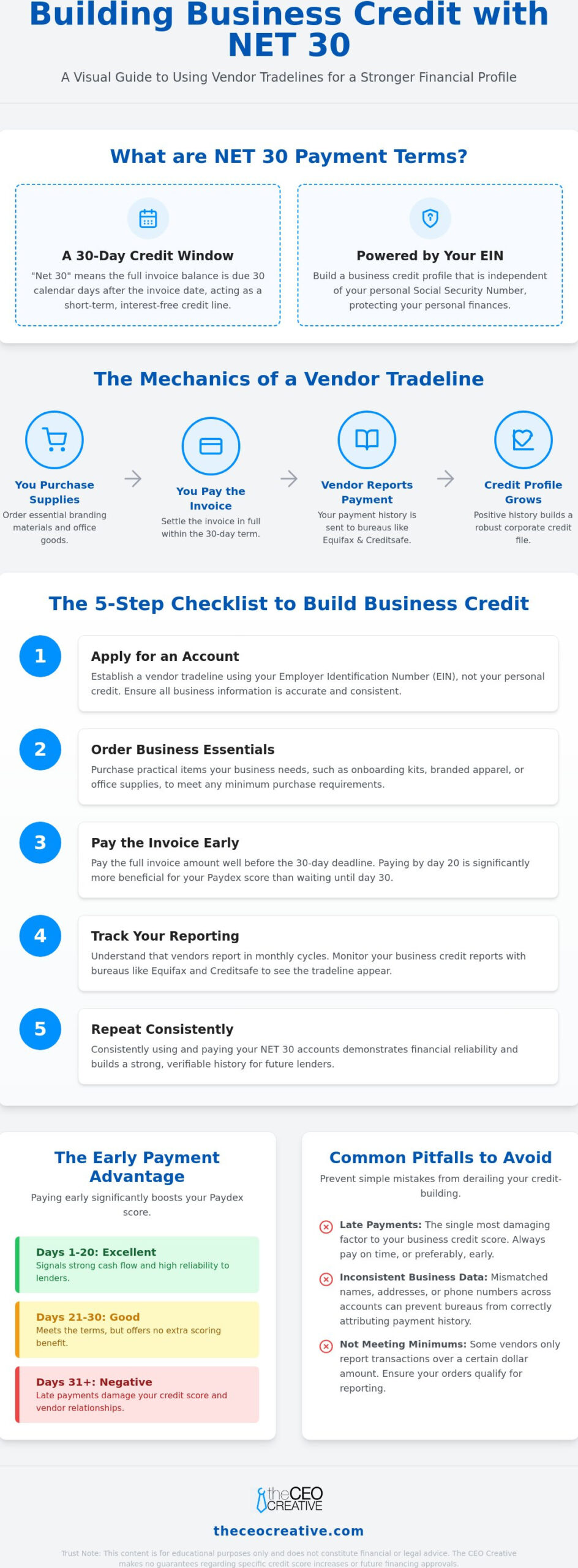
One of the most overlooked strategies is the “Early Payment” advantage. While the terms give you 30 days, paying on day 20 is significantly better than waiting until day 30. Bureaus like Equifax and Creditsafe track how early you pay relative to your due date. This proactive behavior signals financial strength. It shows you aren’t just scraping by to meet deadlines. Instead, you’re managing your capital with precision. This habit can lead to a more robust profile than simply being “on time.”
The Step-by-Step Credit Building Cycle
- Step 1: Apply for a Business Net 30 Account with your EIN. This ensures the tradeline is attached to your corporate identity, keeping your personal credit protected.
- Step 2: Place an order for essential office supplies or branding materials. Focus on items like custom stationery or onboarding kits that add immediate value to your operations.
- Step 3: Pay your invoice in full. Aim for that 20-day window to maximize the positive impact on your reporting.
Track and Repeat for Tier 2 Growth
Consistency is the primary factor in achieving high credit scores. A single on-time payment won’t unlock high-limit credit lines. You need a “payment trend.” Use tools like FairFigure to monitor your progress and ensure your vendor reports your activity correctly. By repeating this cycle monthly, you demonstrate a sustainable system for managing debt.
Step 4: Track the reporting on your business credit reports. Verification ensures your efforts aren’t wasted due to administrative errors. If you see a delay, contact your vendor to confirm your business information matches their records exactly.
Step 5: Repeat the process. Consistent activity over six months builds the foundation needed for larger Tier 2 accounts. You can learn more about how to Build Business Credit Without a Loan by following our long-term growth strategies. This repetitive cycle turns routine operational spending into a powerful engine for corporate financial health.
Avoiding Pitfalls: Common Mistakes and Best Practices for Net 30 Accounts
Successfully leveraging net 30 payment terms requires a disciplined approach to avoid common traps that can stall your progress. One of the most dangerous moves an entrepreneur can make is “ghosting” a vendor. Even a single late payment can tank a newly established score, and it’s much harder to fix a damaged profile than it is to build one from scratch. Treat every invoice as a high-stakes test of your professional reliability. If you encounter a temporary cash flow hurdle, communicate with your vendor immediately rather than ignoring the due date. Most partners value transparency, but silence often leads to negative reporting that lingers for years.
To keep your credit building journey on track, you should also ignore common Net 30 Business Account Myths that suggest volume matters more than consistency. It’s better to have two well-managed tradelines than ten accounts with erratic payment histories. Focus on making your spending productive by purchasing items that actually help your business grow. This strategic use of credit ensures you aren’t just “buying a score,” but rather investing in your company’s infrastructure.
Common Mistakes to Avoid
- Excessive Inquiries: Applying for too many Net 30 accounts simultaneously can signal desperation to lenders.
- Non-Reporting Vendors: Neglecting to verify that a supplier actually reports to major bureaus like Equifax or Creditsafe.
- Payment Delays: Paying even one day late can trigger a negative mark on your business credit file.
- Data Mismatches: Using inconsistent business names or addresses across different vendor applications.
- Budget Blindness: Buying unnecessary items just to establish a tradeline without a clear repayment plan.
- Thin File Neglect: Establishing an account but failing to use it regularly, which prevents a “payment trend” from forming.
Maximizing the Value of Your Membership
Instead of purchasing random supplies, focus on customizable products that elevate your brand identity. Outfitting your team with professional Net 30 Apparel or ordering branded onboarding kits serves a dual purpose. You build your business credit while simultaneously increasing your perceived creditworthiness to future partners and clients. A polished, professional image suggests a stable organization, which is exactly what lenders look for. Using the CEO Creative membership as a foundational tool allows you to scale your brand and your credit profile in tandem. Ready to start building? You can apply for your business net 30 account now to begin your first strategic order.
Scaling Your Brand Identity with The CEO Creative Net 30 Accounts
Strategic net 30 payment terms act as a bridge between where your business is today and where it wants to be. By utilizing EIN-only approvals, you effectively decouple your personal financial identity from your corporate obligations. This protection is vital for modern entrepreneurs who value risk management. 2026 is the year to stop relying on personal guarantees for every operational expense. When you establish a standalone credit profile, you give your organization the freedom to grow on its own merits.
As your business expands into new markets, protecting your physical assets becomes just as crucial as building credit. For entrepreneurs navigating global logistics, you can learn more about specialized air freight insurance to ensure your inventory is covered.
Building credit doesn’t have to be a complex administrative burden. Even routine purchases of custom mugs or branded stationery serve as active tradelines on your report. There is also a significant psychological benefit to seeing your logo on high-quality apparel or office essentials. It reinforces your brand identity to your team and your clients while quietly strengthening your financial foundation. As you master these Tier 1 relationships, you’ll find it easier to transition toward larger corporate credit lines with higher limits.
What Happens Next: Your Path to Approval
If you’re ready to take control of your company’s financial future, the path forward is clear and structured. You don’t need a massive budget to start; you just need a consistent system. Every invoice you pay early is a brick in the wall of your corporate legacy. Follow these steps to begin your journey:
- Submit your application using your EIN and verified business details to ensure accurate bureau reporting.
- Receive your account approval and browse the CEO Creative catalog for items your business actually needs.
- Place your first order and pay the invoice by day 20 to establish a high-performance payment trend.
Success in business credit building is a marathon, not a sprint. By keeping your spending professional and your payments prompt, you position your brand as a reliable leader in your industry. It’s time to stop waiting for traditional bank approvals and start creating your own opportunities through smart trade credit management. Focus on quality, maintain consistency, and watch your corporate profile grow.
Final Trust Note: The information provided in this guide is for educational purposes only. It does not constitute financial, tax, or legal advice. Please consult with a qualified professional to discuss your specific business needs and financial strategy.
Build Your Business Credit Legacy Starting Today
You now have the framework to transform your operational spending into a strategic financial asset. By mastering net 30 payment terms, you move beyond the limitations of personal guarantees and start building a corporate identity that stands on its own. Focus on paying by day 20, maintaining consistent business data, and choosing practical products that serve your company’s growth. This disciplined approach ensures your EIN profile remains strong and attractive to future lenders.
The CEO Creative supports your journey with an EIN-only application, a decision within 1 business day, and consistent reporting to Equifax, Creditsafe, and FairFigure. You can equip your office with high-quality branding materials while establishing the tradelines necessary for long-term scalability.
Apply for a CEO Creative Net 30 Account Today
What happens next:
- Submit your application with your EIN and get a decision within 1 business day.
- Browse our catalog to select professional branding products or office essentials.
- Pay your invoices early to trigger positive reporting and build your Paydex score.
Establish your corporate identity by investing in custom mugs or professional Net 30 apparel. These strategic moves turn essential supplies into a robust credit history that supports your business for years to come. Your path to financial independence is ready for you to take the first step.
Frequently Asked Questions
Do Net 30 accounts require a personal guarantee?
Most Tier 1 net 30 payment terms accounts do not require a personal guarantee. They rely on your Employer Identification Number (EIN) to verify your business’s legal status. This structure allows you to build corporate credit without putting your personal assets at risk. It’s a foundational step for new LLCs looking to establish a separate financial identity.
How long does it take for a Net 30 vendor to report to the bureaus?
Vendors typically report to business credit bureaus in monthly batch cycles. You can expect your payment history to be transmitted once every 30 days. Because of the processing time at the bureaus, it often takes 30 to 60 days for the activity to reflect on your official credit report. Patience and consistency are vital during this initial building phase.
Will paying my Net 30 invoice early help my business credit score?
Paying your invoice early has a direct, positive impact on your business credit score. Scores like the Dun & Bradstreet Paydex reward companies that settle debts before the 30-day deadline. Aiming to pay by day 20 demonstrates superior cash flow management. This proactive habit makes your business appear much more reliable to high-tier lenders.
Can I get a Net 30 account with a brand new LLC and no revenue?
You can absolutely secure a Net 30 account as a brand new LLC with zero revenue. Many vendors specialize in helping startups establish their first tradelines. As long as your business is properly registered with the Secretary of State and has an EIN, you can qualify. These accounts serve as the entry point for businesses with no prior credit history.
What happens if I miss a payment on a Net 30 account?
Missing a payment triggers negative reporting that can significantly lower your business credit score. Late payments remain on your report for years and act as a red flag for future creditors. If you realize you’ll be late, contact the vendor immediately to discuss your options. Maintaining a clean payment history is the most important part of managing net 30 payment terms.
Which credit bureaus does The CEO Creative report to?
The CEO Creative reports to Equifax, Creditsafe, and FairFigure. This multi-bureau approach ensures that your positive payment trends are captured by the major entities lenders use for risk assessment. By reporting to these specific bureaus, we help you build a robust and verifiable credit file that supports your company’s long-term financial growth.
Is there a minimum purchase amount required for reporting?
Most vendors require a minimum purchase amount to ensure the transaction is significant enough for bureau reporting. While this amount varies, it’s generally a low threshold designed to confirm active business operations. The key is to make regular, professional purchases that you can easily pay off. Consistent monthly activity is the most effective way to build a strong credit trend.
Do I need a professional business website to be approved for Net 30 terms?
A professional business website is a strong asset during the approval process. It helps vendors verify that your company is a legitimate and active entity. While some vendors may approve you without one, having a website builds trust and confirms your professional identity. It’s a simple step that demonstrates your commitment to your brand’s long-term success.
Building business credit? Open a Net 30 Account — EIN only, no personal guarantee, $60 minimum order, credit lines up to $5,500, a decision in one business day, and every on-time payment reported monthly to Equifax Business, Creditsafe and FairFigure.