


What if your business could unlock its own five-figure credit limit without ever touching your personal credit score? Most entrepreneurs feel trapped in a cycle where they need credit to grow, but can’t get it because their EIN lacks history. It’s frustrating to watch your personal debt-to-income ratio climb just because you’re buying essential office supplies or uniforms. Establishing strategic business credit tradelines with reporting vendors like The CEO Creative is the fastest way to break this cycle. We function as a foundational NET 30 vendor that reports your payment history to major bureaus, allowing you to fund your brand identity while proving your creditworthiness.
You’re likely tired of the confusion surrounding which vendors actually report, especially with new CFPB data collection rules taking effect on June 30, 2026. This guide provides the clarity you need to build a robust corporate profile that stands on its own. You’ll learn how to secure a solid Paydex score and access larger credit lines without the burden of personal guarantees. We’ll walk through the current reporting landscape, identify top-tier accounts, and outline a clear checklist to help you separate your personal and business finances for good.
Key Takeaways
- Understand how strategic business credit tradelines bridge the gap between startup challenges and long-term capital access without relying on personal guarantees.
- Learn to navigate the reporting cycles of major bureaus like Equifax Business and Creditsafe to ensure your payment history is recorded accurately.
- Implement the 5-step framework-Apply, Order, Pay, Track, and Repeat-to build a professional corporate profile systematically.
- Avoid common mistakes like using personal email addresses or inconsistent public records that can prevent your credit file from maturing.
- Discover how to leverage a Net 30 membership to secure high-quality office supplies while simultaneously strengthening your EIN credit.
What Are Business Credit Tradelines and Why Do They Matter?
A business credit tradeline is a formal record of payment history between your company and a creditor or vendor. It’s the foundation of your corporate financial reputation. Many startups fail because they can’t access traditional funding during their first two years. Establishing trade credit through vendor accounts allows you to bridge the gap between having no history and becoming bankable. By strategically using business credit tradelines, you’re building a profile tied to your EIN rather than your personal social security number. This separation protects your personal assets and opens doors to much larger credit limits.
Please understand that this content is for educational purposes only. It doesn’t constitute financial or legal advice, and we make no guarantees regarding specific credit score increases or approvals. Our goal is to provide you with the knowledge to make informed decisions for your organization’s growth. By the end of this guide, you’ll have a clear 5-step framework to scale your credit profile using your EIN.
Key Definitions: Net 30 and Vendor Tradelines
Understanding the vocabulary of commercial credit is essential for success. A Net 30 account refers to payment terms where the full balance of your purchase is due 30 days after the invoice date. These are the most common entry-level business credit tradelines for new LLCs. A vendor tradeline is simply the credit line extended to you by a supplier for goods or services. The magic happens during payment reporting. This is the specific process where a vendor shares your payment data with credit bureaus like Equifax or Creditsafe. If you pay on time, this data builds your score; if you pay late, it can damage your profile just as quickly.
The Role of The CEO Creative as a Reporting Vendor
The CEO Creative functions as a Tier 1 vendor, which is the starting point for businesses with little to no credit history. We offer a Net 30 account that helps you establish a footprint with major bureaus. It’s vital to purchase products that serve a professional purpose, such as onboarding kits, branded apparel, or essential office supplies. Consistent spending on these items shows lenders that your business is active and operational. Our membership model ensures a continuous cycle of credit reporting. By maintaining an active account and paying your invoices early, you create a steady stream of positive data points that strengthen your corporate identity over time.
How Tradelines Report to Major Business Credit Bureaus
Building business credit tradelines is a marathon, not a sprint. The reporting cycle is the engine behind your score, and it’s essential to realize that your profile won’t change overnight. Most vendors report your payment data once a month, but the bureaus can take an additional 30 to 90 days to process and display that information. If you want to Establish business credit effectively, you must align your expectations with these administrative timelines. Rapid growth requires patience and a steady stream of reported activity.
Consistency in your business information is the most overlooked factor in successful reporting. If your company name, address, or phone number varies even slightly between different vendor applications, the bureaus may fail to match the data to your file. This creates “fragmented” files that don’t help your score. Always use the exact details found on your official Secretary of State filing. Additionally, your payment habits dictate your internal ratings; while “on-time” payments keep you in good standing, “early” payments are often the key to unlocking the highest possible credit scores.
The Reporting Trio: Equifax, Creditsafe, and FairFigure
- Equifax Business: This bureau is a powerhouse in the commercial world. They use a Credit Risk Score and a Payment Index to help lenders determine how likely you are to become severely delinquent.
- Creditsafe: With data on over 430 million companies globally, Creditsafe is a critical bureau for businesses looking to establish an international reputation. Many modern lenders prefer their transparent risk ratings.
- FairFigure: This platform is a vital tool for the modern entrepreneur. Their Premium plan, which costs $35 per month as of February 2026, monitors your scores across multiple bureaus and reports your subscription as a tradeline to Equifax and Creditsafe.
The Importance of EIN-Only Reporting
The ultimate goal for most startups is to build credit without a Personal Guarantee (PG). By focusing on EIN-only business credit tradelines, you protect your personal credit score from high debt utilization. This separation ensures that your business expenses don’t lower your personal borrowing power. Before you commit to a purchase, always verify which bureaus the vendor reports to. Applying for a Net 30 account is a practical way to ensure your early payments are captured by the right bureaus, helping you build a self-sustaining corporate profile. This strategy is even more relevant following the CFPB’s June 30, 2026, rule changes, which aim to increase transparency in small business lending data.
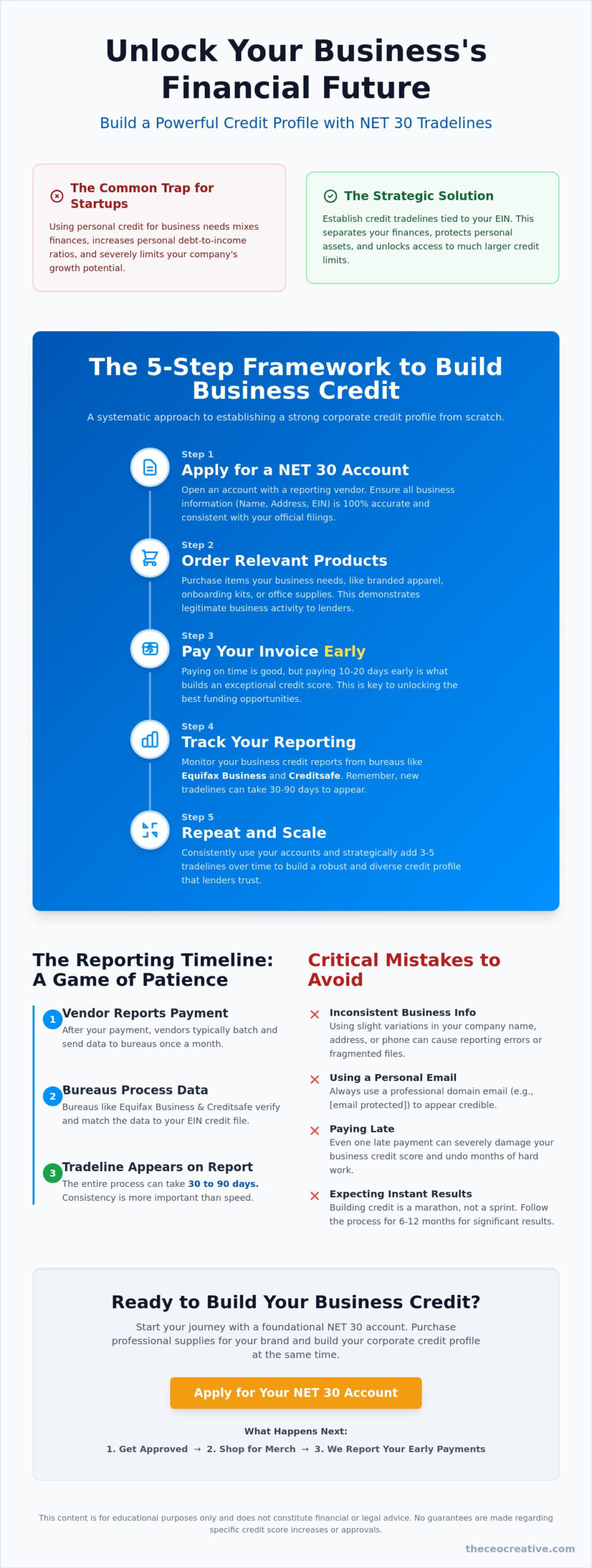
The 5-Step Framework: Apply, Order, Pay, Track, Repeat
Managing business credit tradelines requires a disciplined, operational approach rather than a one-off effort. To build a profile that stands up to lender scrutiny, you need a repeatable system. This framework ensures your business activity is captured correctly by the bureaus while supporting your daily operations. Before you begin, verify that your LLC is properly registered with the Secretary of State and has a dedicated business phone line. These foundational steps are necessary to establish business credit that isn’t tied to your personal identity.
- Step 1: Apply. Submit your application using your exact legal business name and address. Inconsistency is the primary reason tradelines fail to post.
- Step 2: Order. Make a strategic purchase of items your business actually needs. This keeps your spending professional and manageable.
- Step 3: Pay. While on-time payments are the minimum requirement, the golden rule is to pay at least 10 days early. This proactive habit often results in higher internal credit scores.
- Step 4: Track. Use a monitoring service to verify the tradeline appears on your Equifax or Creditsafe report. This usually happens 30 to 60 days after your first payment.
- Step 5: Repeat. A single transaction doesn’t prove reliability. You need a consistent history of multiple orders to build what lenders call a “thick” credit file.
Strategic Purchasing for Your Brand
Smart entrepreneurs use their business credit tradelines to fund the growth of their brand identity. Instead of buying generic supplies, consider investing in customizable products that elevate your professional presence. Items like team uniforms or branded Net 30 apparel serve a dual purpose: they provide your team with a cohesive look and build your credit profile simultaneously. For more options, check out our guide on the Best Net 30 apparel vendors to build business credit in 2026 to diversify your reporting sources.
Maintaining a Consistent Reporting Schedule
Score stability depends on regular activity. If you stop using your tradelines, your score may plateau or even dip due to a lack of recent data. Manage your cash flow to ensure you can meet your Net 30 obligations every month without strain. Recurring monthly orders, even small ones, demonstrate a reliable pattern of behavior. Once you’ve successfully managed three to five Tier 1 accounts for six months, you’ll be better positioned to scale toward Tier 2 vendors and larger revolving credit lines.
Common Mistakes When Building Business Credit Tradelines
Even with a solid framework, small administrative errors can stall your progress. Building business credit tradelines requires absolute precision in how you present your company to creditors. If your EIN data doesn’t match your public records, bureaus may ignore your payment history entirely. This mismatch is a common hurdle that many new LLCs face during their first year of operation. It’s not enough to simply pay bills; you must ensure the data bridges the gap between your vendor and the reporting agencies.
Please remember that results vary for every business. We don’t guarantee specific credit score increases or immediate approvals, as individual creditworthiness depends on various unique factors. Success comes from consistent, professional habits rather than a single transaction.
Avoid these frequent mistakes to keep your profile on track:
- Failing to verify that your business name and address match exactly across all public records and Secretary of State filings.
- Using a personal Gmail or a home address instead of a professional business email and a verified commercial location.
- Making a one-time purchase and expecting a permanent score increase without maintaining a consistent monthly payment history.
- Applying for too many Tier 1 accounts simultaneously without generating activity on any of them.
- Neglecting to monitor your Equifax or Creditsafe reports to verify that your vendors are reporting as promised.
- Assuming all Net 30 vendors report to all major bureaus; many only report to one or two specific agencies.
Administrative Pitfalls to Avoid
Lenders often check 411 directory listings to verify your business’s legitimacy. If your application details differ from these listings, it’s an immediate red flag. Similarly, while virtual offices are popular for remote brands, some high-level creditors flag these addresses as high-risk. Ensure your setup is professional and consistent before you start the application process. For a deeper dive into these requirements, read our guide on How to Build Business Credit Without a Loan.
Financial Missteps in the Early Stages
Don’t overextend your cash flow on products you don’t need just to build credit. It’s better to make small, manageable purchases consistently than to strain your budget. Many vendors offer a specific “early payment” window that can significantly improve your internal rating with that supplier. Missing this window won’t necessarily hurt your score, but it won’t help you scale to higher credit limits as quickly. You can find more details on managing these relationships in our Net 30 Vendors 2026: The Ultimate Guide.
Ready to start building your profile with a reliable partner? Apply for a Net 30 account today and begin reporting your professional purchases to the bureaus.
Leveraging The CEO Creative Membership for Long-Term Growth
Most credit guides treat branding and credit building as two separate tasks. In reality, corporate credibility is a multi-layered asset. When you establish business credit tradelines, you aren’t just chasing a score; you’re proving to lenders that your company is a legitimate, functioning entity. The CEO Creative Membership streamlines this process by providing a reporting tradeline that simultaneously helps professionalize your brand. By using Net 30 terms for essential office supplies, you ensure that every dollar spent serves a dual purpose: operational utility and financial growth.
From Onboarding Kits to Executive Stationery
Choosing products that enhance your brand while building your profile is a strategic move. Many new LLCs struggle to look established during their first year. Investing in custom branding services, such as professional logo design or executive stationery, helps create the “bankable” image that underwriters look for. This synergy between your brand identity and your credit profile makes your business more attractive to high-tier creditors later on. You can explore how these tools work together in our guide on the CEO Creative Membership: Build Credit and Brand Identity. Using your EIN to purchase items like onboarding kits or branded merchandise keeps your spending professional and focused on growth.
What Happens After You Apply?
We’ve designed our system to be as efficient as possible for busy entrepreneurs. Once you decide to start building your corporate profile, the path to reporting is clear and structured. Here is what you can expect from the process:
- Step 1: Submit your application for an instant account review and membership activation. This sets the foundation for your first reporting cycle.
- Step 2: Place your first order for branded merchandise, office essentials, or custom design services. Choose items that your business will use to ensure your spending remains practical.
- Step 3: We handle the monthly reporting to credit bureaus like Equifax and Creditsafe. As you pay your invoices early, you’ll begin to see the development of your EIN credit profile.
Scale Your Corporate Credit with Confidence
Building a corporate profile that stands on its own requires more than just luck. It demands a structured approach to managing your business credit tradelines. You’ve learned how to navigate bureau reporting cycles and why administrative consistency is the secret to a thick credit file. By following the five-step framework of applying, ordering, and paying early, you position your brand for high-level financing without risking your personal assets.
Now it’s time to take the next step toward financial independence. Our membership offers a decision within one business day for new business accounts and requires no personal guarantee. We simplify the reporting process by sharing your payment data with Equifax, Creditsafe, and FairFigure every month. This ensures your professional purchases of office supplies and branded apparel work as hard for your credit as they do for your operations.
Apply for Your CEO Creative Net 30 Account Today and start building the foundation your business deserves. Your future growth depends on the strategic moves you make today. We’re ready to partner with you on this journey to long-term sustainability.
Frequently Asked Questions
Do I need a personal guarantee for a business tradeline?
You don’t need a personal guarantee for many Tier 1 vendor accounts. These accounts rely on your business’s EIN rather than your personal credit score. This allows you to build business credit tradelines without risking your personal assets. It’s a critical strategy for new LLCs looking to separate their financial identities early in the growth process.
How long does it take for a tradeline to report to Equifax?
Reporting usually takes between 30 and 90 days to appear on your Equifax Business report. Vendors typically send data batches once per month. Once received, the bureau needs time to verify and update your file. You should stay patient and maintain consistent ordering to ensure your profile stays active and grows steadily over time.
Can I build business credit without an EIN?
You can’t build true business credit without an EIN. The Employer Identification Number acts as the Social Security Number for your business. Bureaus use this number to track your payment history and generate scores. Without it, any credit you use remains tied to your personal profile, which doesn’t help your company become bankable on its own.
What is the difference between a vendor tradeline and a credit card?
A vendor tradeline is credit extended by a supplier for specific products, like office supplies or apparel. You must pay the full balance within a set timeframe, such as 30 days. A credit card is revolving credit that you can use anywhere for various expenses. Vendor accounts are often the best starting point for businesses with no established history. While you focus on these operational essentials, you can learn more about Chickhuber Coffee to find premium coffee and tea options for your workspace.
Does paying early help my business credit score?
Paying early improves your standing and can lead to higher credit scores. Bureaus like Dun & Bradstreet use the Paydex score, which rewards payments made before the due date. Aim to pay your invoices at least 10 days early to demonstrate superior reliability to future lenders. This habit shows that your cash flow is strong and your management is proactive.
What happens if I miss a Net 30 payment?
Missing a payment can lead to negative marks on your business credit report. Late payments are reported to the bureaus and can lower your score quickly. It also damages your internal rating with the vendor, potentially leading to account suspension or lower credit limits in the future. Always prioritize your Net 30 obligations to maintain your corporate reputation.
Which bureaus does The CEO Creative report to?
The CEO Creative reports your payment data to Equifax Business, Creditsafe, and FairFigure. By reporting to these major agencies, we help you establish a visible and professional credit footprint. This broad reporting ensures that various lenders and suppliers can verify your creditworthiness when you apply for larger financing options later in your business journey.
Can a new LLC get approved for a Net 30 account immediately?
Most new LLCs can get approved for a Net 30 account almost immediately. Tier 1 vendors are designed to help startups establish their first business credit tradelines. As long as your business is properly registered and has a valid EIN, you can usually start ordering and reporting within the same business day to begin your credit journey.
Building business credit? Open a Net 30 Account — EIN only, no personal guarantee, $60 minimum order, credit lines up to $5,500, a decision in one business day, and every on-time payment reported monthly to Equifax Business, Creditsafe and FairFigure.
What are tradelines that build credit?
A tradeline is any credit account reported to a business credit bureau, and it builds your credit file when that reporting shows an on-time payment history. A typical example: a supplier extends net-30 terms, you pay as agreed, the supplier reports that payment to a bureau such as Equifax Business or Dun & Bradstreet, and the entry becomes part of your business credit profile. Not every vendor account reports, so an account can be paid perfectly and still add nothing to your file. More reporting tradelines with a consistent on-time record generally builds a stronger business credit file.
How do I use my EIN to get credit?
Some business credit applications assess the business itself by its EIN instead of pulling the owner’s personal credit, so you apply with the EIN, business details and revenue information rather than a Social Security number. Not every supplier works this way, plenty still require a personal guarantee or a personal credit check, so it’s worth asking directly before you apply. The CEO Creative is one example of a supplier that assesses applications on the business EIN, with no personal guarantee and no personal credit check, and returns a decision within one business day.
How do I build EIN credit?
You build credit under your EIN by opening accounts that report business payment activity to a bureau, then paying every one of them on time. Vendor and trade accounts are a common starting point since many extend terms with less scrutiny than a bank loan, so confirm in writing which bureau each one reports to before you count on it. Reporting accounts paid on time over repeated cycles build a business credit file that sits apart from your personal credit history. A file with only one or two reporting accounts tends to move slowly, so more reporting relationships generally builds a fuller file faster.
What are common mistakes when building business tradelines?
A frequent mistake is opening vendor accounts without confirming they actually report to a business credit bureau, since a paid account that never reports adds nothing to your file. Missed or late payments get flagged directly on a reporting tradeline, so a missed due date does more damage there than on an account that never reports at all. Relying on only one or two reporting accounts also leaves a thin file that builds slowly. It helps to ask each supplier in writing which bureaus it reports to, rather than assuming a new account counts toward your credit file.