

Key Takeaways
- Identify which specific bureaus a vendor reports to, prioritizing those that share data with Equifax, Creditsafe, and FairFigure.
- Master the 5-step framework on how to vet a business credit building company to protect your EIN profile from non-reporting scams.
- Focus on product utility by choosing vendors that offer tangible goods your business actually needs rather than empty “ghost” tradelines.
- Verify that the provider offers EIN-only approval to build business credit without relying on a personal guarantee or your SSN.
- Avoid critical red flags like mismatched business information and personal payment methods that can prevent your tradelines from appearing.
Understanding Business Credit Building Services and Why Vetting is Critical
The year 2026 has become the era of “tradeline transparency.” As major bureaus tighten their reporting requirements, many startups find themselves failing the vetting process because they rely on unverified strategies. A business credit building company is a service provider that helps you establish a documented financial relationship reported to commercial bureaus. This isn’t about fixing mistakes from your past; that’s credit repair. Instead, credit building is about creating a future where your EIN stands on its own. Compliance Note: This content is provided for educational purposes and does not constitute financial or legal advice.
Before diving into the process, it’s vital to understand two core concepts that drive your success:
- Vendor Tradeline: A credit account established between your business and a supplier that allows you to purchase goods or services on deferred payment terms.
- Payment Reporting: The specific process where a vendor transmits your transaction data, including payment timeliness and account balances, to commercial credit bureaus to be recorded on your business credit report.
Legitimate companies focus on data integrity. When you’re learning how to vet a business credit building company, you’ll see that the best partners prioritize transparent reporting over “quick fixes.” They help you move beyond your personal credit score by focusing on Understanding Business Credit Reports and how they impact your company’s borrowing power. This strategic shift is essential for any founder who wants to separate their personal liabilities from their corporate growth.
The Role of the Vendor Tradeline
Vendor tradelines are the foundational building blocks of your corporate credit profile. These accounts allow you to buy the things your business needs now while paying for them later. When you purchase goods on terms, like a Net 30 account from The CEO Creative, and pay the invoice, that positive payment history is reported to bureaus. These entries are what generate a Paydex score or other commercial ratings. Reporting vendors differ from traditional lenders because they allow you to build credit through everyday business purchases like stationery or branded apparel.
Why Vetting Protects Your EIN Profile
Vetting isn’t just about saving money; it’s about protecting your company’s reputation. The market is full of “ghost tradelines” that bureaus eventually reject or red-flag. If you associate your EIN with illegitimate companies, you risk being blacklisted by major financial institutions. Illegitimate providers waste your capital and, more importantly, your time. A properly vetted vendor ensures you’re building a profile without a personal guarantee. This keeps your personal assets safe while positioning your LLC for higher-tier financing and better vendor terms in the long run.
The Reporting Litmus Test: Verifying Bureau Partners and Tradelines
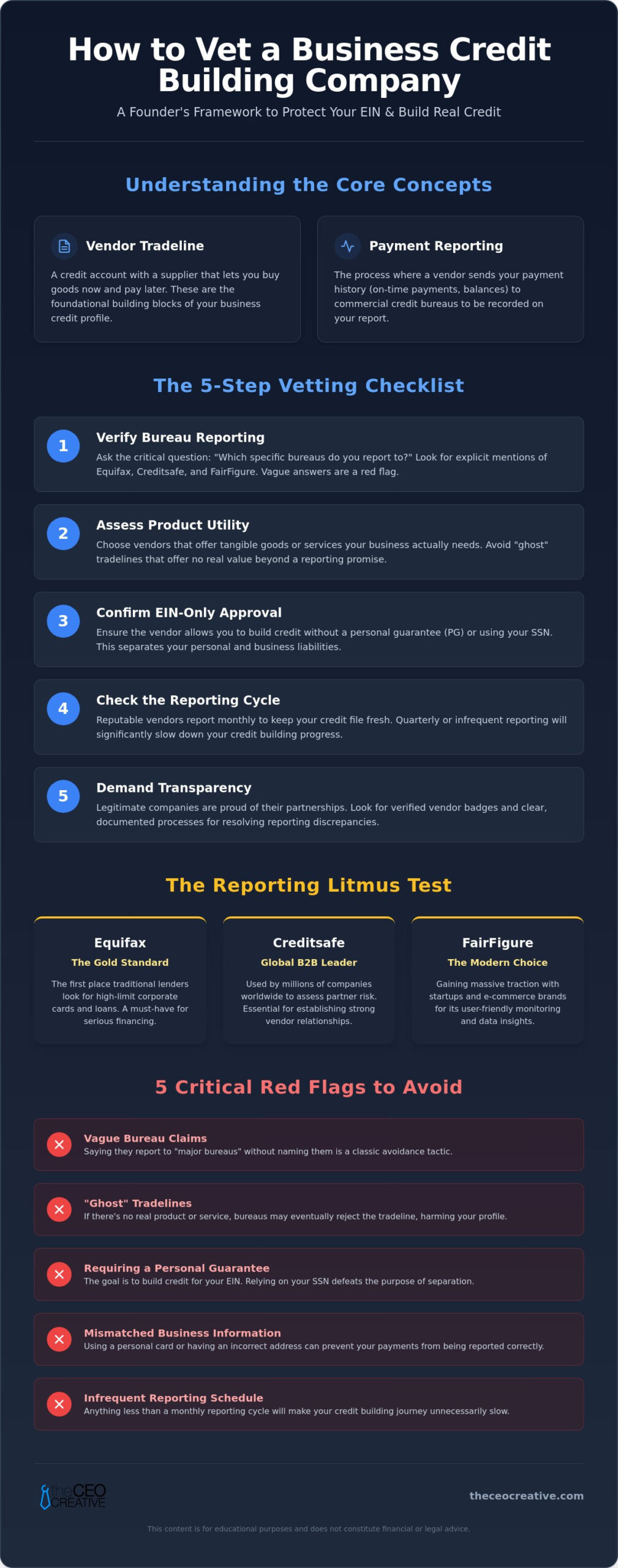
The most critical question you can ask when learning how to vet a business credit building company is: “Which specific bureaus do you report to?” Many providers claim to report to “major bureaus” but remain vague about the exact details. Legitimate vendors are proud of their partnerships and will explicitly name Equifax, Creditsafe, or FairFigure. According to SBA guidelines on business credit, establishing these verified relationships is a vital step in separating your personal and professional finances effectively.
Verification goes beyond a simple “yes” on a sales call. Look for verified vendor badges on the company’s website or check the bureau’s own list of reporting partners. If a company won’t provide a straight answer or a link to their reporting credentials, it’s a major red flag. Another standard to check is the reporting cycle. Most reputable companies report monthly. This ensures your data is fresh and your score reflects your most recent positive payment history. If a vendor only reports once a quarter, your credit building process will feel stagnant and slow.
Equifax and Creditsafe: The Gold Standards
Equifax Small Business is often considered the most prestigious reporting partner for any startup. Traditional lenders look at Equifax data first when you apply for high-limit corporate credit cards or equipment loans. Creditsafe is equally important; it’s a global leader in B2B scoring used by millions of companies to assess the risk of their partners. If your tradeline doesn’t appear on these reports after 60 days, you should contact the vendor’s support team immediately. A legitimate provider will have a clear, documented process for resolving reporting discrepancies and ensuring your data is accurate.
FairFigure and the Future of Monitoring
FairFigure is gaining massive traction among ecommerce brands and modern startups because of its focus on real-time data points and alternative underwriting. It provides a more holistic view of your business’s financial health than traditional models. To keep an eye on these developments, many savvy owners use business credit monitoring services to verify that their credit builders are performing as promised. Vendors that report to multiple bureaus simultaneously offer the most value because they build your profile across the entire financial ecosystem at once. If you’re ready to start with a verified partner, you can apply for a business Net 30 account that reports to the bureaus that actually move the needle for your EIN.
Product Utility vs. Empty Lines: Assessing Value Beyond the Score
Utility is the ultimate vetting indicator. When you’re learning how to vet a business credit building company, look past the promise of a score and examine the vendor’s catalog. The “Real Purchase” Rule is simple: legitimate credit building should involve buying things your business actually needs. Bureaus are increasingly skeptical of “ghost tradelines” or vendors that only sell subscriptions without any tangible goods. Industry experts at Forbes highlight that knowing how to build business credit involves more than just opening accounts; it requires consistent, legitimate activity that proves your business is an active, operational entity.
Fintech lenders, who now serve 29% of small businesses seeking financing, use alternative data to verify your company’s health. They want to see that your credit profile is backed by real-world transactions. A vendor that offers a diverse catalog of high-quality items proves they are a functional business partner rather than a mere credit-reporting shell. This synergy between credit growth and brand development ensures that every dollar you spend serves a dual purpose: strengthening your EIN profile and providing the tools you need to scale.
For businesses that have successfully scaled and are looking to host impactful corporate events, Speakers.com provides access to world-class motivational speakers who can elevate your company’s leadership culture.
Real Goods: Apparel, Office Supplies, and Branding
Creating a paper trail of legitimate activity is easier when you’re purchasing essential items. Buying office supplies on Net 30 terms provides a clear record of business-to-business commerce that bureaus respect. Similarly, investing in customizable products like branded apparel or engraved merchandise serves your marketing needs while building your score. Branding services, such as professional logo design, are another strategic indicator. If a vendor offers these high-level services, it shows they’re invested in your long-term success as a creative partner, not just a service provider.
The Cost-to-Value Ratio
A core part of how to vet a business credit building company is ensuring their membership model balances utility with credit growth. You should evaluate any membership fees against the actual value of the credit line and the quality of the products provided. Avoid vendors that charge exorbitant prices for low-quality “credit-builder” items that have no use in your daily operations. A structured CEO Creative Membership is designed to provide immediate utility through branding assets and business goods while maintaining the reporting integrity required for Tier 1 credit. This approach ensures your capital is an investment in your company’s infrastructure, not just a fee for a tradeline.
Step-by-Step Checklist: How to Vet a Business Credit Provider
Moving from theory to action requires a structured approach. Learning how to vet a business credit building company involves more than just reading a website’s landing page; it requires active due diligence. By following a standardized framework, you can filter out non-reporting vendors and focus your capital on partners that actually strengthen your EIN profile. This step-by-step checklist serves as your roadmap for verifying integrity before you commit your business’s resources.
- Apply: Submit your application using only your EIN. A legitimate credit builder won’t require a personal guarantee or your Social Security Number for a basic Net 30 account.
- Order: Purchase tangible products that serve your company’s needs. This creates a real business-to-business transaction that bureaus recognize as legitimate commercial activity.
- Pay: Settle your invoice in full before the 30-day deadline. Early payments often result in higher scores than those made on the final day of the term.
- Track: Monitor your reports with Equifax, Creditsafe, or FairFigure. Verify that the tradeline appears correctly and reflects your positive payment history within 60 days.
- Repeat: Continue placing orders and paying early. Consistency is what transforms a single tradeline into a robust, Tier 1 credit profile that lenders can trust.
The Verification Phase
Before you fill out an application, conduct a quick background check. Legitimate vendors maintain a professional digital footprint and a physical presence. Search for third-party reviews that specifically mention “tradeline reporting” or “bureau visibility.” If you can’t find evidence of other business owners successfully seeing these lines on their reports, proceed with caution. You should also cross-reference any potential partner with Tier 1 Net 30 vendor lists to see if they are recognized as established industry players. This initial research saves you from wasting capital on “ghost” lines that never report.
The Execution Phase
Once you’ve verified the vendor, the way you interact with them determines your scoring success. Apply for your account using business information that matches your Secretary of State (SOS) filing exactly. Even a small typo in your address can cause a bureau to reject the data transmission. When your account is active, order products that serve your current quarterly goals, such as branded apparel or office essentials. The final, most important rule is to pay the invoice early. This proves to future lenders that your business is liquid and responsible. If you’re ready to start this process with a vetted partner, you can apply for a business Net 30 account here to begin building your profile today.
5 Red Flags and Mistakes to Avoid When Building Corporate Credit
Building corporate credit is a strategic process that requires precision. Even after you’ve learned how to vet a business credit building company, small operational errors can prevent your tradelines from appearing correctly. Awareness of common pitfalls ensures that your efforts result in a robust, Tier 1 profile rather than a series of rejected data points. Precision in the early stages of your EIN development prevents long-term logistical headaches.
One of the most frequent mistakes is mismatched business information, often called NAP (Name, Address, Phone). If your application details don’t match your Secretary of State filing exactly, credit bureaus may fail to link the payment history to your EIN. Similarly, paying for your business invoices with a personal credit card is a major red flag. Always use a business bank account to maintain the corporate veil and prove your company’s financial independence. Separation of assets is a fundamental requirement for any serious organization.
You should also be wary of vendors making “guaranteed score” promises. No legitimate reporting partner can guarantee a specific score increase because bureau algorithms are proprietary and change frequently. Additionally, ignoring the “Net” in Net 30 is a critical error. If you miss that 30-day payment window, you aren’t just failing to build credit; you’re actively damaging your profile. Finally, verify that the vendor actually reports to commercial bureaus. If they only report to personal bureaus or not at all, they aren’t helping you reach your growth goals.
The Danger of “Personal Guarantee” Traps
A true business credit builder shouldn’t need to see your personal credit score. When an account requires a personal guarantee (PG), the debt is tied to your Social Security Number. This can hurt your personal debt-to-income ratio, potentially limiting your ability to secure personal financing for a home or vehicle. Building a separate corporate identity is about mitigating personal risk. Focus on finding Net 30 vendors that report based solely on your EIN to keep your personal and professional lives distinct.
What Happens After You Apply?
After you submit your application you receive the decision by email within 1 business day. Once you have access to the member portal, place your first order immediately. This initial transaction is what triggers the reporting process. Don’t wait for the tradeline to appear before you start using the account; active use is the key to growth. You can then monitor your progress via FairFigure or Creditsafe to see your positive payment history reflected in your commercial files. This proactive monitoring allows you to verify that your credit building partner is performing as promised.
Secure Your EIN Profile with Vetted Tradelines
Mastering how to vet a business credit building company is a vital skill for any founder looking to scale without personal risk. You now have the framework to distinguish between empty reporting promises and legitimate vendor tradelines that provide real utility. Remember that the most successful EIN profiles are built on a foundation of transparent reporting and consistent, early payments for goods your business actually uses.
Apply for a Net 30 Account with The CEO Creative Today
What happens next:
- Receive the decision within 1 business day; once approved, you can access the member portal.
- Select the office supplies or branded apparel your team needs to scale.
- Pay your invoice early to trigger positive reporting to the major bureaus.
The CEO Creative provides a benchmark for vetted vendors by offering a decision within one business day for new LLCs with no personal guarantee required. We report your payment history to Equifax, Creditsafe, and FairFigure to ensure your efforts are recognized. By prioritizing reporting integrity, you’re investing in the long-term sustainability of your corporate credit.
Apply for a Net 30 Account with The CEO Creative Today
Frequently Asked Questions
Do business credit building companies require a personal guarantee?
Legitimate business credit building companies do not require a personal guarantee. These vendors allow you to establish a credit history using only your Employer Identification Number (EIN). This structure protects your personal assets and keeps your personal debt-to-income ratio unaffected by business expenses. Always verify that the application doesn’t ask for a Social Security Number or a hard pull on your personal credit file.
How long does it take for a Net 30 vendor to report to the bureaus?
Most Net 30 vendors report to the bureaus on a monthly cycle, but it typically takes 30 to 60 days for a tradeline to appear on your report. This delay occurs because the vendor must process your payment and then transmit the data to bureaus like Creditsafe or Equifax. Start your first order early to account for this processing window and ensure your score reflects your activity as soon as possible.
Can I build business credit as a new LLC with no revenue?
You can build business credit as a new LLC even if you haven’t generated revenue yet. Many Tier 1 vendors approve accounts based on the legal formation of your business rather than your financial statements. By purchasing essential supplies like stationery or apparel on terms, you prove your entity’s ability to manage debt. This makes Net 30 accounts an ideal starting point for startups and ecommerce brands.
What should I do if a tradeline does not appear on my credit report?
If a tradeline doesn’t appear after 60 days, first verify that your business information matches your credit profile exactly. even a minor address discrepancy can prevent a bureau from matching the data to your EIN. Contact the vendor’s customer support team to confirm they’ve successfully transmitted your payment data. A reputable company will investigate the delay and provide a clear timeline for resolution.
Which credit bureaus are the most important for small businesses in 2026?
In 2026, Equifax, Creditsafe, and FairFigure are the most critical bureaus for small business growth. Equifax remains the primary source for traditional lenders, while Creditsafe is essential for B2B relationships and international trade. FairFigure has gained significant importance for its focus on modern startups and alternative data. Building a profile across all three ensures your business is visible to a wide range of financial partners.
Is a membership fee for a credit-building vendor worth it?
A membership fee is worth the investment if the vendor provides tangible utility and verified bureau reporting. When you’re learning how to vet a business credit building company, look for memberships that offer more than just a tradeline. Services that include branding assets, high-quality merchandise, or credit monitoring tools provide a higher return on investment. This ensures your capital supports both your credit score and your daily operations.
Can I build business credit using just my EIN?
You can build business credit using just your EIN by working with reporting vendors that don’t require a personal guarantee. This is the primary objective for most entrepreneurs who want to separate their personal and professional liabilities. By opening Net 30 accounts with vendors like The CEO Creative, you establish a corporate identity that stands on its own. This path eventually leads to higher credit limits and better financing terms.
What is the difference between Tier 1 and Tier 2 vendors?
Tier 1 vendors are starter accounts that typically approve new businesses with no prior credit history. These are usually suppliers offering Net 30 terms on physical goods. Tier 2 vendors include retail stores and gas cards that often require you to have at least three to five existing tradelines. Successfully managing Tier 1 accounts is the necessary first step before you can qualify for the higher limits found in Tier 2.
Building business credit? Open a Net 30 Account — EIN only, no personal guarantee, $60 minimum order, credit lines up to $5,500, a decision in one business day, and every on-time payment reported monthly to Equifax Business, Creditsafe and FairFigure.