


Want the account itself? The CEO Creative offers open a net 30 account — assessed on your EIN, decided within one business day, with a $60 minimum order.
Title: Fixing a Tradeline Not Reporting: A Step-by-Step Guide
Key Takeaways
- Understand that tradeline reporting is a voluntary exchange, so you’ll learn how to select vendors that prioritize visibility with bureaus like Equifax and Creditsafe.
- Discover exactly what to do if a tradeline is not reporting by auditing your business information for consistency across all corporate documents and applications.
- Identify why using personal details instead of your EIN can stall your progress and how to separate your personal and business credit profiles effectively.
- Master the reporting timeline by waiting for the standard 60-day cycle before troubleshooting missing data with your vendor or the credit bureaus.
- Establish a routine of consistent spending on practical items like custom apparel or office supplies to keep your active tradelines warm and reporting regularly.
Understanding Why Tradelines Fail to Appear on Your Business Credit Report
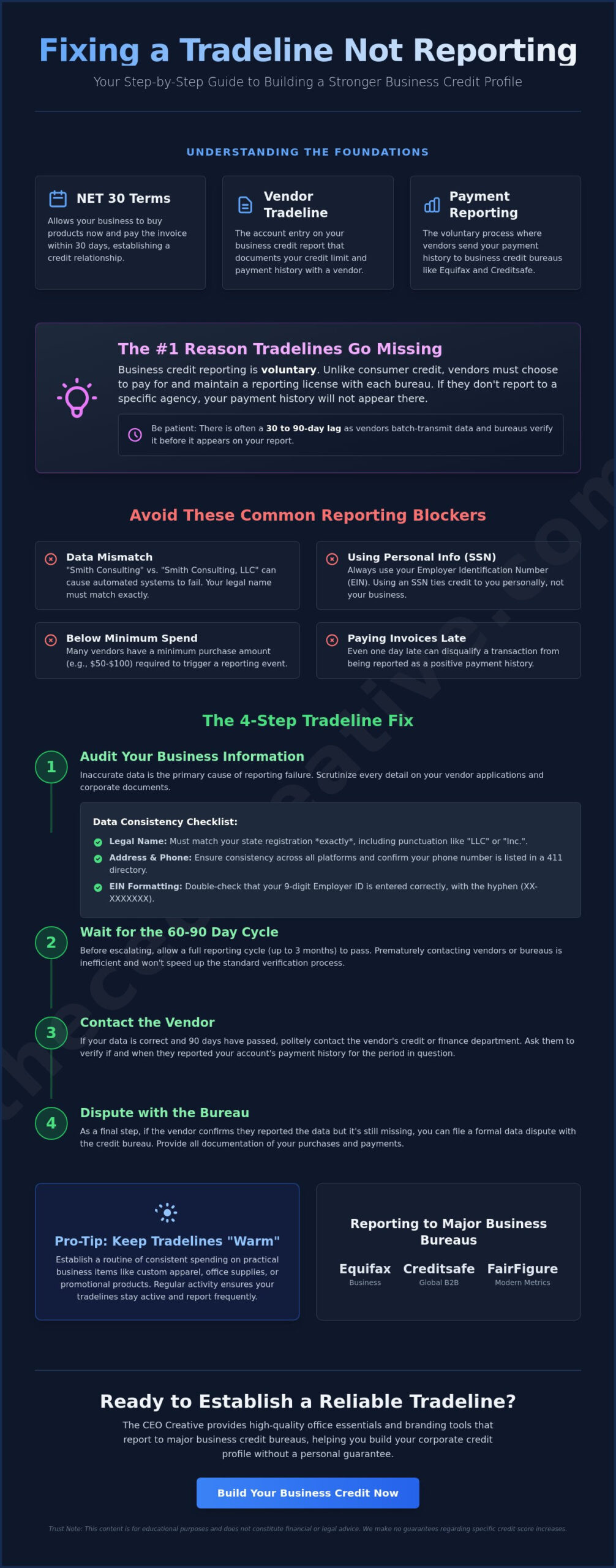
The CEO Creative serves as a reporting NET 30 vendor, providing a foundational support system for entrepreneurs looking to establish corporate fundability. To navigate this process, you must understand three core terms. First, NET 30 credit terms allow your business to purchase products now and settle the invoice within 30 days. Second, a vendor tradeline is the specific account entry that appears on your business credit report, documenting your credit limit and payment history. Finally, payment reporting is the voluntary process of transmitting your business’s payment history, including the date paid and the amount owed, to third-party credit agencies. Understanding these definitions is the first step in knowing what to do if a tradeline is not reporting, as it clarifies how data moves from a purchase to your profile.
To visualize how this reporting cycle functions, watch this helpful breakdown:
Unlike consumer credit, where most lenders share data, Understanding Credit Bureaus reveals that business reporting is entirely optional for suppliers. This “voluntary reporting” reality is often why accounts remain invisible. If a vendor doesn’t pay for a reporting license with a specific agency, your activity won’t be documented there. This remains the most common reason why business owners are confused about what to do if a tradeline is not reporting. Furthermore, the transmission cycle often involves a 30 to 90 day lag while bureaus verify the batched files transmitted by the vendor.
The Role of Net 30 Vendors
Reporting vendors act as the primary entry point for Tier 1 credit. While many retailers offer credit, only a small percentage are “reporting” vendors that actively share data to help you build an EIN-based profile. The CEO Creative bridges this gap by providing high-quality office essentials and branding tools that directly contribute to your corporate footprint. Using these accounts allows you to build credit without a personal guarantee.
Major Business Credit Bureaus in 2026
- Equifax Business: This bureau remains a primary source for traditional bank lending and small business risk assessment.
- Creditsafe: A global benchmark for trade payment data, used by millions of organizations to assess B2B creditworthiness.
- FairFigure: This platform offers a modern window into your metrics, allowing you to monitor your PowerScore and track reporting consistency.
Trust Note: This content is for educational purposes and does not constitute financial or legal advice. We make no guarantees regarding specific credit score increases.
Common Mistakes That Prevent Tradeline Reporting
Data mismatch is the silent killer of business credit building. When you’re trying to figure out what to do if a tradeline is not reporting, the first place to look is your own paperwork. Credit bureaus like Equifax and Creditsafe use automated matching algorithms. If your vendor application says “Smith Consulting” but your Secretary of State filing says “Smith Consulting, LLC,” the system might fail to link the data to your profile. Precision is mandatory. A single digit error in your EIN or a transposed number in your business address can cause a reporting failure that lasts for months.
Another frequent hurdle is the use of personal information. If you apply for a vendor account using your Social Security Number (SSN) instead of your Employer Identification Number (EIN), the activity will likely never hit your business credit report. Business credit is a separate ecosystem. It requires a clean break from your personal identity to build a standalone corporate score. Additionally, many vendors have a “minimum spend” threshold. If you open an account but don’t make a purchase, or if your purchase is too small (often under $50 or $100 depending on the vendor), the transaction may not trigger a reporting event. If you discover a legitimate reporting error that isn’t due to a typo, you may need to dispute an error on my credit report through the proper bureau channels.
Data Consistency Checklist
- Legal Business Name: Verify that your name matches your articles of incorporation exactly, including punctuation.
- Phone Number: Ensure your business line is listed in a 411 directory or a recognized business database.
- EIN Formatting: Double check that your tax ID is correctly entered on every vendor application you submit.
Common Mistakes to Avoid
- Applying for vendor accounts before your LLC or Corporation is fully registered with the state.
- Paying invoices even one day late, which can disqualify the transaction from being reported as a positive trade.
- Ordering inexpensive items that fall below the vendor’s internal reporting dollar amount.
- Closing an account too quickly after the first purchase before the data has hit your credit file.
- Using a residential home address when a vendor or bureau specifically requires a commercial business address.
- Neglecting to monitor your Creditsafe or FairFigure dashboard to catch reporting gaps early.
Ensuring your data is perfectly aligned before you shop is the best way to avoid technical delays. If you want to start with a partner that prioritizes data accuracy, consider opening a business net 30 account to build your foundation correctly from the start.
How to Verify and Fix Non-Reporting Tradelines
Fixing a missing account requires a logical, step-by-step approach. If you’re wondering what to do if a tradeline is not reporting, your first action shouldn’t be a dispute; it should be an audit. Start by waiting at least 60 days from the date of your payment. Most vendors report in monthly batches, and bureaus can take several weeks to update their records. If you check too early, you’re looking for data that hasn’t been sent yet. Patience is a necessary part of the process.
Second, confirm that the vendor actually reports to the specific bureau you’re monitoring. If you’re checking your Equifax report but the vendor only reports to Creditsafe, the line will never appear there. If the timeline and the bureau align but the data is still missing, contact the vendor’s support team. Ask them to verify that your information was included in their most recent transmission. Finally, audit your credit file for “Thin File” status. If your business is brand new, the bureau might not have enough data to generate a file, which can cause new accounts to be suppressed until more activity occurs.
The 5-Step Credit Building Framework
Success in business credit comes from a repeatable process. Follow this framework to ensure your accounts report correctly and stay active:
- Apply: Secure Fast-Decision Net 30 accounts using your EIN. Avoid using personal details to keep your profiles separate.
- Order: Purchase practical business items like office supplies or promotional materials to trigger a reporting event.
- Pay: Settle the invoice early. Paying 10 days before the due date signals high creditworthiness to potential lenders.
- Track: Use a monitoring service to watch your profile on Equifax, Creditsafe, and FairFigure for updates.
- Repeat: Make small, consistent purchases every few months. This keeps the tradeline “warm” and active on your report.
When to File a Formal Dispute
If you’ve confirmed that the vendor reported the data and the bureau still hasn’t posted it after 90 days, it’s time for a formal inquiry. Distinguish between a missing account and a factual error. For a missing line, gather your proof of payment and copies of your invoices. You can find resources for Disputing Errors on Your Credit Reports through the FTC website. Write a “Reasonable Reinvestigation” request to the bureau, providing your EIN and the specific account details. This forces the bureau to verify the information with the vendor, often resolving the bottleneck in your credit profile.
Practical Business Uses for Tradeline Maintenance
Maintenance isn’t a one-time event. Once you’ve established your accounts, you must keep them active to ensure they continue to impact your score. Fixing your credit footprint is only half the battle; knowing what to do if a tradeline is not reporting ensures you catch errors, but maintaining that line is what builds long-term fundability. Many bureaus will stop updating an account if it shows no activity for several months, which can lead to a stagnant or even a dipping score. By consistently purchasing customizable products, you keep your tradelines “warm” and visible to lenders.
Strategic spending is better than high spending. A single large purchase followed by a year of silence doesn’t demonstrate reliability. Instead, focus on small, frequent orders. This creates a consistent pattern of “invoice, payment, report” that builds a robust payment history. Consistency prevents the confusion of what to do if a tradeline is not reporting because a “dead” account often stops being updated by the bureau entirely. Regular activity proves your business has ongoing operational needs and the cash flow to meet them.
Branding for Credibility
Your credit building tools can pull double duty as marketing assets. Professional logo design significantly impacts how lenders and vendors perceive your company’s legitimacy. A polished brand identity signals that you’re an established entity rather than a fly-by-night operation. You can extend this professionalism to your team by using Net 30 apparel for uniforms. Equipping your staff with business t-shirts and custom stationery unifies your brand while simultaneously feeding data to your credit profile. It’s a practical way to turn necessary business expenses into credit-building milestones.
Strategic Procurement
Budgeting for recurring essentials is the smartest way to manage Net 30 accounts. Avoid “credit churning,” which is the habit of opening dozens of accounts and only using them once. Reliable vendors value long-term relationships, and bureaus reward that stability. You can use your credit lines for onboarding kits to welcome new hires with branded mugs, pens, and notebooks. This tiered approach to vendor credit allows you to start with basic Tier 1 accounts and gradually move toward higher credit limits as your payment history matures. It’s about making your credit work for your daily operations, not the other way around.
Ready to start building a brand that lenders respect? Apply for a business net 30 account today and begin establishing the professional footprint your company deserves.
Establishing Reliable Tradelines with The CEO Creative
Building business credit shouldn’t feel like a guessing game. While other vendors might leave you wondering what to do if a tradeline is not reporting, The CEO Creative prioritizes transparency. We specifically designed our systems to support the developmental stage of new LLCs and startups. By choosing a partner that understands the technical nuances of bureau data transmission, you eliminate the common hurdles that stall most credit building journeys. Our reporting schedule is consistent, helping you avoid the 90-day silence often found with traditional retailers.
Our commitment to your success includes active reporting to Equifax, Creditsafe, and FairFigure. This multi-bureau approach ensures your payment history is visible where it matters most. The CEO Creative Membership provides a structured path to corporate maturity. Instead of chasing non-reporting accounts, you can focus on scaling your business with the support of a foundational credit system. We handle the logistical hurdles of data transmission so you can focus on executive-level decisions. Don’t leave your fundability to chance; choose a reporting partner that values your progress.
Membership Benefits and Outcomes
Joining our community gives you immediate access to high-quality custom branding and office essentials. Our structured Net 30 terms are engineered to help you build a verifiable corporate history without the need for a personal guarantee on standard vendor accounts. This allows you to protect your personal assets while your business identity grows. You’re not just buying products like onboarding kits or uniforms; you’re investing in a fundable future. We provide the tools you need to look professional while your credit score reflects that same level of established reliability.
What Happens After You Join
The process is fast and purposeful. We mirror the fast-paced nature of the professional world you serve. Once you join, you’ll experience a seamless transition from a new entity to a credit-active business. Here’s what you can expect:
- Account Access Once Approved: Gain immediate access to the member catalog and begin your credit building journey without delay.
- Monthly Reporting: We transmit your payment data consistently to ensure your profile growth stays on a steady, predictable path.
- Proactive Support: Our team provides direct assistance for any reporting or data consistency questions, helping you avoid the confusion of missing lines.
Stop worrying about what to do if a tradeline is not reporting and start working with a vendor that values your growth. Applying for an account is the first step toward a more fundable brand. Get approved, place your first order for essential business gear today, and watch your business credit foundation take shape.
Take Control of Your Business Credit Growth
Building a fundable brand requires attention to detail and reliable partnerships. You’ve learned that data consistency is the foundation of a healthy corporate credit profile. By aligning your business information and following a structured reporting cycle, you can resolve most visibility issues. Knowing exactly what to do if a tradeline is not reporting allows you to troubleshoot with confidence and keep your expansion plans on track.
The CEO Creative simplifies this process by acting as a transparent reporting partner. We offer a decision within one business day for new LLCs and startups with no personal guarantee required. Our system ensures your payment history reaches major bureaus like Equifax, Creditsafe, and FairFigure, turning routine purchases into strategic credit assets. Stop guessing about your progress and start building a verifiable corporate identity today.
Apply for a CEO Creative Net 30 Account Today
Your journey toward a fundable business starts with one consistent payment. We’re here to help you turn your operational needs into a powerful financial footprint. Stay focused on your long term goals and watch your brand’s credibility grow with every reported invoice.
Frequently Asked Questions
Do vendors have to report my tradeline by law?
No legal mandate requires vendors to report your trade activity to business credit bureaus. Reporting is a voluntary data exchange where vendors pay fees to share their customer payment history. If a supplier hasn’t established a reporting agreement with a specific bureau, your on-time payments won’t appear on your profile regardless of your financial discipline or history.
How long does it take for a Net 30 account to show up on Equifax?
You should typically expect a lag of 60 to 90 days before a new Net 30 account appears on your Equifax Business report. Most vendors batch their data transmissions once per month, and the bureau requires additional time to process and verify those files. If you’re wondering what to do if a tradeline is not reporting after this 90-day window, you should audit your application for data mismatches.
Will paying early help my business credit score more than paying on time?
Paying early is one of the most effective ways to accelerate your business credit growth. Many business scoring models reward companies that settle invoices 10 to 20 days before the deadline. This behavior demonstrates strong cash flow and reliability, which can lead to higher scores than simply paying exactly on the due date.
Can I build business credit without a personal guarantee?
Yes, you can build business credit without a personal guarantee by using vendor tradelines that report solely to your EIN. Net 30 accounts from reporting vendors allow you to establish a corporate credit footprint without linking your personal Social Security Number. This structure is essential for protecting your personal assets while your business identity matures.
Why does my tradeline show on Creditsafe but not Equifax?
A tradeline appearing on one bureau but not another usually means the vendor only has a reporting agreement with that specific agency. Vendors choose which bureaus to report to based on their own costs and business needs. To ensure maximum visibility, it’s a smart move to work with vendors that report to multiple major bureaus like Equifax, Creditsafe, and FairFigure.
What is the minimum purchase amount for a tradeline to report?
Most reporting vendors require a minimum purchase between $50 and $100 to trigger a data transmission to the bureaus. While the exact threshold varies by supplier, very small orders for single items often won’t meet the reporting requirements. It’s best to consolidate your orders for office supplies or apparel to ensure you hit the necessary spend level for reporting.
Does a missing tradeline mean I have a “Thin File”?
A missing tradeline can contribute to a “thin file” status, which occurs when a business has fewer than three to five reporting accounts. Bureaus often need a minimum amount of data to generate a reliable credit score. If your accounts aren’t reporting, your file remains thin, making it harder to qualify for higher-tier credit lines or business loans.
How do I fix a typo in my business name on a credit report?
You must contact the credit bureau directly to fix a typo in your business name. Provide official documentation, such as your articles of incorporation or IRS SS-4 letter, to verify the correct legal spelling. Knowing what to do if a tradeline is not reporting due to a typo involves submitting these documents to the bureau’s dispute department to ensure your data matches perfectly.
Building business credit? Open a Net 30 Account — EIN only, no personal guarantee, $60 minimum order, credit lines up to $5,500, a decision in one business day, and every on-time payment reported monthly to Equifax Business, Creditsafe and FairFigure.