


Title: How to Dispute Errors on Your Business Credit Report | CEO Creative
Key Takeaways
- Learn how to access and audit your business credit files from major bureaus like Equifax and Creditsafe to spot hidden inaccuracies early.
- Master the step-by-step process for disputing errors on your business credit report by gathering concrete evidence like invoices and bank statements.
- Avoid common pitfalls that lead to rejected disputes, such as failing to provide specific documentation or attempting to remove accurate negative data.
- Discover how to replace corrected errors with positive history by leveraging Net 30 vendor accounts for essential office supplies and branding materials.
- Position your company for successful financing and Net 30 approvals by maintaining a clean, professional, and transparent business credit profile.
Understanding Business Credit Accuracy and Reporting Terms
Building a strong credit profile is a strategic move for any growing organization. By cleaning your report now, you build a solid foundation for 2026 growth and ensure your company is ready for new opportunities. This content is for educational purposes and is not financial or legal advice. We make no guarantees regarding specific credit score increases. Accuracy isn’t just a goal; it’s a requirement for accessing high-level capital and favorable terms.
At The CEO Creative, we act as a reporting Net 30 vendor to help you establish this foundation. A Net 30 vendor provides credit terms that allow you to pay for your purchases 30 days after the invoice date. This activity creates a vendor tradeline, which is a specific credit account listed on your report that tracks your payment history. Payment reporting is the process where vendors send your transaction data to bureaus like Equifax and Creditsafe. This data directly impacts your credit utilization, which is the ratio of your outstanding balance to your total available credit limit. Monitoring these metrics is the first step in disputing errors on your business credit report before they block your funding.
The Role of Data Furnishers in Your Credit Profile
Data furnishers are the entities that provide information to credit bureaus. Business credit reports rely on these furnishers to maintain accuracy. When you purchase office supplies from a vendor like The CEO Creative, your on-time payments are reported to build your score. Unlike personal credit, these tradelines typically don’t require a hard inquiry. This means your score won’t take a dip just for opening the account.
Consistency is your best defense against errors. Your business name, address, and phone number must match exactly across all platforms to prevent fragmented files. If your data is inconsistent, bureaus might create multiple files for the same business, leading to confusion and lower scores.
Why Business Credit Errors Occur
Errors often slip through the cracks due to simple clerical mistakes or data entry lapses. Identity theft or “mixed files” occur when two businesses have similar names, causing one company’s debt to appear on another’s profile. You might also see a lag in reporting. If you pay a Net 30 invoice, it can take 30 to 60 days for that update to reflect on your profile. A single inaccuracy can damage your corporate credibility and make lenders hesitate. Staying vigilant and disputing errors on your business credit report promptly ensures your credit history accurately reflects your company’s reliability.
Auditing Your Profile: Identifying Errors on Major Business Bureaus
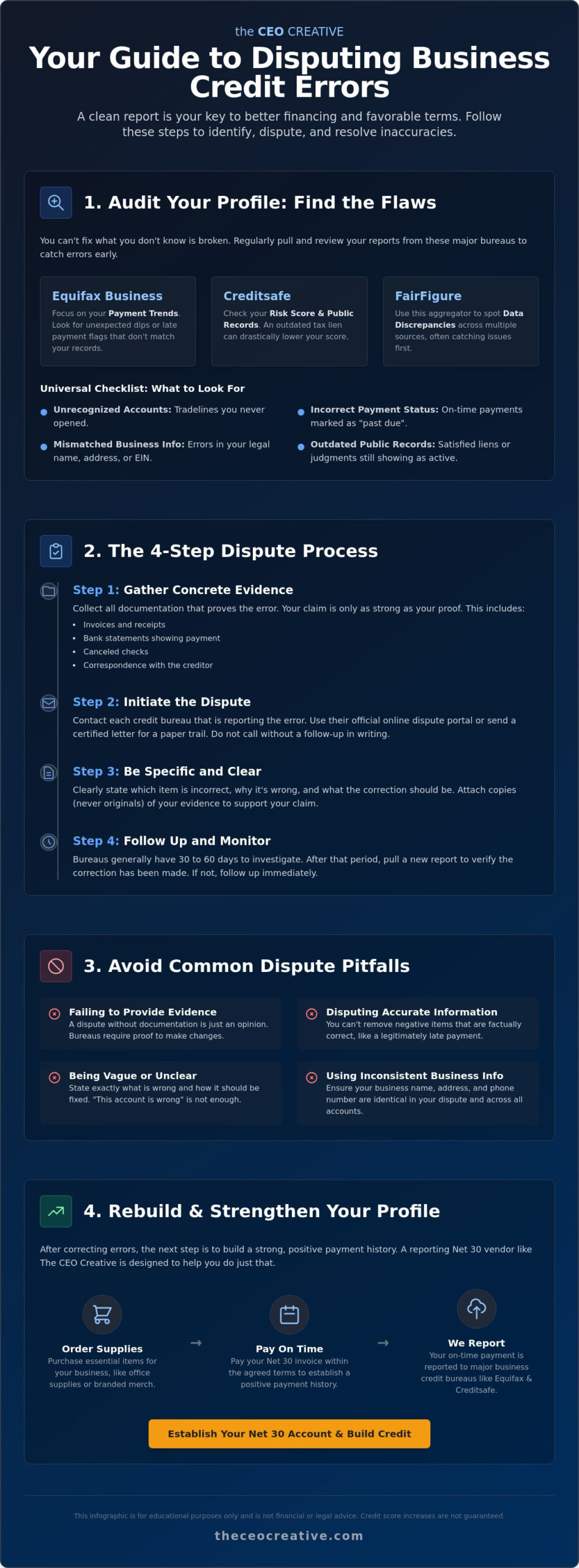
You can’t fix what you don’t track. Identifying inaccuracies requires a meticulous review of your current standing across the major reporting agencies. You should pull your reports from Equifax Business, Creditsafe, and the FairFigure platform at least once a quarter to ensure your data remains untarnished. When you review these files, keep a sharp eye out for accounts you don’t recognize or payment statuses that don’t match your internal records. If you paid an invoice on time but it shows as “30 days past due,” that’s a major red flag. Checking your “Key Score Factors” is equally important. These indicators tell you exactly why your score is where it is. If a factor lists “high utilization” but you’ve paid down your balances, you’ve found a reporting lag. Always verify that your EIN and legal business name are identical on every file. A single digit error in an EIN can cause your credit history to be attributed to a different company entirely.
Specifics for Equifax and Creditsafe
Equifax often highlights “payment trends” which show your reliability over time. Look for unexpected dips in your trend line that don’t align with your actual spending habits. Creditsafe calculates risk differently than traditional bureaus; they focus heavily on the likelihood of business failure within the next twelve months. A mistake in your “public records” section, such as a satisfied tax lien still showing as active, can plummet your Creditsafe score and trigger a high-risk warning to lenders. The process of Disputing Errors on Your Credit Reports starts with catching these specific details before they become permanent fixtures on your profile.
Monitoring FairFigure for Modern Credit Insights
FairFigure provides a modern edge by aggregating data from multiple sources into a single, easy-to-read FairFigure score. Discrepancies often appear here first. If FairFigure shows a significantly lower score than your individual bureau reports, it might be pulling data from a vendor tradeline you haven’t checked recently. Real-time monitoring prevents long-term reporting damage because you can catch a mistake the moment it’s reported. While you work on disputing errors on your business credit report, it’s a smart strategy to continue adding positive data. You can proactively strengthen your profile by opening a business net 30 account to ensure your on-time payments are consistently documented. This balanced approach of removing bad data while adding good data is the fastest way to a healthy business credit profile.
Step-by-Step Guide to Disputing Business Credit Inaccuracies
Don’t stop at the bureau. You must also contact the data provider or vendor who reported the error. If the source data isn’t corrected, the inaccuracy might reappear during the next reporting cycle. Finally, stay diligent by following up within the 30-day investigation window. Set a calendar alert to check your status exactly four weeks after your initial submission. This proactive stance is essential when disputing errors on your business credit report to protect your company’s funding potential.
Drafting an Effective Dispute Letter
A professional dispute letter should be clear and factual. Include your legal business name, EIN, and the specific account number in question. State exactly what is wrong and provide a concise explanation of the correct data. If you need a starting point, the CFPB offers guidance on how to dispute an error on your credit report. Avoid using robotic, templated jargon. Bureaus are more likely to take your claim seriously if it’s written in a straightforward, professional tone that clearly outlines the facts of the case.
Engaging with Vendors for Rapid Correction
Speaking directly with a vendor’s credit department can often resolve issues faster than a bureau’s investigation. Ask to speak with a supervisor if the initial representative is unhelpful. Request a “letter of correction” that you can forward to the bureaus to expedite the update. Using The CEO Creative Net 30 Account serves as a model for clear reporting, as we prioritize transparency in our data furnishing. Clear communication with your vendors ensures that your positive payment history is the only thing being reported.
To maintain a pristine profile, follow the Clean and Build Checklist:
- Apply: Open accounts with reporting vendors.
- Order: Purchase essential supplies or branding materials.
- Pay: Settle invoices early or on time.
- Track: Monitor your reports for accuracy every month.
- Repeat: Continue the cycle to build a deep, positive credit history.
Common Mistakes to Avoid in the Dispute Process
Even the most diligent founders can undermine their progress by making simple procedural errors. Disputing errors on your business credit report is a precise task that requires attention to detail. One major mistake is attempting to dispute accurate but negative information. If you were actually late on a payment, the bureau will verify this with the furnisher, and your dispute will be rejected. This wastes valuable time and can damage your credibility with the bureau. You should also avoid these common pitfalls:
- Failing to provide specific documentation: A generic letter isn’t enough; you must attach the specific invoice or bank statement that proves your case.
- Neglecting all three bureaus: An error might exist on Equifax but not on Creditsafe. You must check each one individually.
- Using personal credit repair strategies: Business credit isn’t governed by the same FCRA rules as consumer credit, so “templated” legal jargon often fails.
- Stopping credit activity: Don’t freeze your spending. Continue to build positive history while the dispute is pending.
- Inconsistent contact information: If your address or phone number varies between disputes, bureaus may flag your file for fraud.
Treating your EIN file like a personal credit report is a recipe for failure. Many startups expect a 30-day resolution but fail to follow up once that window closes. Set a reminder to check the status of your claim exactly four weeks after submission. If you don’t stay on top of the process, your dispute may simply stall in the bureau’s system and leave your funding options in limbo.
The Danger of ‘Frivolous’ Dispute Labels
Bureaus look for patterns of “frivolous” behavior. Disputing errors on your business credit report shouldn’t be a scattershot approach; it requires a focused strategy. If you mass-dispute every negative item on your report at once, the bureau may flag your file. This flag makes it significantly harder to resolve legitimate errors later. Focus your energy on the “Key Score Factors” for the biggest impact. These are the items the bureau identifies as having the most weight on your current score. If a dispute is denied, request a specific reason for the denial and provide new evidence rather than resubmitting the same letter.
Maintaining Business Info Consistency
Your Net 30 tradelines must match your Secretary of State filing exactly. If your business uses a virtual office address, ensure the bureau recognizes it as a legitimate place of business. Some reporting systems flag virtual offices as high-risk, which can complicate the verification process. Ensure your business phone number is a dedicated line that matches your credit profile. Accuracy in these small details prevents unnecessary delays. Ready to build a profile that stands up to any audit? Apply for a business Net 30 account today to start adding consistent, accurate data to your reports.
Beyond Disputes: Strengthening Your Profile with The CEO Creative
Fixing mistakes is just the beginning. While disputing errors on your business credit report clears the path, you still need to drive forward. You can’t just have a clean report; you need a strong one. Using high-quality office supplies through a Net 30 account is a practical way to build positive history. Strategic spending on items like onboarding kits and employee uniforms ensures you’re reporting consistent activity every month. Paying these invoices early, rather than waiting for the full 30 days, can further boost your score by demonstrating exceptional reliability. For those who want a structured approach, joining The CEO Creative Membership provides ongoing credit support and branding tools to keep your profile growing.
Replacing Bad Data with Positive Tradelines
A “thin file” can be just as damaging as a file with errors. Lenders see a lack of data as a lack of proof. Focusing on building business credit without a loan allows you to grow your score through operational expenses instead of debt. This reduces your financial risk while you’re still disputing errors on your business credit report. Typically, new positive reporting starts to outweigh old corrected errors within 90 to 120 days of consistent activity. This transition period is vital for turning a rescued profile into a robust asset.
Leveraging Custom Merch for Brand and Credit
Your credit building should serve your brand’s growth. Ordering Net 30 apparel helps you create a professional presence while establishing a solid tradeline. Consistent, small orders of branded gear keep your accounts active and healthy without overextending your budget. It’s a strategic move that combines marketing with financial management. Corporate credibility is the result of accuracy plus active building. When you combine the dispute process with a reporting vendor, you create a profile that lenders can trust.
Take Control of Your Corporate Credit Future
A clean credit profile is a strategic asset that opens doors to better financing and higher vendor tiers. By mastering the art of disputing errors on your business credit report, you ensure that your company’s hard work is accurately reflected in every bureau file. Removing bad data is only half the battle. To build a truly robust profile, you must replace inaccuracies with a steady stream of positive, on-time payment history. Consistent auditing and proactive building are the twin engines of your financial success.
Don’t let a simple reporting error stall your growth. You can start building a stronger, more accurate profile immediately with a partner that understands the needs of modern startups. Apply for a CEO Creative Business Account to Start Building Better Credit Today. Our accounts offer a decision within one business day for new LLCs with no personal guarantee required. We report your activity to Equifax, Creditsafe, and FairFigure to help you establish the corporate credibility you deserve.
What happens next:
- Your account is a decision within one business day without a personal credit check, giving you immediate access to professional Net 30 terms.
- You select essential office supplies or branding materials that support your daily business operations and growth.
- We report your consistent, on-time payments to major bureaus to strengthen your profile and increase your borrowing power.
Maintaining your company’s financial health requires a blend of data accuracy and consistent activity. Once you’ve finished addressing inaccuracies, keep your profile healthy by ordering professional apparel or custom engraved items. This strategy ensures your tradelines stay active while you build a brand that’s ready for long-term expansion.
Frequently Asked Questions
Do business credit disputes require a personal guarantee?
Business credit disputes do not require a personal guarantee. The dispute process is a formal request for data accuracy and isn’t an application for new credit or financing. You can file a dispute for any inaccuracy regardless of how the account was originally opened or whether you personally guaranteed the underlying debt. This ensures your corporate file remains accurate without putting your personal assets at risk during the investigation.
How long does it take for Equifax to update a disputed item?
Equifax typically takes 30 days to complete an investigation and update a disputed item on your business profile. While some preliminary investigations for high-risk errors may move faster, you should expect the full 30-day window for most corrections to reflect on your report. Keep your tracking number or confirmation email handy to follow up if you don’t see an update after four weeks have passed.
Will disputing an error on my business report hurt my score?
Disputing an error on your business report won’t hurt your credit score. The act of questioning an item’s accuracy isn’t a negative factor in any major credit scoring models. Successfully removing incorrect late payments or unverified debts is actually one of the fastest ways to see a score increase. You’re simply ensuring the data reflects the truth of your business operations to potential lenders.
Can I dispute errors on my business credit report myself for free?
You can handle disputing errors on your business credit report yourself for free without hiring an outside agency. Major bureaus like Equifax and Creditsafe provide online portals where you can upload evidence and track your claim status at no cost. Taking a hands-on approach gives you direct control over your company’s financial reputation and ensures your documentation is submitted correctly the first time.
Does paying a vendor early improve my business credit reporting?
Paying a vendor early often improves your business credit reporting and can lead to a higher score. Many business credit models prioritize “Days Beyond Terms” (DBT) to measure your reliability. When you pay before the invoice due date, you demonstrate superior liquidity and cash flow management. This proactive habit helps build a consistent pattern of positive behavior that lenders find highly attractive.
What should I do if the credit bureau refuses to remove an error?
If a bureau refuses to remove an error, you should contact the data furnisher or vendor directly to resolve the issue at the source. Ask the vendor’s credit department to verify their records and send a “letter of correction” to the bureau to expedite the update. If the vendor confirms the error but the bureau still won’t budge, you can add a formal statement to your file to explain the discrepancy to future creditors.
How often should I audit my business credit profile for mistakes?
You should audit your business credit profile for mistakes at least once every quarter. Business credit data is updated frequently, and errors can appear the moment a new vendor reports your information or an old account is closed. Regular check-ins allow you to catch clerical mistakes or potential identity theft before they block a critical loan or Net 30 application. Consistent monitoring is the foundation of a healthy profile.
What is the difference between a tradeline and a credit limit on a report?
A tradeline is the specific account reported by a vendor, while the credit limit is the maximum amount of credit extended to you on that account. Your tradeline tracks your payment history, the age of the account, and your current balance. The credit limit helps bureaus determine your utilization ratio and your overall credit capacity. Both pieces of data are essential for a complete and accurate business credit profile.
Building business credit? Open a Net 30 Account — EIN only, no personal guarantee, $60 minimum order, credit lines up to $5,500, a decision in one business day, and every on-time payment reported monthly to Equifax Business, Creditsafe and FairFigure.
How do you dispute errors on a business credit report?
Contact the bureau that’s reporting the error directly, in writing, and include documentation that backs up the correct information, like invoices, payment records or a signed account statement. Each business bureau, including Equifax Business, Dun & Bradstreet and Experian Business, runs its own dispute process and form, so check that bureau’s current instructions before you submit. Keep a copy of what you send and any response you get back, since business credit disputes aren’t standardized the way personal credit disputes are.
How do you dispute an error on an Equifax business credit report?
Equifax Business Credit Reports run through a separate dispute channel from Equifax’s personal consumer reports, so start on the business side of their site rather than the regular consumer dispute portal. Pull together documentation that supports the correction, such as invoices or a lender’s payoff letter, and submit it through that process, following up in writing if you don’t hear back. We report payment activity to Equifax Business monthly, so if a tradeline listed under The CEO Creative looks off, you’re welcome to reach out to us directly to confirm what we reported.
How long does a business credit dispute take?
There’s no fixed legal timeline for business credit disputes the way there is for personal credit, where the FCRA requires consumer bureaus to investigate within 30 days. Business bureaus set their own procedures, so turnaround depends on the bureau and how fast you and the reporting company supply documentation. A clear, complete submission with dated paperwork generally moves faster than a partial one.
What evidence do you need to dispute a tradeline?
You need documentation that proves the reported information is wrong, such as invoices, payment confirmations, bank or check records showing when a payment actually posted, or a written statement from the creditor confirming the correct status. The more directly the paperwork ties to the specific date and amount in question, the stronger the dispute. If a tradeline shows a late payment you believe was on time, a canceled check or bank statement date is often the clearest evidence to include.