

Relying on a secured loan to launch your brand might feel like the safest move, but it’s often the quickest way to tie your personal future to business risks. You want to scale your operations without the constant fear of personal guarantees or risking your family’s assets. Choosing the right path between vendor credit vs secured business loans is the foundation of a sustainable financial strategy. This guide is for educational purposes only; it isn’t financial or legal advice and makes no guarantees regarding specific credit score increases.
You’ll learn how to strategically choose between vendor tradelines and secured financing to build business credit without a personal guarantee. The CEO Creative is a reporting NET 30 vendor that empowers businesses to establish tradelines through professional supplies. We’ll explore how to establish a credit file quickly by separating your personal and business finances. This article covers exactly how to obtain credit reporting to Equifax and Creditsafe through smart spending and consistent payment habits.
Key Takeaways
- Compare the strategic advantages of vendor credit vs secured business loans to protect your personal assets while scaling operations.
- Explore how Net 30 tradelines report payment history to bureaus like Equifax and Creditsafe to establish a solid credit file for your EIN.
- Determine the specific scenarios where collateral-based financing is necessary versus when interest-free vendor terms offer better cash flow.
- Follow a proven five-step checklist to move from initial application to tracking your credit growth with precision.
- Learn to use professional branding items, such as custom onboarding kits and uniforms, as strategic tools for building business credit.
Key Takeaways
- Compare the strategic advantages of vendor credit vs secured business loans to protect your personal assets while scaling operations.
- Explore how Net 30 tradelines report payment history to bureaus like Equifax and Creditsafe to establish a solid credit file for your EIN.
- Determine the specific scenarios where collateral-based financing is necessary versus when interest-free vendor terms offer better cash flow.
- Follow a proven five-step checklist to move from initial application to tracking your credit growth with precision.
- Learn to use professional branding items, such as custom onboarding kits and uniforms, as strategic tools for building business credit.
Understanding Vendor Credit vs. Secured Business Loans for Startups
Starting a business requires capital, but traditional lenders often demand a history you haven’t built yet. This creates a fork in the road for many entrepreneurs: vendor credit vs secured business loans. The CEO Creative operates as a reporting Net 30 vendor, providing a bridge for new organizations to build their corporate identity and credit profile simultaneously. We offer a path to establish a credit profile from scratch using EIN-only methods that don’t require you to put your personal assets on the line.
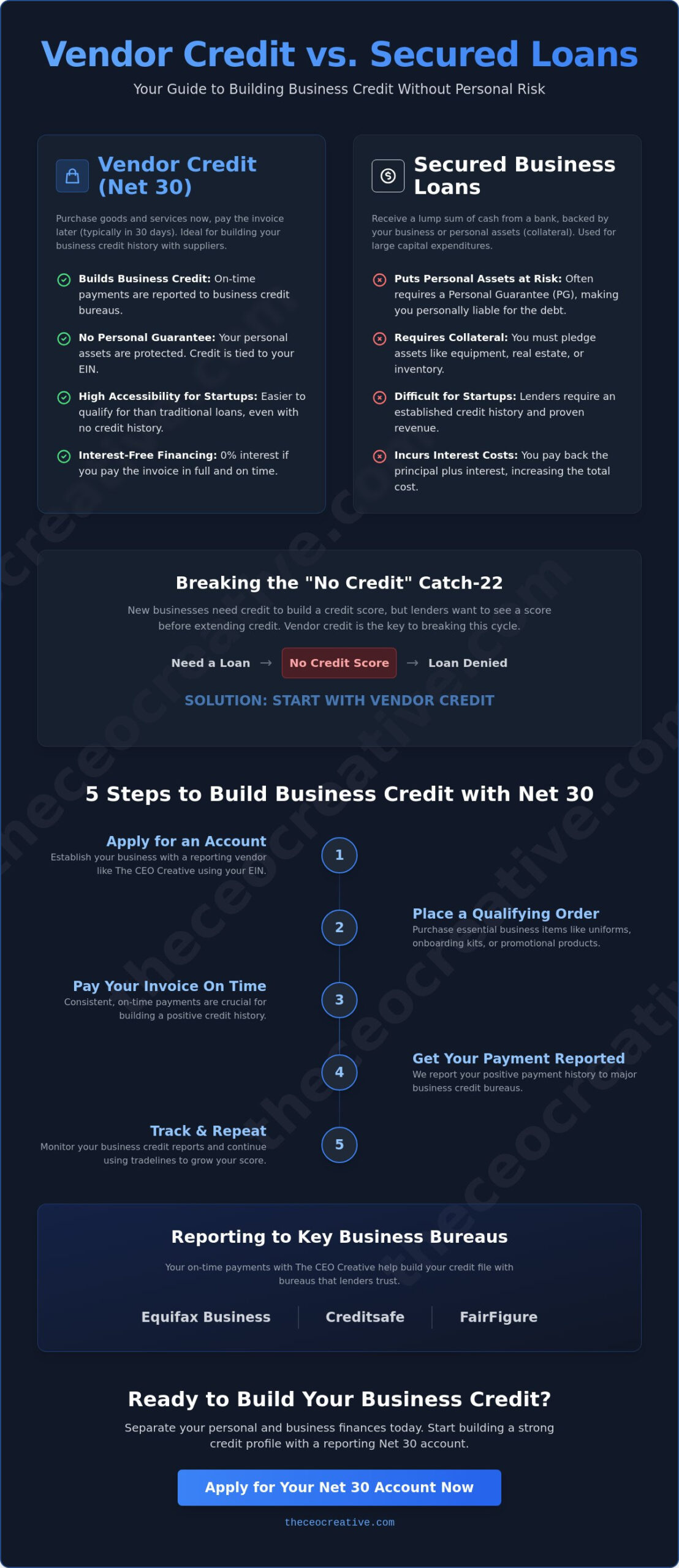
Vendor credit, frequently referred to as trade credit, is a short-term financing arrangement. It allows you to purchase goods or services now and pay the full invoice amount within a set timeframe, usually 30 days. Secured business loans are different. These involve receiving a lump sum of cash from a financial institution, which is backed by physical or financial collateral like equipment, inventory, or real estate. While loans provide cash, vendor credit provides the essential supplies your business needs to function daily.
The Problem: The “No Credit” Catch-22
New LLCs often face a frustrating cycle. Banks want to see a solid business credit score before approving a loan, but you can’t build that score without someone first giving you credit. Secured lending might seem like the only way out, but it carries a heavy burden. Lenders usually require a personal guarantee, meaning if the business fails, your personal bank accounts and home are at risk. You can break this cycle by starting with Tier 1 vendor tradelines. These accounts are easier to obtain for new businesses and allow you to build a history of on-time payments that bureaus can see.
Trust Note & Disclaimer
The information provided in this guide is for educational and informational purposes only. It does not constitute financial, legal, or professional advice. Every business situation is unique, and you should consult with a qualified professional before making significant financial decisions. We make no guarantees regarding specific credit score increases or approval for any specific financial products. Success in building credit depends on your individual business practices and consistent payment history.
By choosing a business net 30 account, you take the first step toward financial independence. This method focuses on using your business’s own Tax ID to secure terms, slowly separating your personal finances from your professional obligations. It’s a strategic move that builds a foundation for larger financing options in the future.
Mechanics of Credit: Tradelines vs. Collateral-Based Financing
Understanding the technical mechanics of how debt is recorded is essential when weighing vendor credit vs secured business loans. When you utilize a Net 30 vendor, they create a “tradeline” on your business credit report. This tradeline acts as a documented record of your credit limit and payment performance. In contrast, secured loans typically involve a lender filing a UCC-1 lien against your business assets. This legal claim gives the lender the right to seize specific collateral, such as equipment or inventory, if the business fails to meet its obligations.
The reporting ecosystem for business credit is more diverse than personal credit. While many banks only report to one or two major bureaus, specialized vendors focus on a broader range of partners. Reporting to Equifax Business, Creditsafe, and FairFigure ensures that your positive payment history is visible to a wide variety of future lenders and partners. The SBA identifies getting vendor credit as a strategic way to build this history while keeping your cash flow liquid for daily operations.
Consistency is the silent engine of credit building. You must ensure your Business Info Consistency is perfect across every application. Your business name, physical address, and phone number should match your Secretary of State filings exactly. Even minor discrepancies, like using “Suite” on one form and “Ste.” on another, can lead to split credit files. This confusion makes it difficult for bureaus to aggregate your data, potentially hiding the progress you’ve made.
The Reporting Schedule
Vendors typically report your payment data on a fixed monthly cycle. Paying your invoices early, rather than just on time, can have a dramatic impact on your business credit score. Bureaus often reward “days beyond terms” (DBT) metrics; a negative DBT indicates you pay before the deadline. Regular, consistent reporting creates a pattern of reliability that lenders look for when you eventually move toward larger financing options. If you’re ready to start this cycle, you can apply for a business account today to begin building your file.
Personal Guarantees and EIN-Only Approval
The most significant hurdle in traditional lending is the personal guarantee. This requirement ties your personal assets and FICO score to the business’s debt. However, Net 30 accounts for LLCs are specifically designed to bypass this need. By focusing on your EIN (Employer Identification Number) for approval, these accounts allow you to build credit in the name of the business itself. This structure protects your personal finances and establishes your company as a standalone legal and financial entity.
Choosing the Right Path: When to Prioritize Net 30 Vendor Credit
Deciding between vendor credit vs secured business loans requires a clear look at your current balance sheet and long-term goals. For many service-based agencies and ecommerce brands, the immediate need isn’t a massive cash injection for a warehouse; it’s the ability to procure branding materials and office essentials without draining cash reserves. Vendor credit is superior for these operational needs because it provides interest-free terms while simultaneously building your business credit history. You get the supplies you need to grow your brand, and the bureaus get the data they need to verify your reliability. To further support your digital scaling, you can check out Crypto Chief for a unified Web3 infrastructure platform designed for developers and businesses.
There are specific scenarios where a secured loan becomes necessary. If your business requires heavy machinery, a fleet of vehicles, or physical real estate, a vendor account for office supplies won’t suffice. However, the “Tier 1” strategy suggests you should use vendor credit to qualify for better loan terms later. By establishing a strong track record with Net 30 accounts first, you solve the catch-22 of having no credit history. This preparation allows you to approach traditional lenders with a proven file, potentially securing lower interest rates and higher limits. To master this transition, review our How to Build Business Credit Without a Loan: The 2026 Guide.
Benefits for New LLCs and Startups
New organizations often find the barrier to entry for traditional loans insurmountable. Vendor credit offers a more accessible entry point with many fast-decision options. This allows you to manage cash flow effectively by deferring payments for 30 days. You can focus your initial capital on high-quality promotional items, apparel, and office essentials that define your corporate identity. It’s a strategic way to look professional while your EIN-based credit file matures.
Pros and Cons Comparison
- Vendor Credit:
- Fast approval process with minimal documentation.
- Builds essential tradelines with bureaus like Equifax and Creditsafe.
- Requires no collateral or personal assets.
- Typically offers lower initial credit limits than bank loans.
- Secured Business Loans:
- Provides higher amounts of capital for major expansions.
- Offers lower interest rates compared to unsecured alternatives.
- Requires physical assets or cash as collateral.
- Carries high risk; failure to pay results in the loss of the pledged asset.
The 5-Step System for Building Business Credit Without Personal Guarantees
To successfully implement a strategy of vendor credit vs secured business loans, you need a repeatable process. Most entrepreneurs fail because they approach credit building as a one-time event rather than a monthly cycle. By following a structured five-step system, you can establish a robust credit file that eventually unlocks larger financing opportunities without risking your personal assets.
- Apply: Your business must be “credit ready” before you submit an application. This means having a registered LLC, an EIN, a professional website, and a business phone number listed in 411 directories. Discrepancies here often lead to instant denials.
- Order: Purchase items your business actually uses. Selecting professional essentials like office supplies allows you to build credit through routine operational spending rather than unnecessary debt.
- Pay: Timing is everything. Pay your invoices at least 10 days before the due date. This early payment is often reflected in your credit score as a “days beyond terms” (DBT) metric, which bureaus use to calculate your reliability.
- Track: Verify that your activity is being reported correctly. Check your reports with Equifax, Creditsafe, and FairFigure to ensure the tradelines are appearing.
- Repeat: One tradeline isn’t enough to build a strong score. Continue ordering and paying early to show a consistent pattern of reliability over several months.
Common Mistakes to Avoid
- Inconsistent Business Addresses: Using a home address on one application and an office address on another creates split files. Stick to the physical location listed on your articles of organization.
- Missing the Payment Window: Even one late payment can significantly damage your business credit score. Set digital reminders to ensure you pay well before the 30-day mark.
- Unverified Bureau Reporting: Not all vendors report to the same bureaus. Ensure your chosen vendors report to major agencies like Equifax or Creditsafe to maximize the impact of your spending.
- Over-extending Limits: Don’t max out your credit lines immediately. Gradual growth shows responsible management and keeps your credit utilization in a healthy range.
- Membership Lapses: Failing to maintain a CEO Creative Membership can interrupt the flow of consistent reporting to the bureaus, slowing your progress.
Tracking Your Progress
Monitoring your growth is just as important as the spending itself. You can use platforms like FairFigure to monitor your business credit health in real-time. This visibility helps you spot errors or identify if a tradeline isn’t showing up on your report. Understanding the trajectory of vendor credit vs secured business loans helps you determine exactly when your business is ready for more complex financial products. If a payment hasn’t appeared after 60 days, contact the vendor to verify that your business information matches their records exactly. If you’re ready to start your first tradeline, you can apply for a business net 30 account to begin the process today.
Strategic Branding: Using Custom Products to Scale Your Corporate Identity
Building a brand isn’t just about a logo; it’s about the systems that support your visibility. When comparing vendor credit vs secured business loans, the most striking difference is what you actually hold in your hand after the transaction. A secured loan leaves you with a monthly interest payment and a lien on your assets. Vendor credit through a Net 30 account leaves you with high-quality branding materials that help generate more business. This approach transforms a routine operational expense into a strategic move for your company’s financial future.
Investing in customizable products serves a powerful dual purpose. You aren’t just buying office supplies or promotional gear; you’re populating your business credit file with positive payment data. Every order you place and pay early acts as a vote of confidence for your EIN. This is especially useful for new LLCs that need to establish a professional presence quickly without the high stakes of collateral-based financing.
Onboarding kits and uniforms keep your spending professional and consistent. By utilizing Net 30 apparel, you create brand ambassadors out of your employees while building your credit history. This visibility is essential for service-based agencies and ecommerce brands looking to stand out in a crowded market. You’re building a sustainable business through structured credit and quality branding simultaneously.
Maximizing Your Membership
To get the most out of your account, choose products that your business actually needs for daily operations. Whether it’s engraved pens for clients or branded mugs for the office, every purchase should serve your brand’s growth. This strategy helps you create a professional image that attracts higher-value clients while your EIN profile matures. It’s a method that prioritizes utility over vanity, ensuring that every dollar spent contributes to your long-term sustainability.
Final Recap and Summary
Choosing vendor credit provides a strategic advantage by allowing you to build essential tradelines without the burden of personal guarantees or physical collateral. It offers a low-risk entry point for startups to establish credit history through routine business purchases. By separating your personal assets from your business growth, you protect your financial future while scaling your corporate identity. Start small, pay early, and watch your business stand on its own two feet.
Secure Your Company’s Financial Independence
The strategic choice between vendor credit vs secured business loans determines how effectively you’ll separate your personal liability from your professional growth. While secured loans are useful for major capital acquisitions, vendor tradelines offer a manageable, interest-free path to establishing a solid credit file. By focusing on your EIN-based history, you build a foundation that eventually unlocks the highest tiers of corporate financing.
Ready to establish your first tradeline? Apply for a Net 30 Business Account with The CEO Creative to start building your profile today.
What happens next
- Complete the online application to secure your business credit line with fast-decision options.
- Place your first order for branding essentials to trigger your initial reporting cycle.
- Track your growth as we report your consistent payment history to Equifax, Creditsafe, and FairFigure.
Maintaining a healthy credit file is a simple process when you integrate it into your routine operations. You can scale your corporate identity by browsing our professional apparel or high-quality office supplies. These strategic purchases ensure your business remains credit-active while looking established to every client you serve.
Frequently Asked Questions
Do Net 30 vendors require a personal guarantee?
Most Tier 1 Net 30 vendors do not require a personal guarantee for approval. They use your business’s EIN to establish credit in the name of the organization itself. This structure allows you to separate your personal and professional finances while protecting your private assets from business liabilities. It’s a foundational step for new LLCs and startups that want to scale without the hurdles of traditional banking.
How long does it take for vendor credit to show on my credit report?
It usually takes between 30 and 60 days for a vendor tradeline to appear on your business credit report. Vendors typically report data to bureaus on a fixed monthly schedule. If your payment doesn’t show up after two reporting cycles, verify that your business information matches your Secretary of State filings exactly. Consistency prevents data from being lost or split into multiple files.
Can I build business credit without a secured loan?
You can definitely build business credit without a secured loan by using vendor accounts. When weighing vendor credit vs secured business loans, vendor tradelines are often the faster and safer entry point for startups. These accounts allow you to establish a payment history through routine purchases like office supplies or apparel, proving your reliability to bureaus without pledging collateral or cash up front.
Does The CEO Creative report to all major business credit bureaus?
The CEO Creative reports your payment history to Equifax Business, Creditsafe, and FairFigure. By reporting to these major bureaus, we ensure your positive payment habits are visible to a wide range of future lenders. Maintaining a consistent history with multiple reporting partners is essential for building a robust credit file that eventually unlocks higher limits and better financing terms for your organization.
What is the difference between a tradeline and a loan?
A tradeline is a record of credit extended by a supplier for specific goods or services, whereas a loan is a lump sum of cash provided by a financial institution. Tradelines are interest-free if paid within terms, such as Net 30. Loans accrue interest and often require collateral. Understanding this distinction is vital when deciding between vendor credit vs secured business loans for your daily operational needs and long-term growth.
Will paying my Net 30 account early help my business credit score?
Paying your Net 30 account early is one of the most effective ways to strengthen your business payment history. Bureaus track “Days Beyond Terms” (DBT), and a negative DBT score shows that you pay before the deadline. This proactive habit demonstrates high financial reliability to lenders and is recorded differently from simply paying on the due date.
Can I get a Net 30 account with a new LLC and no history?
You can get a Net 30 account with a brand new LLC and no prior credit history. Tier 1 vendors are specifically designed to help startups bridge the gap between having no credit and qualifying for traditional bank loans. As long as your business is properly registered with an EIN and a professional presence, you can gain approval and start building your file immediately.
What happens if I miss a payment on a vendor credit account?
Missing a payment on a vendor account can result in late fees and immediate damage to your business credit score. Most vendors report late payments as delinquent once they pass the 30-day window. This negative mark stays on your report and can make it difficult to qualify for higher credit tiers or better loan terms in the future. Always prioritize on-time or early payments.
Building business credit? Net 30 Vendors Compared — EIN only, no personal guarantee, $60 minimum order, credit lines up to $5,500, a decision in one business day, and every on-time payment reported monthly to Equifax Business, Creditsafe and FairFigure.