

Here to apply rather than research? The CEO Creative offers apply for a net 30 account — no personal guarantee, no personal credit check, and credit lines up to $5,500.
Related: Net 30 Vendors Compared — the four things worth comparing, and a direct comparison against every major vendor.
Your personal credit score shouldn’t be the anchor that keeps your startup from reaching its full potential. Many new entrepreneurs feel trapped because traditional lenders demand a credit history that hasn’t been built yet. It’s a frustrating cycle that often leads to founders risking their personal assets just to keep the lights on. However, you can break this cycle by using a strategic starter vendor list for new businesses to establish a standalone corporate profile.
We agree that navigating business credit bureaus can feel overwhelming and confusing for any new owner. That’s why we’ve designed this guide to help you master the art of building business credit through net 30 accounts and Tier 1 vendors. You’ll learn exactly which suppliers report to major bureaus, how to follow a proven five-step checklist for success, and why professional branding is your secret weapon for long term creditworthiness.
Key Takeaways
- Leverage a strategic starter vendor list for new businesses to establish a credit profile using your EIN without risking your personal credit score.
- Identify Tier 1 vendors like The CEO Creative that report payment history to Equifax Business, Creditsafe and FairFigure.
- Master the five-step checklist for managing net 30 accounts, ensuring every purchase serves a practical business purpose and contributes to your creditworthiness.
- Learn how to maintain business data consistency to avoid application denials and ensure your trade lines are accurately reflected on your reports.
- Transform routine operational costs into credit-building assets by choosing vendors that offer custom branding, apparel, and essential office supplies.
What is a Starter Vendor List for New Businesses?
A starter vendor list for new businesses is a curated collection of Tier 1 suppliers that extend credit to companies with little to no established history. These vendors are unique because they often approve applications using only an Employer Identification Number (EIN). This allows you to build a corporate profile without relying on a personal guarantee or risking your personal credit score. The CEO Creative serves as a primary example of a reporting net 30 vendor, providing essential branding and office products while helping startups establish their first trade lines. It’s a foundational step for any entrepreneur who wants to move beyond using personal credit cards for business expenses.
Trust Note: This content is for educational purposes only. It does not constitute financial or legal advice. We make no guarantees regarding specific credit score increases or approval outcomes.
Key Definitions: Net 30, Tradelines, and Reporting
Understanding the mechanics of trade credit is essential for any modern entrepreneur. A Net 30 account is a credit agreement where you must pay the full balance within 30 days of the invoice date. When a vendor approves you for these terms, they create a Vendor Tradeline on your business credit report. The most critical part of this relationship is Payment Reporting. This is when the vendor sends your transaction history to bureaus like Equifax, Creditsafe, or FairFigure. If you pay on time, this data builds the foundation of your business credit score, such as a Paydex or similar rating.
Why New Businesses Need a Strategic List
Most traditional banks won’t even look at an LLC that hasn’t been active for two years. This creates a “No Credit” trap where you need money to grow but can’t get it because you haven’t grown yet. Using a net 30 business account allows you to bypass these hurdles immediately. It provides the breathing room to manage cash flow while simultaneously proving your reliability to future lenders.
By following a strategic starter vendor list for new businesses, you can separate your personal and business finances. This protects your family’s assets while professionalizing your brand. Our goal is simple: follow the steps in this guide to establish your first 3 to 5 tradelines. Once these are reporting, you’ll have the data footprint necessary to unlock higher tiers of credit and more competitive financing terms.
Top Tier 1 Net 30 Vendors for Startups in 2026
Selecting the right initial partners is the most significant decision you’ll make when launching your corporate credit journey. To Establish business credit, you must prioritize vendors that offer high approval rates for new EINs and consistent reporting to major bureaus. A strategic starter vendor list for new businesses focuses on companies that provide essential utility while building your financial footprint. We evaluate these partners based on their reporting reliability, the practical value of their inventory, and their willingness to work with entities that lack an established credit file.
The CEO Creative: Branding Your Way to Credit
The CEO Creative is a premier choice for modern startups because it bridges the gap between operational needs and professional brand identity. Unlike industrial suppliers that offer generic warehouse items, this vendor allows you to invest in custom apparel, engraved drinkware, and professional stationery. This approach professionalizes your brand’s image for clients while simultaneously reporting your payment history to Equifax, Creditsafe, and FairFigure. It turns a standard business expense into a strategic growth asset that strengthens your score every month. If you’re ready to professionalize your image and build a reporting history, you can Apply for a Business Net 30 Account and start building your profile immediately.
Industrial and Shipping Giants: Uline and Grainger
Beyond branding, your starter vendor list for new businesses should include high-utility industrial and shipping suppliers. Uline and Grainger are the traditional staples for a reason. Uline offers a massive inventory of shipping boxes, warehouse equipment, and office furniture. They’re known for a straightforward “Invoice Me” process at checkout, which is a common entry point for new LLCs. It’s generally recommended to keep orders at $50 or more to ensure the payment history is meaningful when reported to the bureaus.
Grainger provides a similar level of utility, focusing on maintenance, repair, and safety equipment. These vendors are essential for physical product brands that need to manage logistics and inventory. By spreading your purchases across these different categories, you create a diverse credit profile that signals stability to future lenders. Always ensure your business information remains perfectly consistent across all applications. Discrepancies in your legal name, address, or phone number can lead to reporting delays or immediate denials. Consistency is the primary requirement for building a profile that lenders will trust for high-tier financing.
How to Build Business Credit: The 5-Step Checklist
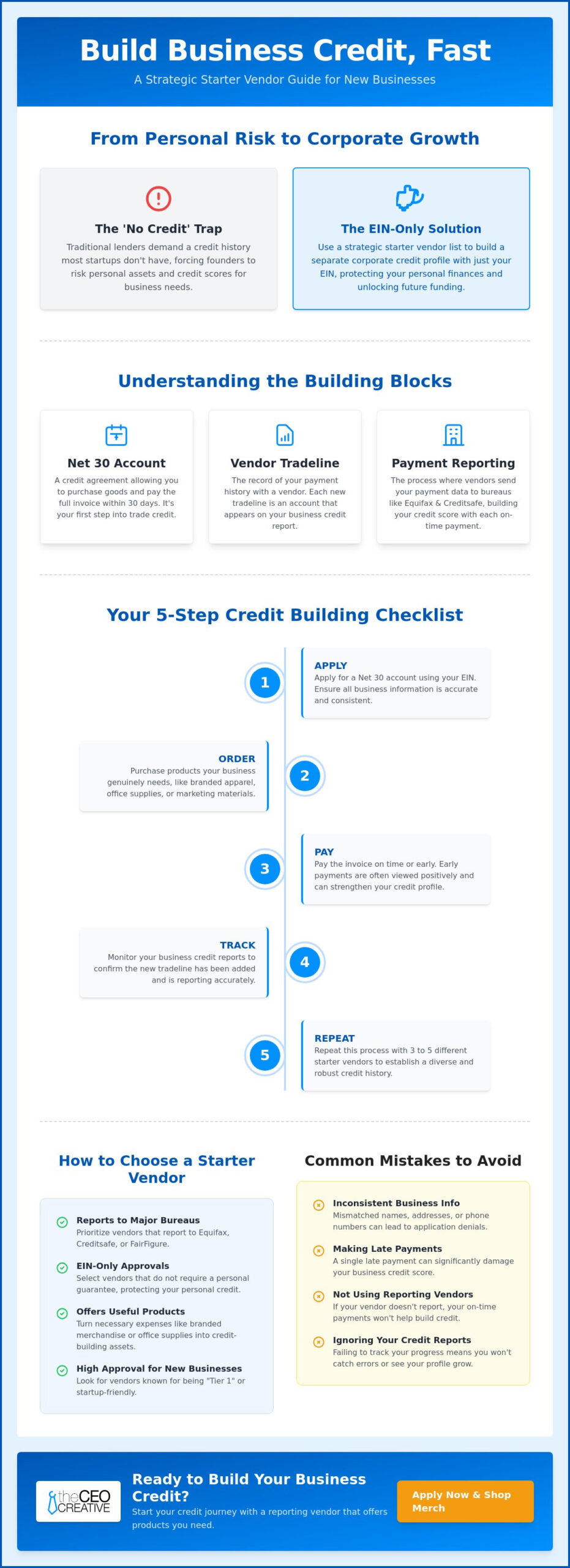
Establishing a repeatable framework is what separates successful startups from those that remain stagnant. When you use a strategic starter vendor list for new businesses, you’re building a professional financial resume from the ground up. To build business credit effectively, you need more than just a list of names; you need an operational system. This five-step cycle ensures your corporate profile grows with every transaction you make.
Step 1 & 2: Application and Strategic Ordering
The first step is your application. You must ensure your business information is perfectly consistent across every vendor. Your legal name, physical address, and phone number should match your Secretary of State filing exactly. Even a small discrepancy can cause a reporting failure or a denial. Once approved, focus your spending on items that offer immediate utility. Strategic ordering means purchasing products that professionalize your brand, such as onboarding kits for new hires or branded uniforms. You can Browse Net 30 Apparel Categories to find high-quality items that serve a clear business purpose while establishing your first trade lines.
Step 3, 4 & 5: Payment and Monitoring
Payment is the engine of your credit score. While net 30 terms allow for a full month to pay, making your payment within 10 or 20 days is a superior strategy. Early payments often signal a higher level of financial stability to automated scoring models, potentially accelerating your progress. After you pay, you must move into the tracking phase. Understand that there is typically a 30 to 60 day lag between your payment and when it reflects on your reports at Equifax, Creditsafe, or FairFigure. Monitoring these bureaus allows you to verify that your vendors are reporting correctly.
The final and most important step is repetition. A single reported trade line isn’t enough to secure major financing. You must repeat this cycle monthly across multiple accounts to create the depth of history lenders require. Using membership tools can help you streamline this journey by keeping your reporting consistent and your data organized. This disciplined approach transforms routine operational costs into a powerful asset for your company’s long-term sustainability.
8 Common Mistakes When Using Vendor Tradelines
Even the most effective starter vendor list for new businesses won’t help if your execution is flawed. Many entrepreneurs treat vendor accounts like personal credit cards, but the reporting mechanics are entirely different. Avoiding these common pitfalls ensures your trade lines actually contribute to your score rather than becoming a source of frustration. If you want to see real progress, you must approach each application and transaction with surgical precision.
- Data Inconsistency: Failing to match your application details with your official business records.
- Ordering Personal Items: Purchasing non-business products that don’t reflect a professional brand.
- Last-Minute Payments: Paying on the 30th day, which often results in late reporting due to processing delays.
- Aggressive Application Cycles: Applying for too many Tier 1 vendors before your first account has even started reporting.
- Non-Reporting Vendors: Spending money with suppliers that don’t send data to major bureaus.
- Premature Applications: Applying for credit before your LLC is fully registered with the state.
- Ignoring Bureau Discrepancies: Failing to monitor and dispute errors on your corporate credit reports.
- Generic Contact Info: Using a personal Gmail instead of a professional business email and dedicated line.
Data Inconsistency: The #1 Approval Killer
A mismatched suite number or a single digit error in your phone number can trigger a fraud alert in a vendor’s automated system. Your Secretary of State (SOS) filing is the source of truth for every lender and supplier. If your application says “Suite 100” but your SOS filing says “Unit 100,” you risk an immediate denial. Consistency is the backbone of a strong corporate profile. For a deeper dive into establishing your foundation, read our guide on How to Build Business Credit Without a Loan.
The “Ghost” Vendor Trap
Using vendors that don’t report is a significant waste of your capital and time. These “ghost” vendors might offer great products, but they do nothing to establish your score at Equifax or Creditsafe. You should also pay attention to modern reporting metrics like FairFigure, which many lenders now use to assess risk. Always verify a vendor’s reporting status before placing your first order. If you’re ready to work with a partner that prioritizes your growth, you should apply for a business net 30 account to ensure your payments are documented correctly.
Finally, don’t make the mistake of paying exactly on the 30th day. Most vendors take 2 to 3 business days to process a payment and update their internal ledgers. If you wait until the last minute, you might be reported as late. Aim to pay by day 20 to ensure your account remains in good standing. This simple habit protects your reputation and keeps your credit-building journey on the fast track. Using a strategic starter vendor list for new businesses is only half the battle; disciplined management is what secures your financial future.
Why Branding and Credit Building Go Hand-in-Hand
Most entrepreneurs view branding and credit building as two separate workstreams. In reality, they’re two sides of the same coin. A starter vendor list for new businesses shouldn’t just focus on industrial giants that sell shipping tape and safety cones. It should include partners that help you look established to your clients and future lenders alike. When you turn routine operational expenses into credit-building assets, you’re maximizing every dollar spent. This approach allows you to build a professional reputation while simultaneously constructing a corporate credit profile that stands on its own.
Custom Gear as a Credit Tool
Professionalism is a signal that lenders use to assess risk. When you walk into a meeting with custom notebooks and pens, you demonstrate that your business is organized and stable. These items serve a functional purpose, but they also act as silent ambassadors for your brand. Every time you Shop Customizable Office Supplies, you’re placing an order that contributes to your trade line history. High-quality promotional products signal to the world that you’ve invested in your company’s longevity. This psychological impact is a powerful, often ignored tool in the credit-building journey.
The CEO Creative Membership Advantage
Leveraging a subscription model can streamline your path to financial independence. The CEO Creative Membership: Build Credit and Brand Identity provides a structured way to acquire essential services like logo design and web packages. This model ensures that your credit-building efforts remain consistent month after month. You aren’t just buying merch; you’re accessing a system designed to professionalize your entire operation. It’s a strategic move that helps you avoid the “ghost” vendor trap by ensuring every purchase is reported to the major bureaus.
Your journey from a new LLC to a creditworthy enterprise depends on the quality of your initial trade lines. Using a strategic starter vendor list for new businesses creates the documented history that banks and high-tier lenders require. By maintaining consistency and paying your invoices early, you’ll soon move from Tier 1 vendors to more advanced credit options. This foundation isn’t just about a score; it’s about building a sustainable, professional brand that can weather any economic climate.
This professional brand is exactly what organizers look for when selecting participants for high-profile events. If you are ready to take your business to the public, you can find out more about the upcoming exhibitor schedule for Art and Craft Expo events.
Scale Your Business with a Strategic Credit Foundation
Building business credit is a strategic move that transforms your operational spending into a powerful financial asset. By selecting partners that report to Equifax, Creditsafe, and FairFigure, you’re creating a verifiable history that traditional lenders respect. Using a strategic starter vendor list for new businesses allows you to establish these essential trade lines without a personal guarantee. This approach protects your personal assets while giving your company the breathing room it needs to grow and scale.
The CEO Creative provides the perfect entry point for modern startups. You can access high-quality custom branding products that professionalize your brand while our reporting helps you establish a solid corporate credit score. There’s no better time to move beyond personal credit cards and start building a profile that stands on its own. Apply for a CEO Creative Account and Start Building Credit Today to secure your company’s financial future. Your journey toward higher credit tiers and competitive financing begins with this foundational step. We’re excited to partner with you as you scale your vision.
Frequently Asked Questions
Do I need a personal guarantee for starter vendors?
No, most vendors on a starter vendor list for new businesses do not require a personal guarantee for Tier 1 approval. This allows you to build credit using only your business EIN, which protects your personal credit score from potential impact. It’s an essential strategy for new LLC owners who want to separate their individual liabilities from their corporate obligations.
How long does it take for a net 30 vendor to report to Equifax?
Reporting to Equifax typically takes between 30 and 60 days from the time your invoice is paid. This lag occurs because most vendors report in monthly batches rather than in real time. It’s important to monitor your reports consistently to ensure your activity is recorded accurately by each supplier.
Can I build business credit with just an EIN?
You can absolutely build business credit with just an EIN by focusing on vendors that don’t require a personal social security number for approval. This process establishes a standalone credit file for your company. It’s the most effective way to professionalize your financial profile while protecting your personal assets.
What happens if I pay my net 30 invoice late?
Paying a net 30 invoice late can result in late fees and negative marks on your business credit reports. These marks can significantly lower your business credit score and make it harder to qualify for Tier 2 or Tier 3 credit. You should always aim to pay at least 10 days early to avoid processing delays.
How many tradelines do I need to get a business credit score?
You generally need at least three reporting tradelines to generate an initial business credit score like the Dun & Bradstreet Paydex. However, most experts suggest having five or more accounts on your starter vendor list for new businesses to build a robust profile. A diverse mix of accounts shows lenders that your business is reliable across different spending categories.
Does paying early improve my business credit score more than paying on time?
Yes, paying early can improve your score more than paying exactly on the due date. For instance, the Paydex score specifically rewards early payments with a higher rating than on-time payments. Paying within 10 to 20 days of the invoice date is a strategic move that can accelerate your progress through different credit tiers.
Do all starter vendors report to all three major bureaus?
No, not all starter vendors report to every major bureau. Some may focus exclusively on Equifax or Creditsafe, while others might report to FairFigure or Experian Business. You must verify a vendor’s reporting partners before applying to ensure you’re building a balanced and complete credit profile across all relevant platforms.
Is there a minimum purchase amount required for reporting?
Many vendors require a minimum purchase, often around $50, to trigger a report to the credit bureaus. While your account might be open, the bureau needs to see active utilization to update your score. Small, consistent purchases are generally more effective for credit building than one large, infrequent order.
What is the difference between Tier 1 and Tier 2 vendors?
Tier 1 vendors are starter accounts that approve new businesses with no credit history using only an EIN. Tier 2 vendors typically require you to have at least three reporting tradelines and an established score. Moving to Tier 2 allows your business to access higher credit limits and more favorable terms.
Can I use a residential address for my business credit application?
While you can use a residential address, a commercial physical address often leads to faster approvals and higher credit limits. Lenders and bureaus use automated systems that may flag residential addresses as higher risk. A professional virtual office address can be a viable alternative for home-based startups looking to establish credibility.
How does The CEO Creative help with business credit building?
The CEO Creative helps by reporting your payment history to Equifax, Creditsafe, and FairFigure. We specialize in custom branding products, allowing you to professionalize your brand identity while building your credit file. This dual focus supports both your operational needs and your long-term financial growth strategy.
Are net 30 accounts considered a form of business loan?
Net 30 accounts are not business loans; they are a form of trade credit. Unlike a loan where you receive a lump sum of cash, trade credit allows you to receive goods or services and pay for them later. This manages your short-term cash flow without adding long-term debt to your company’s balance sheet.