

Did you know that 5.8 million new businesses are projected to launch this year, yet many will face immediate rejection for bank loans because their EIN has no history? It’s incredibly frustrating to realize that your personal financial success doesn’t automatically transfer to your company. You’re likely searching for a clear answer to a vital question: how many tradelines do I need to build credit that actually opens doors for your brand?
Establishing business credit shouldn’t feel like a guessing game. We’re here to provide the exact roadmap to move your business from a thin file to a visible, creditworthy entity. In this guide, you’ll learn why 3 to 5 high quality vendor tradelines represent the “golden ratio” for a strong start. We’ll break down which bureaus require your data and provide a repeatable checklist to help you secure NET 30 accounts with confidence. By the end, you’ll have a clear path to go from zero to a solid business credit score.
Key Takeaways
- Identify the exact answer to “how many tradelines do I need to build credit” to transition from an invisible file to a creditworthy business entity.
- Learn why maintaining five active vendor accounts is considered the “Golden Ratio” for reaching Tier 1 credit maturity.
- Understand the importance of choosing vendors that report to major bureaus like Equifax Business, Creditsafe, and FairFigure.
- Discover the “Apply to Pay” loop, a systematic roadmap for building a robust EIN credit history through routine business purchases.
- Establish a solid foundation by partnering with reporting Net 30 vendors like The CEO Creative to secure consistent credit data.
What is a Business Tradeline and Why Does Your EIN Need Them?
A business tradeline is a credit account established between your company and a vendor, supplier, or lender. While personal tradelines are tied to your Social Security Number (SSN), business tradelines are linked specifically to your Employer Identification Number (EIN). This distinction is critical for understanding credit scores because it allows you to separate your personal liabilities from your business obligations. By building a profile for your EIN, you create a professional financial identity that exists independently of your personal history.
Many entrepreneurs start their journey by asking, “how many tradelines do I need to build credit that actually matters?” The answer lies in reaching a specific threshold of activity. Securing 3 to 5 reporting tradelines can effectively unlock access to Tier 2 and Tier 3 credit, which includes higher-limit store cards and traditional bank lines of credit. Please remember that this content is for educational purposes and does not constitute financial or legal advice. Every business is unique, and results will vary based on your specific financial situation and reporting timelines.
The Role of Net 30 Vendors
Net 30 vendors are often the first step for new LLCs and startups looking to establish a foundation. These suppliers, such as The CEO Creative, provide goods or services and allow you to pay the full invoice within 30 days. Because these accounts typically don’t require a long credit history for approval, they serve as the primary building blocks for your EIN profile. When a reporting Net 30 vendor shares your payment data with bureaus, they create the “payment reporting” history necessary for your company to appear legitimate to future lenders.
How Tradelines Impact Your Business Credit Score
Business credit scores, such as the Dun & Bradstreet Paydex score, operate differently than personal FICO scores. While personal scores focus heavily on credit utilization and length of history, business scores are almost entirely driven by payment timing. If you pay your invoices early or on time, your score increases. This is why the question of how many tradelines do I need to build credit is so important. Without enough active reporting accounts, the bureaus don’t have sufficient data to generate a score at all. Consistent reporting from multiple sources acts as the fuel that drives your credit growth and visibility.
The Magic Number: How Many Tradelines Do You Actually Need?
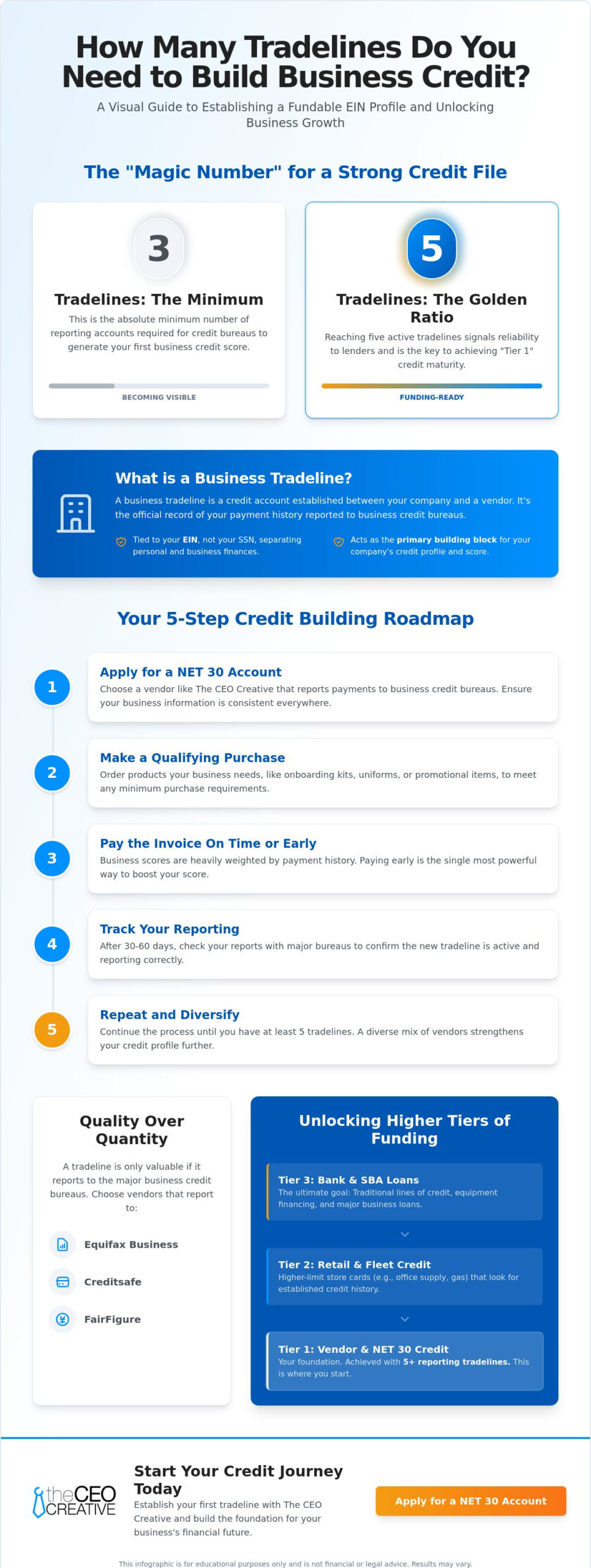
Determining the exact point where a business becomes “creditworthy” in the eyes of a lender often feels like a moving target. If you are asking how many tradelines do I need to build credit, the answer depends on your immediate goals. For most reporting agencies, three tradelines is the absolute minimum required to generate a business credit score. Without at least three distinct sources reporting your payment habits, your file remains essentially invisible to the algorithms that calculate risk.
While three accounts get you on the map, five tradelines represent the “Golden Ratio” for Tier 1 credit maturity. At this level, your business demonstrates a pattern of reliability across multiple vendors. This diversity proves that your company can manage various obligations simultaneously. If you stop at one or two accounts, you’ll likely face the “thin file” problem. Lenders often reject thin files because a single positive account doesn’t provide enough data to predict future behavior.
To secure larger lines of credit or traditional bank financing, you should eventually aim for a “thick file” containing ten or more active reporting accounts. This level of activity signals that your business is established and capable of handling significant financial responsibility. Starting with a manageable number allows you to focus on the quality of your payment history rather than just the quantity of accounts.
Tier 1 vs. Tier 2 Requirements
The journey to a robust profile starts with Tier 1 vendors. These are typically Net 30 accounts that don’t require a personal guarantee (PG). Establishing these first is a vital step as you establish business credit for the first time. Once you have three to five Tier 1 tradelines reporting consistently for at least 90 days, you can graduate to Tier 2. This tier includes store revolving cards from major retailers. These lenders will check your existing vendor history before approving your application, making your early tradeline count the gatekeeper to higher limits.
The Importance of Account Age
Opening several accounts at once might seem efficient, but account age is a heavy factor in your overall score. It’s better to keep your first few tradelines active for years than to constantly open and close new ones. Consistency is the key here. Make small, purposeful monthly purchases to ensure the vendor continues to report your activity. If you’re still wondering how many tradelines do I need to build credit, remember that five aged accounts are worth more than ten brand-new ones. A long-term strategy like The CEO Creative Membership serves as a permanent age builder for your profile. By maintaining an active account over time, you build a legacy of reliability that makes your business look stable to future financial partners.
Beyond the Number: Why Bureau Reporting and Diversity Matter
Reaching the “Golden Ratio” of five accounts is a significant milestone, but the quality of those accounts matters just as much as the quantity. If you are still wondering how many tradelines do I need to build credit that lenders respect, you must look at where that data is going. Not all vendors report to every bureau. A tradeline that only reports to one minor agency won’t help you qualify for a high limit loan at a major bank. True credit strength comes from visibility across the entire ecosystem.
Diversity is the next pillar of a mature file. While Net 30 accounts are the perfect starting point, lenders want to see that you can handle different types of debt. A robust profile mixes vendor tradelines with revolving store cards and service based tradelines like utilities or rent. This variety proves your business is versatile. Learning how to build business credit effectively involves balancing these different account types to create a well rounded financial picture. Consistency in your business information is also vital. Your business name, address, and phone number must match exactly across all accounts to ensure the bureaus can correctly link the data to your EIN.
The Business Credit Bureau Ecosystem
Equifax Business operates as a distinct entity from the personal Equifax bureau you likely already know. It focuses on financial data and trade credit, providing a more comprehensive view of your company’s health. Creditsafe plays a massive role in international and B2B credit verification, making it essential for companies looking to work with global suppliers. For modern tracking, FairFigure offers a streamlined way to monitor your scores across multiple bureaus in one place. Ensuring your vendors report to these specific agencies is the best way to maximize the impact of every purchase you make.
Common Mistakes When Building Tradelines
Even with the right number of accounts, small errors can stall your progress. Avoid these frequent pitfalls to keep your growth on track:
- Using a residential address: Lenders and bureaus prefer a registered business address; residential ones can trigger red flags.
- Failing to verify reporting: Never assume a vendor reports. Always ask which bureaus they notify before you apply.
- Paying exactly on the due date: In the business world, “on time” is late. Aim to pay 1 to 10 days early to boost your score.
- Rushing Tier 2 applications: Don’t apply for store cards until your Tier 1 accounts have reported for at least 90 days.
- Incorrect EIN attachment: Double check that your EIN is correctly linked to every account you open to ensure credit is attributed to your business.
By focusing on reporting accuracy and account diversity, you ensure that your answer to “how many tradelines do I need to build credit” results in a profile that actually converts into funding opportunities.
The Step-by-Step Roadmap to Adding Your First Tradelines
Building a business credit profile is a systematic process, not a one-time event. While you now know the answer to how many tradelines do I need to build credit, the actual implementation requires a disciplined approach. We call this the “Apply to Pay” loop. Before you start, your business must look professional on paper. This means having a dedicated business website and a professional email address. Lenders and vendors use automated systems to verify your legitimacy. If your setup looks like a hobby, your application might be flagged.
Focus on making small, practical purchases that your business actually needs. Large, one-time buys don’t build as much trust as consistent, monthly activity. For a deeper look at this strategy, see our guide on how to build business credit without a loan. Keeping your spending consistent allows you to manage cash flow while simultaneously strengthening your EIN history.
The 5-Step Credit Building Checklist
- Apply: Sign up for a Net 30 account using your EIN. Many Tier 1 vendors don’t require a personal guarantee.
- Order: Purchase essential office supplies or branded custom apparel for your team.
- Pay: Settle the invoice within the 30-day window. Paying early is even better.
- Track: Monitor your reports on Equifax and Creditsafe for the update.
- Repeat: Make a new purchase every 30 to 60 days to show consistent activity.
Maximizing Your “Payment Performance”
Your “Payment Performance” is a metric that reflects how quickly you settle debts. In systems like the Paydex score, paying exactly on the due date usually results in a score of 80. To reach a higher score, you should aim to pay at least 10 days before the deadline. Most vendors report monthly or quarterly. Your consistency over several months is what builds the “thick file” mentioned earlier. Keep a detailed tradeline log to ensure you never miss a payment window and can track which bureaus have received your data.
Ready to start your first loop? Apply for a reporting Net 30 account today to begin establishing your EIN history.
Building Your Foundation with The CEO Creative
Establishing a fundable business profile requires more than just opening accounts. It requires a partnership with vendors that understand your growth trajectory. The CEO Creative serves as a strategic Tier 1 reporting vendor, designed to help you bridge the gap between a new EIN and a robust credit history. By providing reporting Net 30 terms, we help you solve the core challenge: how many tradelines do I need to build credit that lenders actually trust? Our membership program streamlines this path by offering a consistent, recurring tradeline that bureaus like Equifax Business and Creditsafe recognize.
The journey from zero credit to a visible profile is about intentionality. You aren’t just buying items; you’re investing in your brand’s infrastructure. Whether you are a new LLC or an established agency, having a reliable reporting source allows you to focus on operations while your credit profile matures in the background. By the time you reach that “Golden Ratio” of five accounts, your business will have the professional tools it needs to succeed alongside a credit score that reflects your reliability.
Practical Products for Professional Brands
We believe every purchase should serve two purposes: improving your operations and building your credit. Our selection of customizable products, including engraved stationery and executive gifts, helps you maintain a professional image. Uniforms and promotional gear do more than just look good. They build a cohesive brand identity that signals stability to both customers and future lenders. If you’re just starting, you can even look into Logo Design for Business Credit to establish your visual identity while simultaneously adding a reporting tradeline to your file.
For businesses looking to stand out with unique corporate identity products and creative promotional gifts, you can discover Creaworks to explore high-quality options that support your brand’s professional growth.
What Happens Next After You Apply
Once you submit your application, the process moves quickly. Qualified EINs often receive a decision within one business day, allowing you to place your first order immediately. This first purchase is the catalyst. It triggers the reporting process to major business bureaus, officially putting your company on the map. As you maintain consistent, early payments, you build the necessary history to move beyond Tier 1. This foundation is what eventually allows you to qualify for Tier 2 store cards and high-limit revolving lines without needing a personal guarantee. The path to a thick file starts with a single, smart application.
Secure Your Business’s Financial Future Today
Reaching the “Golden Ratio” of five accounts is the most reliable way to transition from an invisible file to a fundable entity. You now have the roadmap to answer how many tradelines do I need to build credit with confidence. By focusing on reporting accuracy and consistent payment performance, you’ll create a foundation that supports your brand for years to come.
Take control of your company’s financial identity. Apply for a CEO Creative Net 30 Account and Start Building Your Tradelines Today.
What happens next:
- Submit your EIN-based application for a decision within one business day.
- Place an order for essential business products to trigger your first tradeline.
- Pay your invoice early to maximize your score across Equifax, Creditsafe, and FairFigure.
Building credit is a strategic move that elevates your brand while securing its future. Start by browsing our professional apparel, custom mugs, or engraved items to find products that serve your daily operations. Each purchase brings you closer to a robust, independent business credit profile.
Frequently Asked Questions
Do I need a personal guarantee to open a vendor tradeline?
You don’t typically need a personal guarantee to open Tier 1 vendor tradelines. These accounts are approved based on your business’s EIN and its legal formation rather than your personal FICO score. This allows you to protect your personal assets while building a separate financial identity. It’s a fundamental step for new LLCs and startups looking to establish credit without risking their personal financial standing.
How long does it take for a Net 30 vendor to report to the bureaus?
Most Net 30 vendors report to the business credit bureaus on a monthly or quarterly basis. You can usually expect to see your first reporting update within 30 to 60 days after you have fully settled your invoice. It’s important to ensure your business information is consistent across all applications to avoid delays in the data reaching your Equifax Business or Creditsafe reports.
Can I build business credit with just one tradeline?
You generally cannot build a functional business credit score with just one account. Most bureaus require a minimum of three distinct reporting sources before they generate a score for your EIN. This is why many founders ask how many tradelines do I need to build credit to look professional to lenders. Aiming for five active accounts provides the diversity and depth needed to qualify for higher limit Tier 2 revolving cards.
Does paying early help my business credit score more than paying on time?
Paying early significantly boosts your score compared to paying simply on the due date. In the business credit world, a score of 80 often represents “on time” payment, while scores of 90 or 100 are reserved for those who pay 10 to 20 days early. Since business scores focus heavily on payment performance, settling your debts ahead of schedule is the most effective way to demonstrate reliability.
Which business credit bureaus are the most important for new LLCs?
Equifax Business, Creditsafe, and FairFigure are the primary bureaus for modern small businesses. While Dun & Bradstreet is well known, many B2B vendors and alternative lenders rely on these agencies to verify your creditworthiness. By ensuring your vendors report to these specific bureaus, you maximize the impact of every purchase and build a profile that is visible to a wider range of financial partners.
What is the difference between a revolving tradeline and a vendor tradeline?
A vendor tradeline, such as a Net 30 account, requires you to pay the full balance within a set timeframe. A revolving tradeline allows you to carry a balance and pay a minimum amount each month. Lenders like to see both types on a credit report because it proves your business can manage both short term trade debt and long term revolving credit limits effectively.
Do Net 30 vendors report to personal credit bureaus?
Net 30 vendors do not report to personal credit bureaus like TransUnion or the personal side of Equifax. These accounts are strictly tied to your EIN and appear only on business credit reports. This separation is critical for business owners who want to avoid high credit utilization on their personal reports while funding the growth and operational needs of their developing companies.
What happens if I stop using a tradeline after the credit is built?
If you stop using a tradeline, the vendor may eventually stop reporting your activity to the bureaus. This can lead to a drop in your score or a return to a “thin file” status over time. To maintain a strong profile, you should make a small purchase every three to six months. Consistent activity ensures your accounts remain active and continue to contribute to your business’s credit age.
Building business credit? Open a Net 30 Account — EIN only, no personal guarantee, $60 minimum order, credit lines up to $5,500, a decision in one business day, and every on-time payment reported monthly to Equifax Business, Creditsafe and FairFigure.
The Four Categories of Tier 1 Vendor Tradelines
“Open more tradelines” is easier advice to follow once it’s clear what kinds of vendors actually count. Tier 1 net-30 accounts, the ones that approve on the EIN alone with no personal guarantee, generally fall into four categories. Office and business supplies is the most common starting point, since every business buys consumables regularly, which supports the repeat-purchase pattern bureaus want to see. Branded apparel and promotional products is a close second, useful for businesses that need uniforms, giveaways, or event materials anyway.
Business services and software subscriptions — things a company already pays for monthly, like certain SaaS tools or professional services — make up a third category, though fewer of these report to business bureaus than product vendors do, so confirming reporting matters more here than anywhere else. Shipping and packaging supplies round out the fourth category, relevant for any business that ships physical product regularly. Spreading tradelines across two or three of these categories, rather than opening several accounts within the same one, is what actually builds the diversity bureaus and lenders look for — five accounts that are all office-supply vendors reads very differently to an underwriter than five spread across categories.
Frequently Asked Questions
What counts as a 'good' tradeline for a new business?
A good starter tradeline is a vendor that approves based on the business EIN alone, doesn't require an existing credit history, and actually reports payment activity to a business bureau. Net-30 vendor accounts for supplies, apparel, or office products are the most common entry point because they're built specifically for a business with no prior credit file.
Do all tradelines count equally toward a business credit score?
No. A tradeline only helps if the vendor actually reports it, so an account with a supplier that doesn't report to any bureau builds no visible history at all, no matter how long the account stays open or how much is spent through it. Before opening an account specifically to build credit, it's worth confirming which bureaus that vendor reports to.
What's the best mix of tradelines for a new LLC?
A workable starting mix is 3-5 Tier 1 net-30 vendor accounts across a couple of different categories — supplies and apparel, for example — reporting to at least two of the major business bureaus, kept active for 90-plus days before applying for Tier 2 revolving accounts. Spreading accounts across vendor types tends to matter more than the sheer number opened.
How many net 30 tradelines should a brand-new business open in its first month?
Most guidance points to opening 2-3 in the first month rather than all 5 at once, since several new accounts opened simultaneously can look less stable than adding them gradually. Apply, order, and pay off one or two first, confirm they're actually reporting, then add the next. Spreading first purchases over 30-60 days also matches how vendors expect ongoing account activity to look.
The Tradeline Progression: Thin File to Thick File
| Tradelines Reporting | Stage | What It Typically Unlocks |
|---|---|---|
| 0–2 | Thin file | Usually not enough data for bureaus to generate a business credit score; the file reads as invisible to lenders |
| 3 | Minimum reporting threshold | The commonly cited floor for bureaus to begin generating a score at all |
| 5 | “Golden Ratio” for Tier 1 | A pattern of reliability across multiple vendors; a step toward Tier 2 store and revolving credit |
| 10+ | Thick file | Signals an established business capable of handling larger lines of credit or traditional bank financing |