

Did you know that fraud and scams cost American businesses and consumers a staggering $38 billion in 2025 alone? For a new LLC or a growing startup, the pressure to establish a credit file can make “guaranteed” overnight score increases look like a lifeline. The reality is that many of these offers are actually business credit building scams to avoid if you want to keep your company’s reputation and legal standing intact.
We understand the frustration of starting with a blank credit file and the anxiety that comes with trying to decode bureau reporting schedules. You deserve a clear, legitimate path to growth that doesn’t involve “gray area” tactics or legal risks. This guide will show you how to spot predatory credit repair schemes and replace them with a proven strategy. We’ll explore how verified Net 30 vendors and consistent reporting to Equifax and Creditsafe create a foundation for your long-term success.
Key Takeaways
- Identify major red flags and common business credit building scams to avoid, including illegal Credit Privacy Numbers and misleading shelf corporations.
- Discover the legitimate path to establishing a credit file by partnering with reporting Net 30 vendors that verify your payment history.
- Understand how consistent reporting to bureaus like Equifax and Creditsafe builds a foundation for securing larger lines of credit in the future.
- Learn to use practical business purchases, such as custom apparel or office supplies, to demonstrate financial reliability to creditors.
- Master a compliant five-step strategy to apply, order, and pay, ensuring your business growth remains sustainable and legally sound.
What is Legitimate Business Credit Building?
Before we dive into the mechanics of credit growth, keep in mind that this content is for educational purposes only and does not constitute financial or legal advice. Legitimate business credit building is the process of establishing a verified history of financial responsibility under your Employer Identification Number (EIN). Unlike personal credit repair, which often focuses on disputing errors, building business credit is about creating a fresh, positive paper trail. The CEO Creative serves as a reporting Net 30 vendor, providing a compliant way for startups and LLCs to establish their first tradelines through the purchase of essential business supplies.
The marketplace is unfortunately filled with bad actors using tactics found in common types of financial scams to exploit new entrepreneurs. By the end of this guide, you’ll know exactly how to identify these business credit building scams to avoid and how to implement a reliable 5-step growth plan. Our goal is to help you move from a blank file to a robust profile that attracts high-limit lenders and favorable terms.
Key Terms: NET 30 and Vendor Tradelines
A Net 30 account is a standard business credit arrangement where a vendor allows you 30 days to pay your full invoice balance after a purchase. This isn’t a loan; it’s an extension of trust. When a supplier reports this activity to the bureaus, it becomes a vendor tradeline. These tradelines are the building blocks of your corporate credit score. They prove to future creditors that your business can manage short-term debt and meet its obligations on time, every time.
The Role of Major Business Credit Bureaus
Your payment history only matters if the right people see it. Reporting to Equifax Business and Creditsafe is non-negotiable for serious growth. Creditsafe is a global leader in business intelligence, and Equifax is a primary source for traditional lenders. To stay on top of your progress, you can use the FairFigure platform to monitor your credit health and see how new tradelines impact your standing. Always ensure your business information, including your name, address, and phone number, is perfectly consistent across all platforms. Even a small typo can cause bureaus to create “split files,” which can hide your hard-earned progress from potential lenders.
Common Business Credit Building Scams to Avoid
Understanding the difference between legitimate growth and predatory schemes is vital for your company’s survival. The marketplace is unfortunately crowded with bad actors who exploit the ambitions of new entrepreneurs. The FTC has issued specific warnings on fraudulent funders that target small businesses with deceptive promises. Identifying these business credit building scams to avoid early on protects you from legal trouble and financial loss.
The Danger of CPNs and EIN Misuse
One of the most dangerous “solutions” marketed today is the Credit Privacy Number (CPN). Scammers often pitch these as federally backed numbers that can replace your SSN or EIN to hide a poor credit history. In reality, CPNs are frequently stolen Social Security numbers belonging to children or deceased individuals. Providing a CPN on a credit application is considered a felony and can lead to federal prosecution for mail or wire fraud. Legitimate vendors only require your verified EIN for business accounts. They don’t offer “new” identities; they help you build a reputable history for the identity your business already has. To ensure your business’s digital identity remains secure as you scale, you can visit Cloud Choice Technologies for professional managed IT and cybersecurity support.
Shelf Corporations and Aged Credit Myths
A shelf corporation is a business entity that was registered years ago and then left to sit “on a shelf” without any real activity. Scammers sell these aged shells for thousands of dollars, claiming they allow you to bypass the “new business” risk category. However, modern credit algorithms at bureaus like Equifax and Creditsafe are incredibly sophisticated. They can easily detect sudden changes in ownership and officer information. When a dormant EIN suddenly starts reporting high-limit tradelines under new management, it triggers immediate fraud alerts. Building your own history from scratch is safer, cheaper, and far more effective for long-term funding.
Beyond these major schemes, you should be wary of trade-line “rentals.” This involves paying a fee to be added as an authorized user on a stranger’s high-limit credit account. While this might show a temporary score bump, lenders view this as a deceptive “gray area” tactic. If a lender discovers you’ve rented a tradeline, they may blacklist your business permanently. Similarly, avoid any service that “guarantees” a specific Paydex score within a set timeframe. Since Paydex is a proprietary Dun & Bradstreet metric based on real payment data, no third party can ethically guarantee a specific number. Instead of looking for shortcuts, focus on applying for a legitimate Net 30 account that builds real trust through actual commerce.
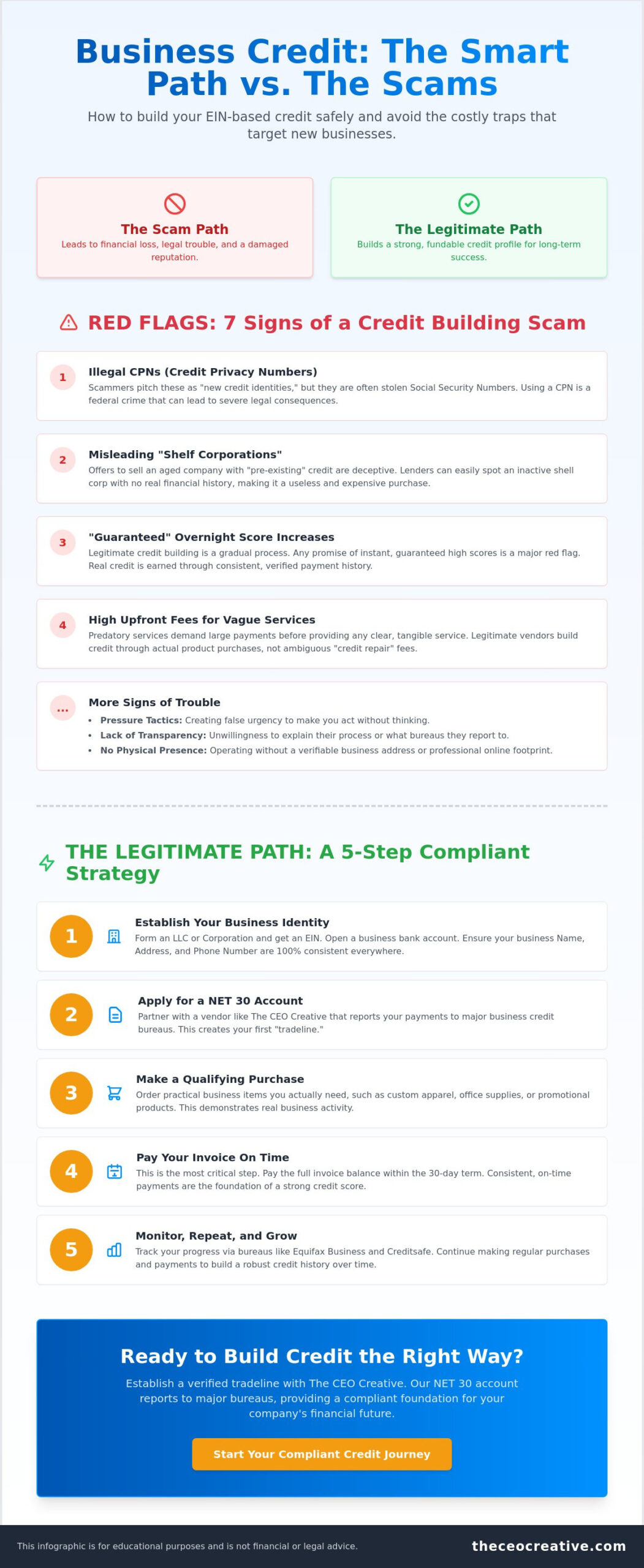
Red Flags: 7 Signs of a Credit Building Scam
Detecting a scam requires a sharp eye for detail. While building credit is a strategic move, rushing the process often leads to mistakes. The FTC guide to business scams highlights how bad actors target small entities with false promises. If a service provider demands high upfront fees for “consultation” before extending any credit, walk away. Legitimate vendors earn your trust through commerce, not by charging for the privilege of a conversation. Another major warning sign is when a company tells you to create a “new” identity using a different EIN or CPN. This isn’t a “secret strategy”; it’s a fast track to legal trouble.
Avoiding the “Quick Fix” Mentality
Any promise of an “instant” 800 score is a major red flag for fraud. Real credit growth is a marathon; it isn’t a sprint. Authentic business credit building takes consistent effort and verified payment history. Before signing up, verify a vendor’s physical presence and browse their product catalog. Legitimate companies like The CEO Creative offer tangible goods, such as office supplies or professional apparel, to ensure your spending is practical. You should always research a company on the Better Business Bureau (BBB) or check for recent FTC alerts to see if other owners have reported issues. These steps are essential to identify business credit building scams to avoid before they damage your reputation.
The Importance of Transparency in Reporting
Legitimate vendors are proud of their reporting partnerships. They’ll explicitly name partners like Creditsafe or Equifax. If a vendor is vague about where your data goes, they probably aren’t reporting at all. Be wary of anyone who refuses to provide a clear, written agreement or tries to hide their reporting schedule. You can verify if a Net 30 account is working by checking your reports after 30 to 60 days. If the account doesn’t appear, you aren’t building credit; you’re just spending money. Transparency is the hallmark of a partner that actually wants your business to succeed.
Common Mistakes to Avoid
- Using inconsistent business data, such as different addresses or phone numbers, across different applications.
- Ignoring the specific reporting schedule of your vendors, which leads to confusion about when scores update.
- Failing to pay invoices early or exactly on time, which is the most critical factor for a high Paydex score.
- Applying for too many accounts at once, as this can signal financial desperation to lenders.
- Attempting to dispute accurate negative information instead of focusing on building new, positive history.
- Neglecting to monitor your credit file on platforms like FairFigure to catch errors or identity theft.
- Mixing personal and business expenses, which muddies the legal separation of your LLC.
The Legitimate Path: Building Credit Step-by-Step
Once you’ve identified the business credit building scams to avoid, you can focus on a strategy that produces real results. Legitimate growth doesn’t happen through shortcuts or “gray area” tactics. It happens through documented trade history with suppliers who trust your business. By following a structured process, you build a profile that traditional lenders and credit card issuers will actually respect. Use this checklist to establish your foundation:
- Apply: Submit an application for a Net 30 account with a reporting vendor like The CEO Creative.
- Order: Place a professional order for items your business actually needs, such as office essentials or branded gear.
- Pay: Settle your invoice in full. Aim to pay early to maximize your score potential.
- Track: Monitor your business credit profiles with Creditsafe or Equifax Business to ensure the tradeline appears correctly.
- Repeat: Maintain a consistent pattern of ordering and paying to show long-term financial reliability.
Strategic Spending for New LLCs
For a new startup, every dollar should serve a dual purpose. Don’t just spend money to “buy” credit; invest in items that help your business operate. Focusing on practical items like onboarding kits, employee uniforms, and promotional gear keeps your records professional. High-quality customizable products allow you to build your brand identity while simultaneously establishing your credit file. It’s better to make small, consistent monthly purchases than one large, infrequent order. This steady activity creates a more reliable data set for the credit bureaus to analyze.
Managing Your Tradelines for Maximum Impact
Timing is everything when you’re managing vendor accounts. Paying your bill before the 30-day mark is a strategic move that can significantly boost your Paydex score. Most reporting systems reward early payments more heavily than those made exactly on the due date. Consistency is the other half of the equation. Ensure your business name, address, and phone number are identical on every application you submit. If you’re ready for more advanced tactics, check out our Net 30 Vendors 2026 Guide to learn how to scale your credit limits safely.
Ready to start your journey with a compliant partner? Apply for a Net 30 account today and begin building the credit profile your business deserves.
The CEO Creative: Your Partner in Compliant Credit Growth
Building a sustainable business requires more than just a dream; it requires a structured system of financial reliability. While the market is full of business credit building scams to avoid, The CEO Creative provides a transparent and compliant alternative. We function as a legitimate reporting Net 30 vendor, helping you establish a trade history through the purchase of products your business actually uses. By choosing a partner that values both your brand’s aesthetics and its underlying systems, you set yourself up for long-term success without resorting to “gray area” tactics.
The CEO Creative Membership is specifically designed for new startups and LLCs looking to grow with confidence. This membership provides immediate access to Net 30 terms, allowing you to build corporate credibility while accessing essential tools. For many founders, this starts with professional logo design and branding services. Establishing a strong visual identity is a strategic move that signals professionalism to both customers and future creditors.
Why Real Products Matter for Credit Building
Legitimate credit building is anchored in real-world commerce. Purchasing office supplies that your company needs for daily operations creates a natural paper trail of responsibility. Similarly, investing in Net 30 apparel helps create a unified, professional image for your team while strengthening your credit profile. As you consistently pay these invoices, you move through the ranks of Tier 1 vendors. This progress eventually opens doors to higher credit limits and more complex financial products without the need for personal guarantees.
What Happens Next After You Apply
We’ve simplified the onboarding process to match the fast-paced nature of the professional world. Here is what you can expect when you join our community:
- A Decision Within One Business Day: Submit your application with your verified EIN today.
- Order Fulfillment: Browse our catalog of high-quality branding tools and supplies, then have them delivered directly to your door.
- Monthly Reporting: We report your payment activity to major business bureaus like Equifax and Creditsafe, ensuring your hard work is visible.
Remember that building business credit is a marathon of consistency, not a sprint of shortcuts. Avoid the hype of unrealistic promises and focus on the practical, step-by-step growth that creates a lasting legacy. By partnering with a reliable mentor like The CEO Creative, you can navigate the logistical hurdles of management and keep your eyes on the visionary goals of your brand.
Build Your Corporate Legacy with Confidence
Now that you can confidently identify the business credit building scams to avoid, you are prepared to take the first step toward a verified financial future. Protecting your Employer Identification Number starts with choosing a partner that values compliance as much as you value growth. Beyond credit, ensuring your overall financial health through services like those from CTC Tax & Accounting can provide the bookkeeping and tax compliance needed to scale safely. By establishing legitimate tradelines today, you provide your business with the leverage it needs for tomorrow’s opportunities.
Apply for a CEO Creative Net 30 Account and Start Building Credit Today
What happens next:
- Application: Submit your business details for a decision within one business day using only your EIN.
- Selection: Choose from our catalog of essential branding tools and office supplies to place your first order.
- Growth: Pay your invoice on time and watch your positive payment history report to major bureaus.
Establishing credit is a strategic investment in your brand’s future stability and credibility. Start building your trade history now by selecting professional apparel, office supplies, or customizable products to anchor your first tradelines.
Frequently Asked Questions
Do I need a personal guarantee to build business credit with Net 30 vendors?
No, you don’t need a personal guarantee (PG) to build credit with Tier 1 vendors like The CEO Creative. Many suppliers allow you to open an account using only your EIN. This approach ensures your personal assets remain protected and separate from your company’s financial obligations. It’s a vital step for new LLCs that want to establish independent corporate credibility without risking the owner’s personal credit score.
How long does it take for a Net 30 account to show up on my credit report?
You can typically expect a Net 30 account to appear on your business credit report within 30 to 60 days. This timeline depends on the vendor’s specific reporting schedule and the bureau’s processing speed. Most vendors report once per month. If your payment isn’t reflected after two full reporting cycles, verify that your business name and address match your bureau files exactly to prevent split records.
Will paying my Net 30 invoice early improve my business credit score faster?
Yes, paying your invoices before the 30-day deadline is the most effective way to accelerate your score growth. Scoring models like the Dun & Bradstreet Paydex reward early payments more heavily than those made on the due date. For example, a payment made 10 days early signals higher financial stability than a payment made on day 30. This habit builds trust with future lenders and higher-tier suppliers.
Can I use a CPN to apply for business credit if my personal credit is bad?
No, you should never use a Credit Privacy Number (CPN) as it is a central element of business credit building scams to avoid. Using a CPN is considered federal fraud because these numbers are often stolen identifiers marketed as “new” social security numbers. Legitimate business credit is built using your legal EIN. This path is safer, compliant, and ensures your company’s financial history is usable for traditional bank funding.
What business credit bureaus does The CEO Creative report to?
The CEO Creative reports your payment history to Equifax Business, Creditsafe, and FairFigure. By reporting to multiple bureaus, we ensure your positive payment habits are visible to a broad range of creditors and financial institutions. This multi-bureau visibility is essential for building a well-rounded profile. It helps you secure better terms on equipment leases, business credit cards, and larger lines of credit as your company scales.
Is it possible to build business credit using only my EIN?
Yes, it’s entirely possible to build a robust credit profile using only your EIN by starting with Net 30 vendor accounts. These accounts don’t require a personal credit check or a personal guarantee. By making consistent, professional purchases and paying your invoices on time, you create a verified trade history. This history serves as the foundation for your business’s independent financial identity and its future ability to borrow.
What are the most common red flags of a business credit repair scam?
The most common red flags include demanding high upfront “consultation” fees or promising an instant 800 credit score. Be suspicious of any service that tells you to provide false information on a credit application or suggests creating a “new” identity. These are classic business credit building scams to avoid. Legitimate growth requires real commerce and transparent reporting from established suppliers who provide tangible goods or services.
How many tradelines do I need to get a high Paydex score?
You need at least three reported tradelines to generate a Paydex score, but five to ten active accounts are better for a strong profile. Lenders look for a consistent pattern of payment across multiple vendors to assess your risk level. Having a diverse set of tradelines from different categories, such as office supplies and apparel, demonstrates that your business can manage various types of financial obligations responsibly.
Why do some vendors refuse to report to the credit bureaus?
Some vendors don’t report because of the high administrative costs and strict compliance standards required by the bureaus. Reporting is a voluntary process, and many smaller suppliers choose to skip it to save time and money. If your goal is to build credit, always confirm that a vendor is a “reporting vendor” before you place your order. Otherwise, your on-time payments won’t help your score.
Can I build business credit as a brand new LLC with no revenue?
Yes, you can begin building business credit as a brand new LLC even before you generate your first dollar in revenue. Tier 1 vendors like The CEO Creative approve accounts based on your business’s legal formation rather than your monthly sales. By starting early with small, essential purchases like onboarding kits or uniforms, you establish a credit file that will be ready when you eventually apply for larger financing.
Building business credit? Open a Net 30 Account — EIN only, no personal guarantee, $60 minimum order, credit lines up to $5,500, a decision in one business day, and every on-time payment reported monthly to Equifax Business, Creditsafe and FairFigure.