

Banks often reject up to 80% of new business applications because of a lack of documented history. This “thin file” problem makes it nearly impossible for startups to secure the funding they need to grow. If you’re wondering how to make a new business look credible to lenders, the solution isn’t just about your bank balance. It’s about building a foundation that signals professional reliability from day one.
You’ve likely felt the frustration of being told your business doesn’t exist in the eyes of major credit bureaus. At The CEO Creative, we act as a reporting NET 30 vendor to help you bridge this gap and establish the history you need. This guide shows you the exact steps to build a verified credit profile and a brand identity that lenders trust. We’ll cover everything from maintaining consistent business data to strategic vendor reporting so you can stop being a risk and start being a partner.
Key Takeaways
- Transform your “paper-only” LLC into a lender-ready entity by establishing a verified credit history through reporting Net 30 vendor accounts.
- Discover how to make a new business look credible to lenders by combining a professional visual identity with consistent data across all credit bureaus.
- Master the mechanics of credit reporting to Equifax, Creditsafe, and FairFigure to ensure your on-time payments are properly documented and matched to your file.
- Leverage strategic purchases of office supplies and custom branding to signal stability and operational maturity to potential financial partners.
- Follow a clear five-step checklist to apply, order, and pay your way toward a robust business credit profile while avoiding high-risk application mistakes.
What Makes a Business Credible? The CEO Creative Approach
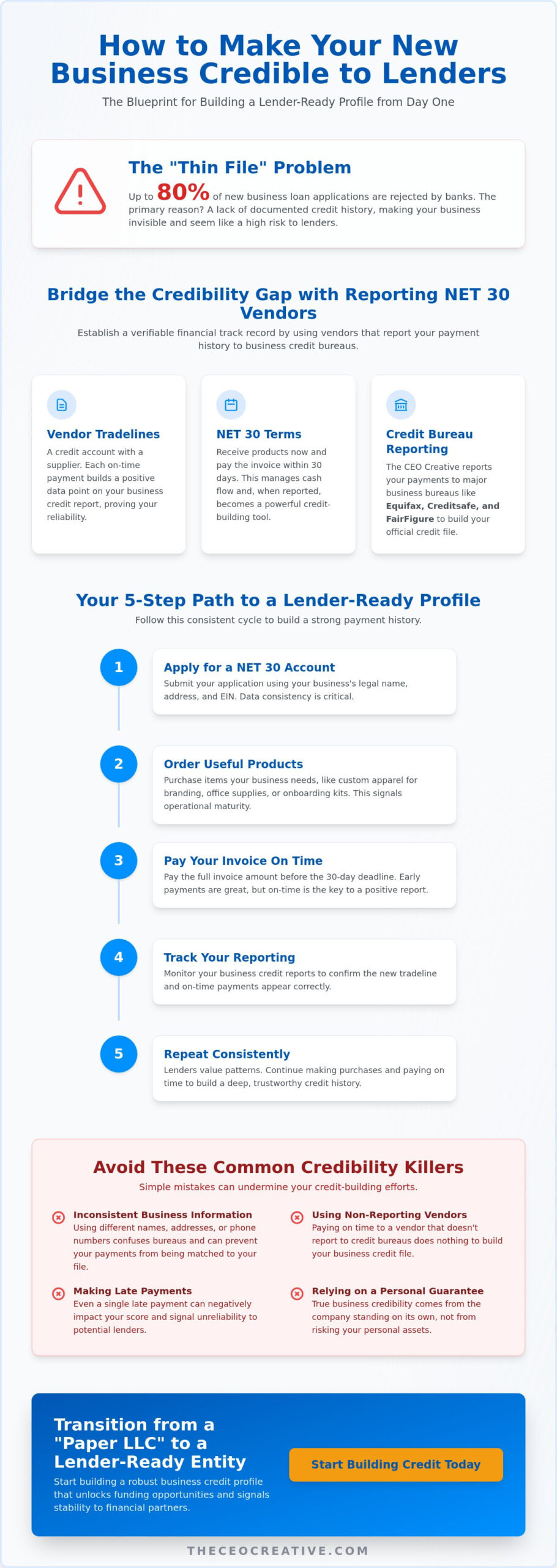
Lenders don’t just look at your bank account; they look for proof that you’ve managed debt before. Statistics show that banks often reject up to 80% of new business applications due to a lack of documented credit history, often called a “thin file.” The CEO Creative bridges this gap by acting as a reporting Net 30 vendor. We provide the tools to help you build a professional brand while simultaneously creating the credit history banks require. This content is for educational purposes only and does not constitute financial or legal advice. By following this guide, you’ll learn how to transition from a “paper-only” LLC to a lender-ready entity.
A foundational piece of this puzzle is the vendor tradeline. This is essentially a credit account with a supplier that reports your payment activity to business credit bureaus. Without these tradelines, your business lacks a professional credit score, which is usually the first metric a lender evaluates. Establishing these lines is a primary step in understanding how to make a new business look credible to lenders. It shows you can handle professional obligations without relying on personal funds.
Defining Net 30 and Payment Reporting
Net 30 terms are a straightforward financial tool. You receive products or services today and pay the full invoice within 30 days. It’s a short-term credit line that helps manage cash flow while you grow. However, these terms only benefit your credit profile if the vendor actually reports your payment history. Many retail companies offer terms but keep that data private, which does nothing for your long-term fundability.
When you apply for a business Net 30 account, you’re working to build credit using your EIN only. This is a critical distinction from a personal guarantee. With a personal guarantee, your own assets are at risk if the business can’t pay. True business credibility comes from the business standing on its own. Consistent, reported payments are the lifeblood of this independence. They prove to lenders that your entity is stable, organized, and worthy of larger capital injections.
The Mechanics of Net 30 Accounts and Credit Bureau Reporting
Credibility isn’t a feeling; it’s a data set. Lenders use automated systems to scan your business credit reports before a human ever sees your application. To understand how to make a new business look credible to lenders, you must understand how data moves from a vendor to a bureau. The CEO Creative reports your payment activity to Equifax, Creditsafe, and FairFigure. This reporting happens on a consistent monthly schedule. Lenders look for a pattern of behavior, not just a single transaction. This is why a reporting schedule matters.
When you establish business credit, data consistency is your most valuable asset. If your business name, address, or phone number varies across different accounts, bureaus may fail to match the data to your file. This creates “fragmented” files. These fragments make your business look disorganized or high-risk to automated underwriting systems. We make no guarantees regarding specific credit score increases. Many factors influence your final rating. However, building “credit depth” through multiple reporting tradelines is a proven way to demonstrate a lower risk profile. Lenders want to see that you can manage multiple obligations simultaneously.
Understanding Equifax Business and Creditsafe
Many entrepreneurs confuse their personal Equifax file with their Equifax Business report. They’re entirely separate. While personal scores focus on individual habits, Equifax Business tracks your entity’s payment trends and public records. Creditsafe is another heavy hitter. Modern lenders often prefer Creditsafe because it provides real-time risk assessment. Understanding these differences is key to learning how to make a new business look credible to lenders who use diverse data sources. Creditsafe offers a more dynamic view of a company’s stability than older, static reporting models.
The Role of FairFigure in Credit Monitoring
FairFigure acts as a central hub for monitoring your financial health. It provides a clear view of how your tradelines are performing across multiple bureaus. By using tools like this, you can track your progress and ensure your data is accurate. Monitoring your file helps you catch errors early. Inaccurate data can stall your progress for months. If you’re ready to start building this history, you can apply for a business Net 30 account to begin the reporting process. Consistent reporting is the engine that drives your fundability.
Professional Branding: Why Logos and Custom Apparel Signal Stability
Lenders often perform due diligence that goes beyond your credit report. They check your website, social media, and even the physical appearance of your team during meetings. Understanding how to make a new business look credible to lenders involves presenting a cohesive brand identity that signals stability. A professional logo and a functional website prove that you’ve invested in your operation. This visual proof complements your financial data. When you work to meet SBA loan eligibility requirements, your branding acts as the face of your creditworthiness.
Using Net 30 terms to purchase customizable products creates a strategic advantage. You aren’t just buying supplies; you’re building a tradeline. This double win allows you to acquire necessary business assets while reporting positive payment history to bureaus. If you’re still using a generic template for your identity, consider professional logo design services. It’s a strategic move that ensures your business doesn’t look like a temporary hobby project.
The psychological impact of branded gear is significant. When a lender visits your site or joins a video call, seeing a team in branded apparel creates an immediate sense of permanence. It suggests that your business has the systems in place to support employees and maintain a professional standard. This level of detail can be the deciding factor when an underwriter reviews a borderline application.
Practical Merch for Credibility Building
Branded items create an atmosphere of an established operation. Onboarding kits that include custom mugs, notebooks, and stationery give your office a professional feel. For businesses that require more specialized physical branding, such as custom-cut acrylic signs or wood displays, partnering with experts like CNC Cut to Size can help create a high-end environment that impresses both clients and lenders. This is especially important if you have a physical location or conduct video calls with financial partners, showing you’re prepared for growth and take your brand seriously.
Uniforms and Net 30 apparel take this a step further. They signal that you have a team based, organized structure. Consistent branding across promotional items like pens and drinkware proves business intent. It shows lenders you’re thinking about long term growth and market presence. These tangible assets are part of the answer to how to make a new business look credible to lenders by showing you have skin in the game.
Your 5-Step Checklist to Establishing Lender-Ready Tradelines
Establishing credit is a repetitive cycle. It isn’t a one-time event. To master how to make a new business look credible to lenders, you must move beyond the setup phase and into active management. Lenders want to see that you can handle recurring debt responsibly. This five-step checklist provides a repeatable framework to build the credit depth discussed in previous sections.
- Step 1: Apply for an account. Submit your application for a business Net 30 account. Use your EIN and ensure your business details match your Secretary of State filings exactly.
- Step 2: Order essential products. Purchase items your business actually needs, such as office supplies or branding materials. Practical spending signals a legitimate operation.
- Step 3: Pay your invoice early. Process your payment as soon as the invoice is generated. While Net 30 gives you a month, paying early reflects even better on your internal risk rating with the vendor.
- Step 4: Track your reporting. Monitor your profile through Creditsafe or FairFigure. This confirms that the vendor has successfully transmitted your data to the bureaus.
- Step 5: Repeat the process monthly. One tradeline is a start. A pattern of six to twelve months of on-time payments is a foundation. Consistency is what separates a startup from an established entity.
Maintaining Business Info Consistency
Data matching is the most common hurdle for new LLCs. If your phone number or suite address varies even slightly between accounts, the bureau’s automated system might not see the payment. This ghosting of your credit history can stall your progress for months. Always use a professional business email address. Generic Gmail or Yahoo accounts often trigger fraud alerts in high-tier lender systems. A professional domain signals that you are a serious organization with a long-term vision.
Managing these details can become complex as you add more vendors. A CEO Creative Membership streamlines this recurring process by providing a central platform for your branding and credit-building needs. It helps you maintain the rigorous consistency required to understand how to make a new business look credible to lenders at scale. If you are ready to move from planning to action, apply for a business Net 30 account today and start your first reporting cycle.
Common Mistakes That Kill Credibility with Lenders
Even the most promising startups can fail the underwriting process due to avoidable errors. If you’re learning how to make a new business look credible to lenders, you must treat your credit profile with the same precision as your tax filings. Small oversights signal high risk to automated systems. Lenders aren’t just looking for wealth; they’re looking for professional discipline. Avoid these common pitfalls to keep your applications in the “approved” pile.
- Premature high-tier applications: Don’t apply for major bank cards like Amex or Chase before you’ve established Tier 1 vendors. Without a foundation, these result in instant rejections and unnecessary hard inquiries.
- Late payments: Business credit is unforgiving. A single payment made even one day late can tank your score and stay on your report for years. Always pay early to be safe.
- Inconsistent naming: Ensure your business name is identical across all platforms. Switching between “ABC Services LLC” and “ABC Services” can cause bureaus to create fragmented files that don’t show your full history.
- Residential addresses: Many lenders flag home addresses as a sign of an unstable or temporary operation. Using a commercial address or a professional virtual office provides a more established image.
- Neglecting visuals: If a lender searches for your business and finds no logo or professional website, they see a hobby rather than a company. Visual presence is a key part of how to make a new business look credible to lenders in a digital-first economy.
How to Fix a ‘Thin’ Credit File
If you’ve been rejected because of a “thin” file, it simply means you don’t have enough data points. One or two tradelines aren’t enough to prove you’re a safe bet. Many industry professionals follow the “Rule of Five” for lender readiness. This suggests that you should have at least five active, reporting tradelines before you approach a bank for significant capital. These five accounts show a diverse and consistent ability to manage debt across different categories.
Start by mastering Tier 1 vendors like The CEO Creative. Once you have a solid three to six months of on-time history, you can begin moving toward Tier 2 vendors, which often include store credit cards or fuel accounts. This progression builds the depth required for high-limit funding. For a deeper dive into this strategy, read our full guide on How to Build Business Credit Without a Loan. Building credit is a marathon, not a sprint, and following a structured path is the only way to ensure long-term success.
Take Control of Your Business Fundability
Building a fundable entity requires more than just a registered name; it demands a strategic alignment of professional branding and verified credit data. You’ve seen that consistency in your business information and a professional visual presence are non-negotiable for modern underwriters. Learning how to make a new business look credible to lenders gives you the leverage needed to scale without relying on personal assets. Credibility is earned through action, and consistency is your greatest asset.
The CEO Creative supports this journey by providing fast-decision options for new LLCs and startups with no personal guarantee required for Net 30 terms. We report your activity to Equifax, Creditsafe, and FairFigure to ensure your growth is documented where it matters most. Your path to sustainable business credit starts with a single, reported purchase that signals stability to the entire financial industry.
Apply for a CEO Creative Net 30 Account Today
What happens next:
- Submit your application using your EIN for a decision within one business day consideration without a personal guarantee.
- Select your initial branding or office essentials from our catalog to establish your first reporting tradeline.
- Pay your invoice on time to trigger the reporting process to Equifax, Creditsafe, and FairFigure.
Establishing a professional identity through reporting vendor accounts is the most effective way to secure your company’s financial future. Start building your foundation today by browsing our collections of custom mugs, branded apparel, or engraved items to signal stability to every lender you encounter.
Frequently Asked Questions
Do I need a personal guarantee for a Net 30 account?
No, many Tier 1 vendors like The CEO Creative offer Net 30 accounts based on your business EIN alone. This allows you to build credit without linking your personal assets or social security number to the debt. It’s a foundational step for separating your personal and professional financial identities. This structure protects your personal credit score while your business establishes its own independent history.
How long does it take for a tradeline to show up on my business credit report?
Most vendors report to the bureaus once per month, usually at the end of the billing cycle. Depending on when you make your purchase and the bureau’s processing speed, it typically takes 30 to 60 days for a tradeline to appear on your report. Consistency in your monthly orders ensures that your file stays active and updated. You should monitor your profile regularly to verify that the data is accurate.
Does paying early help my business credit score more than paying on the due date?
Yes, paying early can positively impact your business credit score, specifically your Dun & Bradstreet PAYDEX score. While paying on time is the minimum requirement for a good rating, many scoring models reward businesses that settle invoices 10 to 15 days before the due date. This proactive behavior signals lower risk and higher liquidity to future lenders. It proves you have the cash flow to manage obligations comfortably.
Which credit bureaus does The CEO Creative report to?
The CEO Creative reports your payment history to Equifax Business, Creditsafe, and FairFigure. By reporting to multiple bureaus, we ensure that your positive payment behavior is visible to a wide range of lenders who use different data providers. This multi-bureau approach is a key part of how to make a new business look credible to lenders who value diverse data sets. It ensures your efforts aren’t wasted on a single, isolated file.
Can I build business credit with just an EIN and no SSN?
Yes, you can build business credit using just your Employer Identification Number (EIN). By working with vendors that offer EIN-only approval, you establish a credit file for your business entity itself. This process is essential for learning how to make a new business look credible to lenders without relying on your personal credit history or individual social security number. It effectively separates your personal liabilities from your corporate growth.
What happens if I miss a payment on a Net 30 account?
Missing a payment can result in late fees and negative reporting to the credit bureaus. Unlike personal credit, which often has a 30-day grace period, business credit bureaus may record a payment as late if it is even one day past the due date. This can lower your score immediately and signal a lack of operational discipline to potential financial partners. Don’t forget to set reminders to ensure your invoices are cleared well before the deadline.
Is a logo really necessary for lender credibility?
A logo is necessary because it functions as a visual marker of an established and serious operation. Lenders often perform social underwriting by checking for a professional web presence and consistent branding. A business without a logo or professional identity often looks like a temporary project, which increases the perceived risk during the loan application process. Investing in your brand’s aesthetics proves that you’re committed to long term sustainability; for professional B2B site development with a global reach, you can check out Cheerway to enhance your digital credibility.
How many Net 30 accounts do I need to look credible to a bank?
Most experts recommend having at least five active, reporting tradelines to establish a thick credit file. Banks look for a variety of accounts to prove that you can handle different types of obligations simultaneously. Starting with Tier 1 vendors and consistently adding more accounts over six to twelve months builds the credit depth required for larger financing options. It shows a mature pattern of behavior that automated underwriting systems can easily verify.
Building business credit? Open a Net 30 Account — EIN only, no personal guarantee, $60 minimum order, credit lines up to $5,500, a decision in one business day, and every on-time payment reported monthly to Equifax Business, Creditsafe and FairFigure.