

Does your company feel like a legitimate entity, or does it still feel like a side project tied to your personal social security number? That transformative feeling of legitimacy with first business credit approval is a major milestone that separates hobbyists from true CEOs. It’s the moment you realize your brand can stand on its own two feet without you acting as the personal guarantor for every routine operational expense. Many entrepreneurs struggle with the “fake it till you make it” phase, but seeing your business name recognized by a creditor changes your entire perspective on professional growth.
We understand the hesitation that comes with confusing bureau reporting and the underlying fear of risking your personal credit score. You want to see your company’s name on a business credit report, not just on a business card. This strategic guide will show you how to unlock both the psychological and financial power of your first approval by leveraging Net 30 vendors. We’ll walk through the exact steps to secure a Net 30 account, establish your professional brand identity, and finally see that first tradeline appear on your business credit file.
Key Takeaways
- Understand how moving beyond a simple EIN to your first approval creates a psychological shift and establishes true corporate credibility.
- Experience the transformative feeling of legitimacy with first business credit approval by using Net 30 vendors that report to major credit bureaus.
- Learn how to bypass personal guarantees and solve the “no credit file” problem through strategic vendor tradelines.
- Follow a clear 5-step process involving application, ordering, and consistent payment to build a robust business credit profile from scratch.
- Discover how purchasing practical items like uniforms or onboarding kits reinforces your brand identity while strengthening your creditworthiness.
Beyond the EIN: Why Your First Business Credit Approval Matters
Obtaining your Employer Identification Number (EIN) is a simple administrative task, but it doesn’t automatically make your business feel real. For many entrepreneurs, the shift from “side hustle” to “legitimate corporation” only happens when an outside institution recognizes the company’s creditworthiness. The CEO Creative operates as a reporting Net 30 vendor specifically designed to facilitate this transition. We provide the tools and credit terms that help startups establish a footprint in the financial world. That specific feeling of legitimacy with first business credit approval acts as a professional rite of passage, signaling that your entity can sustain itself independently.
Trust Note: This content is provided for educational and informational purposes only. It does not constitute financial or legal advice. The CEO Creative makes no guarantees regarding specific credit score increases or future lending outcomes.
Defining the Core Terms: Net 30 and Tradelines
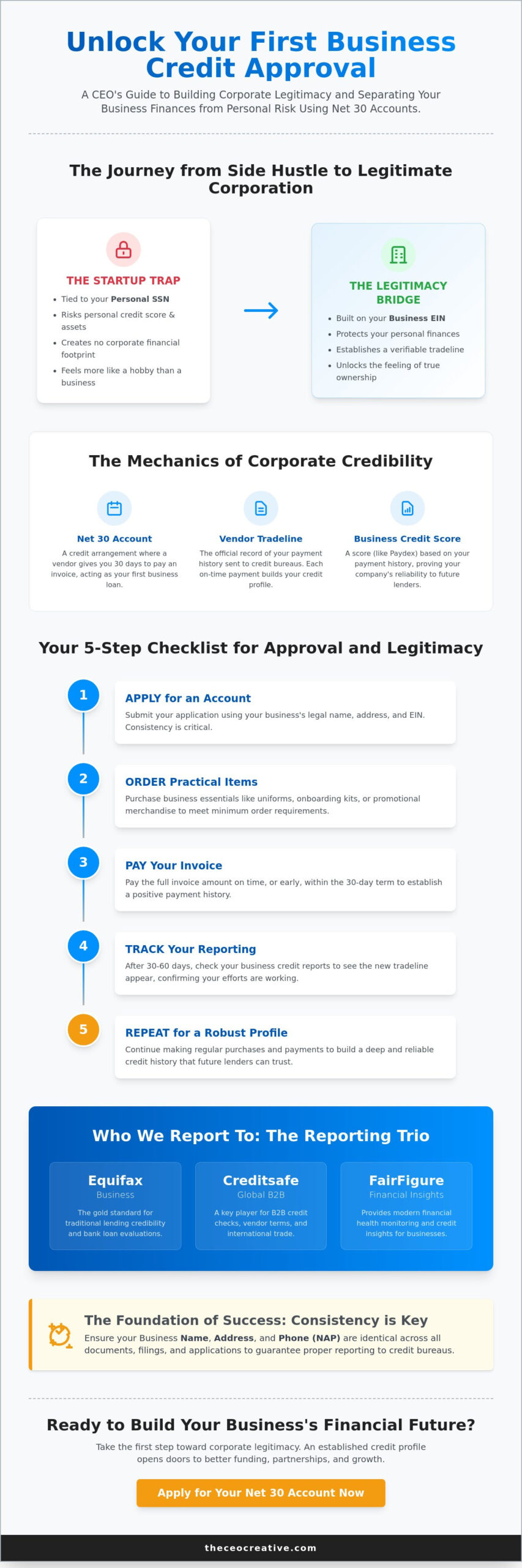
Building a solid foundation requires understanding what business credit reports are and how they differ from personal ones. A Net 30 account is a credit arrangement where a vendor allows you 30 days to pay for business essentials after the invoice date. When you pay that invoice, the vendor reports the activity as a “vendor tradeline.” This tradeline is the actual data entry on your credit file that proves you’re a reliable borrower. Unlike personal credit, which relies on your Social Security number, business credit is tied directly to your EIN, protecting your personal assets from company liabilities.
The “Feeling of Legitimacy” as a Growth Catalyst
Securing that first approval provides more than just a line of credit; it provides confidence. When a vendor trusts your business enough to extend terms, it validates your hard work. This external validation is a powerful growth catalyst. It moves you out of the “no credit file” trap and builds the history needed to access Tier 2 and Tier 3 credit, such as bank loans or high-limit corporate cards. By using a business net 30 account, you elevate routine operational purchases into strategic moves. You aren’t just buying supplies; you’re actively constructing a financial reputation that will serve your company for years to come.
The Mechanics of Corporate Credibility: How Reporting Works
Credibility isn’t just a vague concept; it’s a measurable data set. To establish business credit, you must move beyond simple transactions and into the world of verifiable reporting. When a Net 30 vendor reports your payment history, they’re essentially vouching for your company’s financial discipline. This external confirmation is what creates the feeling of legitimacy with first business credit approval. It transforms your private payment habits into a public record that other lenders can trust. You aren’t just a customer anymore; you’re a verified corporate entity with a growing financial reputation.
Consistency is the primary driver of successful reporting. Your business name, physical address, and phone number (NAP) must be identical across every application and utility bill. If your Secretary of State filing includes “Inc.” but your vendor account omits it, the credit bureaus might fail to link the data to your file. As a business owner, you should use your executive title to oversee these procurement strategies. Managing these small operational details ensures that every invoice you pay acts as a foundational block for a healthy Paydex score. High-level leadership involves making sure the underlying systems of the business are working in your favor.
The 2026 Reporting Trio: Equifax, Creditsafe, and FairFigure
Data reporting in 2026 relies on a few heavy hitters. Equifax Business remains a gold standard for traditional lending credibility, often serving as the first stop for banks evaluating loan applications. Creditsafe provides a global corporate footprint, making your business visible to international partners and high-level suppliers. For modern monitoring, FairFigure offers the tools necessary to track your progress and see exactly how your tradelines are maturing. These three bureaus provide a comprehensive view of your company’s creditworthiness, ensuring that your hard work is visible to the right institutions.
Reporting Schedules and Data Points
Understanding the monthly data cycle is vital for strategic growth. Most Net 30 vendors batch their data and report to the bureaus once every thirty days. During this process, they share specific data points including your total credit limit, current balance, and payment speed. While a Net 30 agreement gives you a full month to pay, settling your debt early can significantly improve your internal vendor rating. Paying five to ten days before the deadline signals extreme reliability and fiscal health. This proactive approach helps you build a robust profile much faster. If you’re ready to start generating these data points, you can apply for a business net 30 account to begin your reporting journey today.
Bridging the Gap: Solving the “No Credit File” Problem
The biggest hurdle for new entrepreneurs isn’t a lack of ambition; it’s a lack of history. Most traditional lenders look at a blank business credit file and see risk. This creates a frustrating cycle where you need credit to build credit. Breaking this loop is the primary goal of the CEO Creative Membership. By providing an accessible reporting tradeline, we help you overcome the “no credit file” objection. That initial feeling of legitimacy with first business credit approval replaces imposter syndrome with a sense of corporate authority. You’re no longer just a person with an idea. You’re a CEO managing a recognized financial entity.
Building this authority requires a shift in how you fund operations. You don’t need a high-revenue track record to start. Instead, you need structured systems that prove your reliability to the bureaus. Whether you are managing a retail shop or a specialized service like Wicked Conjures, this transition from being a founder-funded startup to a business-credited organization is a vital step toward long-term sustainability. It allows your company to build its own reputation while you focus on scaling your services or products.
Establishing Tradelines Without a Personal Guarantee
Protecting your personal assets is a non-negotiable part of professional risk management. Many beginners make the mistake of using a personal guarantee (PG) for every small loan or credit card. This ties your personal credit score to your business’s performance. By using Net 30 vendors that offer EIN-only assessments, you allow your business’s tax ID to act as its own “social security number.” This structure helps you build business credit quickly without exposing your personal savings to company liabilities. It’s the cleanest way to separate your private life from your corporate responsibilities.
The Strategic Use of Vendor Accounts
Success in credit building comes from consistency rather than scale. A common mistake is waiting for a massive purchase to use credit. In reality, bureaus prefer to see a history of small, on-time payments. Selecting vendors that provide essential items like office supplies or branding materials allows you to build credit through routine spending. You’re already buying these items; you might as well get credit for them. For a deeper dive into these strategies, check out our How to Build Business Credit Without a Loan: The 2026 Guide. Consistent reporting on these everyday items creates a “thick” credit file that attracts larger lenders in the future.
Your 5-Step Checklist for Approval and Legitimacy
Building a corporate reputation requires a repeatable process. You don’t need a complex strategy to start; you need a disciplined one. Following a structured checklist ensures that your efforts result in a visible, positive impact on your business credit profile. Nothing beats the feeling of legitimacy with first business credit approval after you see your first reported tradeline. This milestone proves your company is ready for higher levels of financial responsibility. Follow these five steps to secure your first approval and begin your credit-building journey.
- Apply: Submit your application for a Net 30 account using your accurate EIN data.
- Order: Purchase practical business items such as onboarding kits, uniforms, or promotional materials to keep your spending consistent and professional.
- Pay: Settle your invoice in full before the 30-day deadline. Early payments often lead to better internal ratings.
- Track: Monitor your credit file through platforms like FairFigure or Creditsafe to ensure the tradeline is reported correctly.
- Repeat: Continue this cycle for at least 90 days. Consistency is the key to score stability and future growth.
Step-by-Step Application Mastery
Accuracy is your most valuable asset during the application phase. You must ensure your business name matches your Secretary of State filing exactly, including any punctuation or abbreviations. Lenders and bureaus look for data consistency to prevent fraud and errors. Additionally, using a professional business email domain and a dedicated business phone line signals that you’re an established entity. If you’re ready to take this step, you can Apply for a Business Net 30 Account to start building your profile today.
Common Mistakes to Avoid (The “Red Flag” List)
Even small errors can delay your progress or lead to a rejection. Avoid these common pitfalls to maintain a clean trajectory toward the feeling of legitimacy with first business credit approval and long-term financial health:
- Using a personal Gmail or Yahoo account instead of a professional business domain.
- Inconsistent address formatting, such as using “Suite” on one application and “Ste.” on another.
- Paying exactly on day 30. Aiming for day 25 is safer and demonstrates better cash flow management.
- Applying for too many Tier 1 vendors in a single week, which can look like credit desperation.
- Neglecting to verify if the vendor actually reports to the specific bureaus you’re targeting.
- Failing to update your business information with the bureaus if you move or change your phone number.
By avoiding these mistakes, you protect your company’s emerging reputation. High-level procurement requires attention to detail. Treat every application and invoice as a strategic move toward your company’s ultimate scalability.
Leveraging Your Legitimacy: Branding and Scaling
Legitimacy is a dual track process. Your credit file proves your reliability to bureaus, while your brand identity proves it to your clients. When you connect customizable products to your corporate image, you create a cohesive professional presence that signals stability. A professional logo design does more than look good; it increases your perceived creditworthiness in the eyes of partners and high-level vendors. Using your Net 30 terms to stock up on apparel for your team is a strategic double win. You’re building your brand while simultaneously building your credit file. This synergy is what truly solidifies the feeling of legitimacy with first business credit approval.
Product-Focused Credit Building
Success in credit building often comes from integrating financial growth with operational needs. Uniforms, branded stationery, and promotional items are “safe” credit-building expenses because they serve a clear business purpose. Using custom notebooks and pens helps create a legitimate office environment that impresses clients and keeps your team organized. These aren’t frivolous costs. They’re investments in your company’s infrastructure. By purchasing these through a reporting vendor, you ensure every dollar spent on marketing also works to strengthen your financial standing. For a broader look at how to select the right partners for this journey, see our Net 30 Vendors 2026: The Ultimate Guide.
The Future of Your Business Credit
Your first approval is a gateway, not a destination. Once you’ve established a solid history with Tier 1 vendors, you’ll find it much easier to graduate to Tier 2 retail credit and eventually Tier 3 bank financing. That initial feeling of legitimacy with first business credit approval is just the beginning of your company’s financial evolution. A strong initial file, built on consistent payments and professional procurement, eventually leads to unsecured business lines of credit and higher lending limits. These tools provide the capital necessary to scale your operations, hire more staff, and dominate your market. You aren’t just buying products today; you’re buying a corporate future with unlimited potential.
The CEO Creative remains dedicated to this dual-growth model. We believe that building a brand and building a credit file should happen in tandem. By providing the essential tools for branding alongside the reporting power of a Net 30 account, we help entrepreneurs bridge the gap between a startup idea and a recognized corporate entity. Stay focused on your reporting schedule, maintain your business information consistency, and continue to use your credit lines for practical, professional growth—whether that’s through marketing materials or enhancing your office environment with quality products from VentCoverCreations.com.
Take the Next Step Toward Your Corporate Future
Transitioning from a startup to a recognized business entity requires a strategic approach to financial reporting. By establishing vendor tradelines, you protect your personal assets and build a public record of reliability. This process provides that unmistakable feeling of legitimacy with first business credit approval, confirming that your company is ready to scale. You’ve learned how to navigate the reporting mechanics of bureaus like Equifax and Creditsafe while using professional branding to boost your corporate image. These foundational steps ensure your company isn’t just a project, but a sustainable organization with its own financial identity.
Ready to move beyond the EIN? Apply for your Net 30 account and start building legitimacy today. Our membership reports to Equifax, Creditsafe, and FairFigure, providing the visibility you need without requiring a personal guarantee. You’ll also gain instant access to high-quality office supplies and custom branding tools to keep your operations professional and consistent. Your journey from a simple tax ID to a robust credit profile starts with a single reported payment. Stay focused on your goals, and watch your business’s potential expand as you build a future of financial independence.
Frequently Asked Questions
Do I need a personal guarantee for a Net 30 account?
You don’t need a personal guarantee to open a Net 30 account with the CEO Creative. We offer EIN-only assessments that allow your business to stand on its own financial merits. This structure protects your personal credit score while you build your corporate footprint. By avoiding a personal guarantee, you ensure that business liabilities remain separate from your private assets.
How long does it take for a Net 30 account to show up on my credit report?
Most tradelines appear on your business credit report within thirty to sixty days. Vendors typically report payment data to the bureaus once a month in a single batch. After the data is sent, the bureaus require additional time to process and update your file. Consistent monthly orders help maintain a steady flow of data to your credit profile.
Which credit bureaus does The CEO Creative report to?
The CEO Creative reports your payment history to Equifax Business, Creditsafe, and FairFigure. These bureaus are essential for establishing a well-rounded business credit profile that traditional lenders and global partners trust. Reporting to multiple agencies ensures your creditworthiness is visible across different platforms and monitoring tools.
Can I build business credit with a brand new LLC?
You can absolutely build credit with a brand new LLC. In fact, Net 30 accounts are the primary way for new businesses to establish a profile when they have no prior history. Achieving that feeling of legitimacy with first business credit approval is a major milestone for any startup. It proves your entity is recognized by creditors even without years of operational data.
Does paying my Net 30 invoice early help my credit score?
Paying your invoice early is one of the best ways to improve your credit standing. While Net 30 terms give you a full month, settling the debt five to ten days early signals high financial reliability. This proactive behavior can improve your internal vendor rating and positively impact scores that prioritize payment speed.
What happens if I miss a payment on a Net 30 account?
Missing a payment can lead to negative marks on your business credit report and late fees. Since business credit relies heavily on payment history, even one late payment can significantly lower your score. It may also result in the suspension of your credit terms. Always prioritize your Net 30 invoices to keep your corporate reputation intact.
Do I need a high revenue to get approved for business credit?
You don’t need high revenue or massive profit margins to get approved for Tier 1 business credit. Vendors like the CEO Creative focus on the accuracy and consistency of your business information rather than your bank balance. As long as your LLC is properly registered and your data is consistent, you can start building credit immediately.
Is there a membership fee for The CEO Creative?
Yes, there is a membership fee for the CEO Creative Membership. This fee allows us to provide the reporting services and credit terms necessary to build your business credit file. It also grants you access to our full suite of branding tools and office supplies. Think of it as a strategic investment in your company’s long-term financial health.
Building business credit? Open a Net 30 Account — EIN only, no personal guarantee, $60 minimum order, credit lines up to $5,500, a decision in one business day, and every on-time payment reported monthly to Equifax Business, Creditsafe and FairFigure.