


You can spend thousands of dollars on business expenses this month and still see a “no credit file found” error when you apply for a loan. Many entrepreneurs assume that simply paying bills is enough to build corporate credit, but the reality is that reporting isn’t a reward for spending. It’s a technical synchronization of accurate data and strategic vendor selection. If you want to stop being invisible to lenders, you must master how to get your first business tradeline to report to bureaus like Equifax and Creditsafe.
It’s frustrating to feel like your business doesn’t exist on paper despite your consistent growth. You want to build a professional brand identity and access Tier 2 credit without risking your personal assets through personal guarantees. We know that mismatched data and bureau confusion can make this process feel overwhelming. That’s why we’ve created this roadmap to help you establish your first reporting accounts with confidence.
In this guide, you’ll learn the exact steps to apply, order, and pay to ensure your activity shows up on your credit file. We’ll show how a reporting NET 30 vendor like The CEO Creative helps you build business credit through real business purchases. You’ll also learn to avoid common mistakes that keep your file empty. Please note that this content is for educational purposes only and is not financial or legal advice.
Key Takeaways
- Sync your business data with Secretary of State records to ensure your company name and address match perfectly across all credit reporting bureaus.
- Master the exact roadmap of how to get your first business tradeline to report by following the apply, order, pay early, and track framework.
- Partner with Tier 1 reporting vendors like The CEO Creative to build corporate credit through real business purchases without the need for a personal guarantee.
- Establish a legitimate business foundation, including an EIN and a physical business address, before applying for Net 30 accounts to avoid common data mismatches.
- Prioritize early payments on all invoices to build a positive history with bureaus such as Equifax and Creditsafe, unlocking access to higher tiers of financing.
Understanding Business Tradelines and Payment Reporting
Establishing a vendor tradeline is the first real step toward corporate independence. In simple terms, a vendor tradeline is a credit account between your company and a supplier. It allows you to purchase essential goods today while delaying payment for a set period. This arrangement is the foundation of What is Trade Credit? and serves as the primary data source for business credit bureaus. By using these accounts, you separate your business liabilities from your personal finances.
Unlike the consumer world where reporting is almost universal, business reporting is strictly voluntary for the vendor. This distinction is why many owners struggle; they spend money with vendors who never share data with credit agencies. Learning how to get your first business tradeline to report requires choosing partners that prioritize your growth. Please note that this information is for educational purposes and does not constitute financial or legal advice.
What is a Net 30 Account?
Net 30 terms mean you have exactly 30 days to pay your invoice in full after the purchase date. These accounts are often called Tier 1 vendors because they’re accessible to new LLCs and startups without an established credit history. They rarely require a personal guarantee, making them a safe entry point for entrepreneurs. However, you must distinguish between reporting and non-reporting vendors. To grow, you need partners like The CEO Creative, a reporting NET 30 vendor that ensures your activity counts toward your score through real business purchases.
The Role of Business Credit Bureaus
Your payment history doesn’t live in a single database. Major bureaus like Equifax Business, Creditsafe, and FairFigure each maintain separate files on your company. While obtaining a D-U-N-S number from Dun & Bradstreet is a standard first step, your score only populates once a vendor reports your activity. Mastering how to get your first business tradeline to report ensures that your on-time payments actually reach these bureaus. Once that first line of credit is visible, your business officially has a credit profile. This visibility is the “hook” that eventually unlocks Tier 2 and Tier 3 financing, such as high-limit revolving cards and equipment loans.
Setting the Foundation: Before You Apply for Your First Tradeline
Many business owners rush to apply for credit before their company is technically “ready” for the bureaus. This is a critical mistake. If you want to know how to get your first business tradeline to report, you must start with the “Perfect Data” rule. Your business name, address, and phone number must match your Secretary of State records down to the last comma. If your state filing says “ABC Services, LLC” but you apply as “ABC Services,” the bureau’s automated systems may fail to link the data. This “Data Gap” is why thousands of legitimate payments never show up on a credit report. You need a clean, consistent identity across all platforms.
Before you fill out your first application, verify that your business phone number is listed in the 411 directory. While it seems old-fashioned, many credit algorithms still use this as a verification point. You should also ensure you have a physical business address. Most bureaus and high-level vendors flag P.O. Boxes or residential addresses as high risk. If you don’t have a commercial office, consider a virtual office that provides a unique suite number. These small details prove to lenders that your business is a legitimate, stable entity.
EIN and Legal Structure Requirements
You can’t build corporate credit on a foundation of sand. An Employer Identification Number (EIN) is your business’s social security number; it’s the primary identifier for your credit file. Before applying, ensure your LLC or Corporation is in “Good Standing” with your state. If your entity is delinquent or dissolved, vendors will automatically decline your application. Following these 6 steps to build business credit ensures you have the legal framework necessary for reporting. You should also take a moment to learn how to get a D-U-N-S number quickly to establish your identity with Dun & Bradstreet. Remember, mismatched business info is the number one reason tradelines fail to report.
Professional Presence and Credibility
Vendors look for signs of professional infrastructure before extending credit. Your digital footprint matters just as much as your legal filings. Applying with a Gmail or Yahoo address signals that you haven’t invested in your brand. A dedicated domain email and a functional website are non-negotiable for modern credit building. There is a direct connection between your brand identity and your perceived creditworthiness. Investing in professional web packages helps establish the digital presence that vendors trust. When you look like an established brand, vendors are more likely to approve your application without a personal guarantee. Establishing this professional foundation is the secret to how to get your first business tradeline to report successfully. You can apply for a business Net 30 account today to begin your reporting journey once your foundation is set.
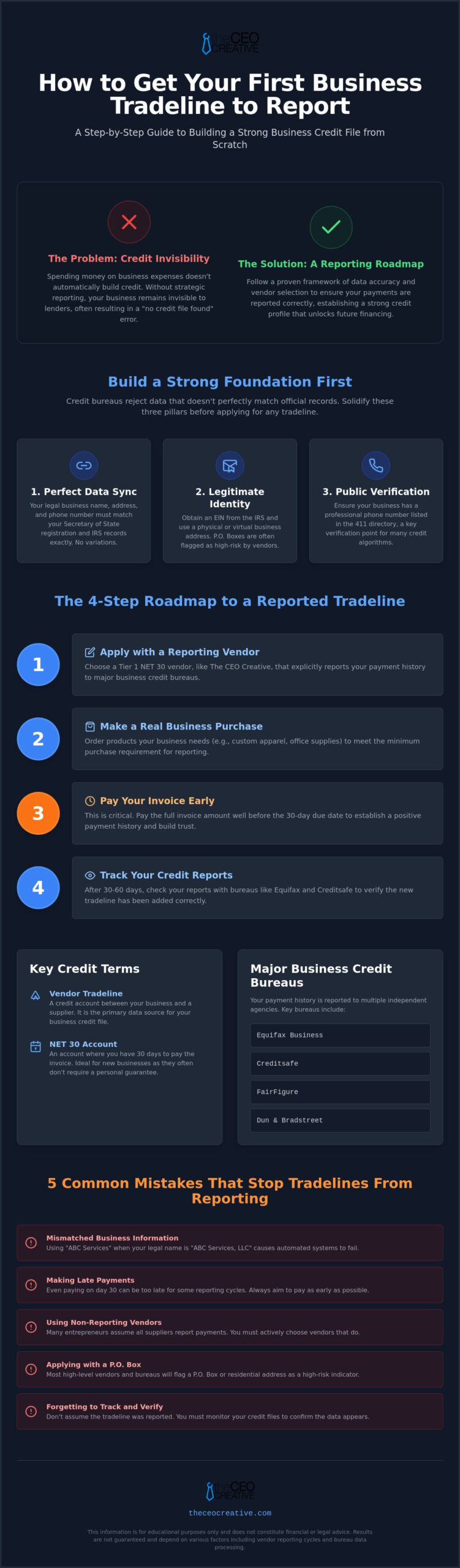
Step-by-Step Checklist: How to Get Your First Tradeline to Report
Once your foundation is solid, you’re ready to execute the 5-step reporting roadmap. This structured path is the most reliable way to ensure your efforts result in a visible score. Many beginners stop after the application, but that’s only the first step. To understand how to get your first business tradeline to report, you must follow through with a purchase and a strategic payment. This process transforms a simple account into a powerful credit-building asset.
- Apply: Submit your application to a reporting vendor using your EIN. The CEO Creative is a reporting NET 30 vendor that helps you build business credit through real business purchases like office supplies and branding gear.
- Order: Place a “Reporting Trigger” order. Vendors don’t report empty accounts; you must have an active balance to generate a data point.
- Pay: Settle your invoice early. In the business credit world, paying 10 to 15 days before the due date is the gold standard for building a high score.
- Track: Monitor your reports with bureaus like Equifax, Creditsafe, and FairFigure to confirm the account appears.
- Repeat: Consistency is key. Multiple months of on-time reporting carry more weight than a single transaction.
Following the SBA guide to establishing business credit can help you stay compliant with federal expectations while you scale your profile. For a detailed list of partners to start with, check out our Net 30 Vendors 2026: The Ultimate Guide.
Executing the Reporting Trigger
Simply opening a Net 30 account doesn’t create a credit file. You must trigger the reporting process by making a purchase on credit terms. Most vendors have a specific reporting threshold or a minimum purchase amount. When you buy branding gear or office supplies, the vendor generates an invoice. Once you pay that invoice, the data is queued for the next reporting cycle. Vendors typically batch report to Equifax and Creditsafe once a month. Don’t wait until the 30th day to pay. Early payments are the strongest signal of creditworthiness and can lead to faster approvals for higher credit tiers.
Tracking Your Progress
Building credit isn’t a “set it and forget it” task. You must actively monitor your profile for the “New Account” notification. It generally takes 30 to 60 days for a new tradeline to appear on your report after your first payment. If your tradeline hasn’t appeared after two full reporting cycles, contact the vendor to verify that your business data matches their records exactly. Small typos in your address or EIN can prevent the bureau from linking the payment to your file. You might wonder, are business credit monitoring services worth it? For a new LLC, these services provide essential real-time alerts that let you know exactly when your hard work pays off.
5 Common Mistakes That Stop Tradelines from Reporting
Even with a clear roadmap, small technical errors can stall your progress. If you’re struggling with how to get your first business tradeline to report, the issue is often a hidden “Data Gap.” Many vendors use automated systems to match your payment to your credit file. If your application uses “Suite B” but your bureau file says “Unit B,” the data may never sync. This mismatch is the most frequent reason for a missing tradeline. You must ensure every character on your application matches your legal filings exactly.
Another common hurdle is the timing of your payment. In the consumer world, paying on the due date is fine. In business credit, paying on the due date can actually hurt your score or result in a “neutral” report. Bureaus like Dun & Bradstreet use metrics like “Days Beyond Terms” (DBT). To see a positive impact, you should pay at least 10 days early. Additionally, check for reporting thresholds. Some vendors only report transactions over a certain dollar amount; if your purchase is too small, it might not trigger a data transmission to the bureaus.
- Legal Structure Errors: Applying as a Sole Proprietorship without a registered DBA often leads to rejection or reporting failures. Bureaus prefer to see a distinct legal entity like an LLC.
- The “On-Time” Trap: Paying exactly on the 30th day instead of early signals a lack of cash flow to some scoring models.
- Threshold Oversights: Ensure your order meets the vendor’s minimum requirements for credit reporting.
Technical Reporting Failures
Your choice of vendor is the most critical factor. Using a non-reporting vendor for your first tradeline is a waste of strategic capital. Many popular retailers offer Net 30 terms but don’t share that data with Equifax or Creditsafe. You must also audit your bureau profiles. If you haven’t claimed your business on Dun & Bradstreet or if your profile is incomplete, the bureau might reject incoming data from your vendors. Before you buy, verify the vendor’s reporting status to ensure your efforts count toward your score.
Strategic Growth Mistakes
Avoid “Credit Thirst” by not opening too many accounts simultaneously. Applying for five or ten vendors in a single week can flag your business as high risk. A better approach is the “Apply, Order, Pay, Track, Repeat” cycle. Use your account consistently; a one-time purchase followed by months of inactivity doesn’t build a strong profile. To avoid these technical pitfalls and start your journey with a reliable partner, you can apply for a business Net 30 account with The CEO Creative today. We focus on providing the clear, consistent reporting you need to scale your corporate credit safely.
Start Building with The CEO Creative: Branding and Credit
Most credit-building guides treat purchases as a chore. They suggest buying items you’ll never use just to satisfy a reporting requirement. We believe credit building should serve your broader business goals. By choosing a partner that reports your activity, you turn necessary operational expenses into a strategic financial asset. This is exactly how to get your first business tradeline to report while simultaneously elevating your brand’s physical presence and professional authority.
Professional branding and consistent Net 30 reporting are the twin engines of business growth. By aligning your aesthetic needs with your credit requirements, you create a sustainable path to corporate independence. This strategy allows you to scale without relying on personal guarantees or risking your personal credit score. It’s a logical, efficient way to manage your administrative needs while securing your company’s financial future, especially when paired with the professional auditing and bookkeeping services of לוי ושות’ רואי חשבון (Levi and Co. CPA).
Custom Merchandise as a Credit Vehicle
Every growing startup needs professional gear to establish authority in its niche. Whether you’re outfitting your team with Net 30 Apparel or ordering Customizable Products for a client event, these purchases are functional investments. The CEO Creative acts as a strategic Tier 1 reporting vendor, ensuring that your branding efforts are recognized by Equifax, Creditsafe, and FairFigure. Our membership model is designed to streamline the reporting process, removing the friction often found with traditional retail vendors. You aren’t just buying office supplies; you’re building the data foundation for your company’s future financing.
Your Next 90 Days
Once you understand how to get your first business tradeline to report, your focus must shift to “seasoning” your profile. A single tradeline is a great start, but lenders typically want to see multiple active accounts reporting for several months before they approve higher-limit credit. Use this time to explore our Tier 1 Net 30 Vendors list to expand your reach. After three months of consistent, early payments, your profile will have the depth required to move toward Tier 2 accounts and unsecured business credit cards.
Ready to take the first step? Apply for a Business Net 30 Account today and start building the credit your business deserves.
What Happens Next
- Your application is reviewed for a decision within one business day based on your EIN and business registration details.
- You place your first order for branding essentials or office supplies to trigger the reporting cycle.
- We report your on-time payment to major bureaus, establishing your initial credit score within 30 to 60 days.
Scale Your Business with Confidence
You now have the exact roadmap to move from credit invisibility to a robust corporate profile. Success depends on maintaining “Perfect Data” consistency and choosing strategic partners that prioritize your growth through transparent reporting. By mastering how to get your first business tradeline to report, you unlock the door to Tier 2 financing and higher credit limits. It’s time to stop relying on personal assets and start building a foundation that supports long-term scaling.
Don’t wait for a lender to find you. Apply for a Net 30 Business Account with The CEO Creative today and begin outfitting your team while you build your score. We’re excited to support your success as you transition into the next phase of your entrepreneurial journey.
Frequently Asked Questions
How long does it take for a tradeline to report to business bureaus?
It typically takes 30 to 60 days for a tradeline to appear on your business credit report after your first payment. Most vendors batch their data and send it to bureaus once a month. If you are learning how to get your first business tradeline to report, remember that the reporting cycle begins after your invoice is settled. Patience is key during this initial seasoning phase.
Do I need a personal guarantee to get my first business tradeline?
You don’t need a personal guarantee to establish your first vendor account. Tier 1 vendors specialize in helping new LLCs build credit using only their EIN. This allows you to separate your personal finances from your company’s liabilities right from the start. It’s a strategic move that protects your personal assets while your business scales and develops its own financial reputation.
Can I build business credit as a brand new LLC with no revenue?
Yes, revenue isn’t a requirement for opening your first Net 30 account. The CEO Creative gives a decision within 1 business day on membership accounts, based on your business’s legal registration and EIN. This makes it possible for startups to begin building a credit history before they even land their first client. It’s about establishing a track record of reliability from day one.
Which credit bureaus does The CEO Creative report to?
The CEO Creative reports monthly to Equifax Business, Creditsafe, and FairFigure. This comprehensive reporting ensures your on-time payments are visible to a wide range of potential lenders and suppliers. By building history across multiple bureaus simultaneously, you strengthen your company’s overall financial reputation. This visibility increases your chances for future high-limit approvals and better terms as your brand grows.
What should I do if my tradeline isn’t showing up on my report?
First, verify that your business data matches your legal filings exactly. Mismatched addresses or typos in your EIN are the most common reasons a report fails to sync with your profile. If you’ve followed the steps on how to get your first business tradeline to report and 60 days have passed, reach out to the vendor’s support team to audit your account for technical errors.
Is there a minimum purchase amount required for reporting?
Most vendors require an active purchase to trigger a report to the bureaus. While there isn’t a universal minimum, making a meaningful purchase of office supplies or branding gear ensures there’s a data point to report. Vendors don’t report empty accounts, so you must use the credit line to see an impact on your business credit file. This proves your company can handle credit responsibly.
Do Net 30 vendors report to personal credit bureaus?
Standard Net 30 vendors do not report to personal credit bureaus like Experian or TransUnion. They focus exclusively on commercial credit agencies like Equifax Business and Creditsafe. This structure is designed to help you build a separate corporate identity. It ensures that your business spending doesn’t negatively impact your personal debt-to-income ratio or personal credit score, maintaining a clear line between your finances.
Can I use my home address for a business tradeline application?
You can use a home address, but it can sometimes hinder your credit-building progress. Many business credit algorithms prefer to see a commercial physical address. If you’re working from home, consider using a virtual office service that provides a professional suite number. This small adjustment can significantly increase your brand’s perceived stability and credibility with lenders who are evaluating your business’s legitimacy.
What is the difference between a tradeline and a credit limit?
A tradeline is the actual record of your credit account as it appears on your business credit report. A credit limit is the specific dollar amount a vendor or lender permits you to borrow on that account. While your credit limit defines your purchasing power, the tradeline itself provides the payment history that bureaus use to calculate your business credit score and determine your reliability.
How many tradelines do I need to get a business credit score?
Most business credit bureaus require at least three active tradelines to generate a numerical credit score. While a single reporting account establishes your file, you’ll need multiple data points to qualify for Tier 2 financing. Establishing your first reporting account with a partner like The CEO Creative is the foundational step toward reaching this goal and proving your business is ready for larger credit lines.
Building business credit? Open a Net 30 Account — EIN only, no personal guarantee, $60 minimum order, credit lines up to $5,500, a decision in one business day, and every on-time payment reported monthly to Equifax Business, Creditsafe and FairFigure.
How long does it take for a tradeline to post?
A new tradeline usually posts within a reporting cycle or two, not right after your first payment, because business bureaus update on a periodic schedule rather than in real time. Most suppliers that extend trade credit report monthly, so where your payment falls relative to their reporting date affects when it shows up. If nothing appears after a couple of cycles, it’s worth confirming with the supplier that they report at all.
How do I get my first business tradeline to report?
You get your first tradeline to report by opening an account with a supplier that extends trade credit and reports payment activity to a business credit bureau, then paying on time or early. Not every supplier that offers terms reports them, so the reporting part has to be confirmed rather than assumed. The CEO Creative, for one, assesses applications on the business EIN with no personal guarantee and no personal credit check, and reports monthly to Equifax Business, Creditsafe, and FairFigure.
How do I verify a vendor is actually reporting my tradeline?
Ask the vendor directly, in writing, which bureaus they report to and how often, then pull your business credit report from that bureau to check whether the account shows up. A vendor can extend credit and never report a single payment, so having terms with them doesn’t prove anything on its own. Written confirmation also gives you something to point back to if the tradeline doesn’t appear when expected.
Why hasn’t my tradeline appeared on my business credit report yet?
The most common reason is timing: bureaus update business files on a periodic cycle, so a new account can take a cycle or two to show up after your first payment. Beyond timing, the vendor may simply not report to the specific bureau you’re checking, since suppliers typically report to only one or a few bureaus rather than all of them. It’s also possible the account reported but didn’t match to your file, which is a separate problem from not reporting at all.
What stops a tradeline from matching my business file?
A tradeline usually fails to match when the business name, address, or EIN tied to the account doesn’t line up exactly with what the bureau has on file. Bureaus match incoming reports to an existing business file using those identifiers, so something as small as using a DBA with a vendor instead of your registered legal name can keep the entry from linking. Keeping your business details consistent across every account you open is the simplest way to avoid this.