

Relying solely on cash to fund your operations might actually be the biggest bottleneck in your company’s growth strategy. While spending only what you have feels safe, it often leaves you with zero business credit history and limited options when a real opportunity arrives. You’re likely wondering, is it better to pay cash or use credit for business when every dollar counts? With average interest rates for new credit card offers sitting at 22.20% as of July 2026, your hesitation to take on high-interest debt is completely valid.
We understand that managing cash flow while trying to establish a footprint with bureaus like Equifax and Creditsafe feels like a balancing act. This guide will show you how to use strategic credit to optimize your liquidity and build a powerful corporate profile using just your EIN. We will explore the differences between liquid capital and vendor tradelines, helping you access higher credit lines in the future. We’ll also look at how The CEO Creative acts as a reporting NET 30 vendor that helps you build business credit through real business purchases. Please note that this content is for educational purposes and does not constitute financial or legal advice.
Key Takeaways
- Preserve your liquid cash for emergencies and payroll by leveraging strategic credit for routine operational expenses.
- Learn why deciding is it better to pay cash or use credit for business depends on whether you want to scale quickly or just survive.
- Understand the major benefits of Net 30 accounts, which offer 0% interest and corporate-only liability to protect your personal assets.
- Master the five-step process of applying, ordering, and paying to ensure your activity is correctly reported to major business credit bureaus.
- Discover how to build corporate credibility through practical purchases like branding gear that establish a professional EIN profile.
The Cash vs. Credit Dilemma: A Hook and Promise for Business Owners
The phrase “Cash is King” is a common mantra in the startup world, but for many growing organizations, it acts more like a cage than a crown. When you hoard every dollar to cover routine expenses, you limit your company’s ability to pivot or invest in sudden opportunities. This mindset forces you to choose between operational liquidity and long-term growth. You might be asking yourself, is it better to pay cash or use credit for business when you want to scale safely? The answer lies in how you leverage Other People’s Money (OPM) to keep your own reserves liquid.
By using strategic credit, you transform your daily overhead into a powerful financial asset. The goal is to build a corporate credit profile that exists independently of your personal life. A critical mistake many new entrepreneurs make is using personal funds for business supplies. This habit keeps your business invisible to bureaus and prevents you from accessing higher limits down the road.
Key Definitions: Vendor Tradelines and Payment Reporting
A vendor tradeline is the foundation of your business credit profile. It is essentially a credit account offered by a supplier that allows you to buy now and pay later. When you use a reporting Net 30 vendor like The CEO Creative, your payment behavior is shared with bureaus like Equifax, Creditsafe, and FairFigure. This journey from an invoice to a credit report is what builds your score. The primary advantage here is the EIN-only structure; it separates your personal liability from your professional obligations, protecting your personal assets while your business grows.
Why Your Choice Today Impacts Your 2026 Funding
The financial decisions you make this quarter will dictate your eligibility for a business line of credit or an SBA loan by 2026. Lenders look for a consistent history of on-time payments to vendors. If you rely exclusively on cash, your business remains a “ghost” in the eyes of financial institutions. Building credit early prevents the “emergency loan” trap, where desperate owners take on high-interest debt because they have no established profile to secure better rates. Start building that foundation today to ensure your future scalability.
Compliance Note: This content is for educational purposes and is not financial or legal advice.
The Strategic Advantage of Using Credit Over Cash
While some financial advisors argue that cash keeps debt in check, they often ignore the high opportunity cost of staying “liquid” at the expense of growth. Using cash for every purchase depletes your dry powder, the essential reserves you need for payroll or unexpected equipment repairs. When you weigh the question of whether is it better to pay cash or use credit for business, consider the flexibility that credit provides. Strategic credit allows you to keep your cash in the bank while building a history that qualifies you for future SBA-guaranteed loans.
There’s also a distinct tax advantage to using credit accounts. Business credit statements and vendor portals provide a consolidated, digital trail of deductible expenses. This makes tax season much simpler compared to hunting down individual cash receipts or digging through bank statements. Additionally, in an inflationary environment, paying for today’s supplies with tomorrow’s dollars is a savvy move. With the Prime Rate at 6.75% as of July 2026, using interest-free credit windows from vendors can actually increase your purchasing power over time.
Bureau Reporting: Who Is Watching Your Payments?
Building a track record with major bureaus like Equifax and Creditsafe is non-negotiable for new LLCs. These agencies track your reliability to determine your risk level for future financing. In the 2026 business credit landscape, FairFigure has also emerged as a critical player for monitoring the real-time health of small businesses. Consistent reporting from your vendors creates a robust profile, often resulting in a Paydex score or similar metric. This score is what lenders use to decide your creditworthiness without ever looking at your personal credit card usage.
Leveraging Net 30 Terms as a Growth Engine
Net 30 terms offer a unique psychology for rapid scaling. You have a 30-day window to turn your inventory or marketing materials into profit before the bill is even due. This allows you to use Net 30 vendors to acquire essential office supplies or branding gear without an immediate cash outlay. For example, purchasing custom branding products doesn’t just build your brand equity. It also builds your credit history simultaneously. If you’re ready to start this journey, you can apply for a business account to begin reporting your positive payment history today.
Cash vs. Credit vs. Net 30: Which is Better for Your Business?
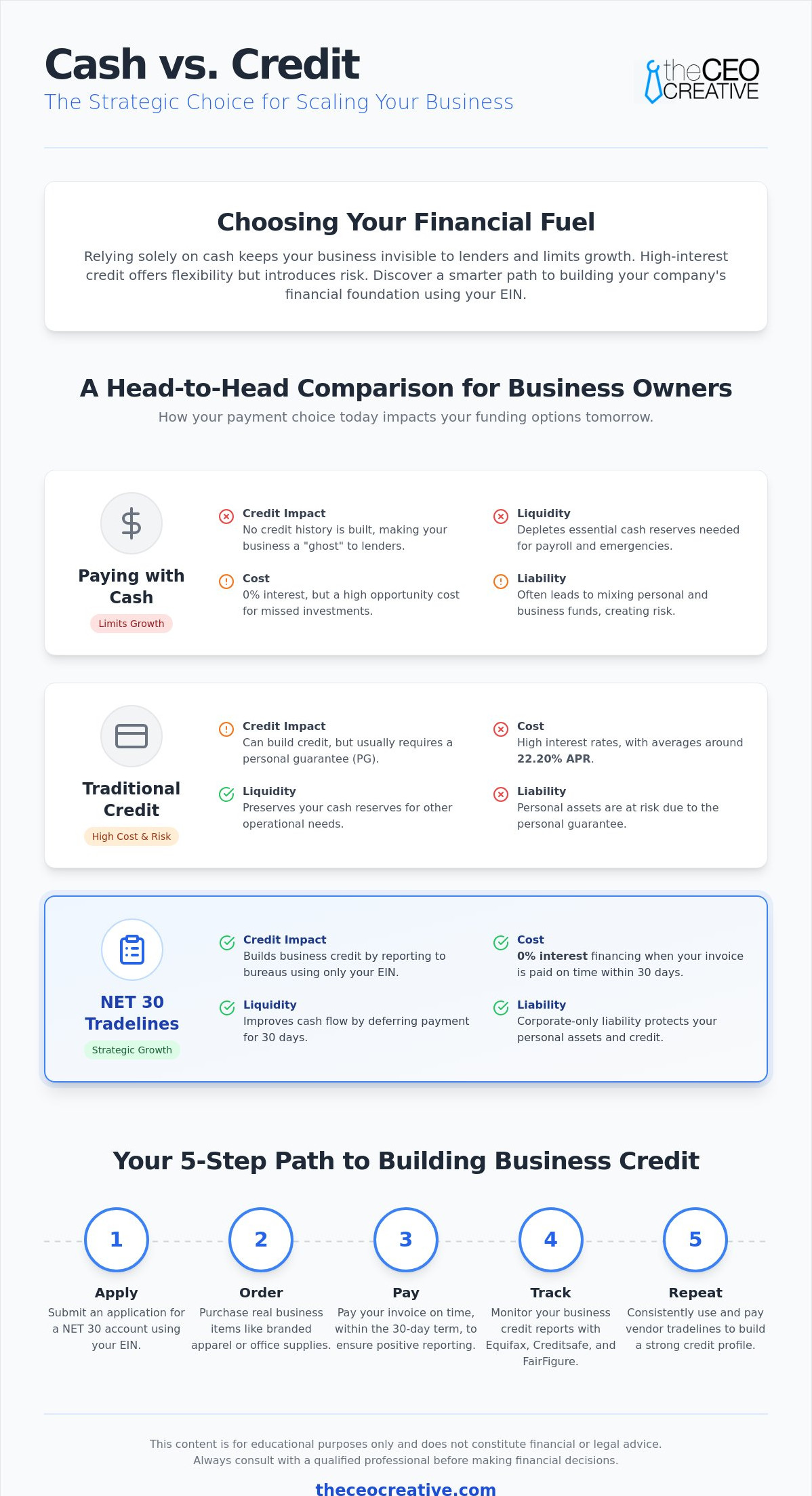
Choosing the right payment method isn’t just about what’s in your bank account today. It’s about calculating the true cost of your capital. When you ask if is it better to pay cash or use credit for business, you have to look at the numbers. Cash has a 0% interest rate, but it carries a 100% opportunity cost. Credit cards for new offers average 22.20% interest as of July 2026. Net 30 terms offer a strategic middle ground. They provide a 0% interest window and often grant a decision within one business day using just your EIN. While traditional bank loans can take weeks to fund, a vendor account is usually active in minutes.
The risk profiles of these methods vary significantly. Most business credit cards require a personal guarantee, meaning your own assets are on the line if the business struggles. In contrast, Net 30 vendor accounts often rely on corporate-only liability. This separation is vital for protecting your personal financial health. A hybrid approach often wins. Use cash for small, daily incidentals, but leverage Net 30 terms for your recurring operational supplies and branding needs.
When Cash is the Wrong Move
Spending your liquid reserves on depreciating assets like office supplies or apparel is often a strategic error. You lose the chance to report a positive tradeline to the bureaus. That cash becomes “dead,” sitting in a supply closet instead of a high-yield account or a marketing budget. In a low-interest environment, hoarding cash feels safe, but it actually slows your momentum. By using credit, you keep your cash reserves available for high-impact investments that cash alone can’t cover.
The Net 30 Advantage for Startups
You can build business credit without a loan by simply shifting your current spending to the right vendors. Most startups find Net 30 accounts easier to secure than high-limit credit cards because they don’t always require an extensive credit history. This allows you to establish your footprint with Equifax and Creditsafe immediately. Using these accounts to purchase custom notebooks and stationery helps you maintain a professional identity. You aren’t just buying supplies; you’re building a corporate credit asset that will pay dividends for years to come.
Mastering the Process: Step-by-Step Checklist and Common Pitfalls
Transitioning from a cash-heavy operation to a credit-leveraged business requires precision. When deciding is it better to pay cash or use credit for business, you must treat your credit profile like a high-value asset. This starts with data integrity. Ensure your business name, address, and phone number match exactly across the Secretary of State, the IRS, and the credit bureaus. Mismatched data is one of the most common reasons a tradeline fails to appear on your report. Understanding whether is it better to pay cash or use credit for business is only the first step; mastering the process is what leads to real growth.
Timing is also a major factor in your success. In the world of corporate credit, “on time” is often considered late. Paying your invoices 10 to 15 days before the deadline often results in a higher score with bureaus like Equifax, Creditsafe, and FairFigure. This proactive approach signals to future lenders that your business is exceptionally low-risk and ready for higher credit limits.
Step-by-Step: From EIN to Established Credit
- 1. Apply: Open a business Net 30 account using your EIN. This ensures the activity is tied to your business entity rather than your personal social security number.
- 2. Order: Place an order for essential office supplies or branding gear. This purchase triggers the reporting process.
- 3. Pay: Settle the invoice in full well before the 30-day window closes to maximize your score.
- 4. Track: Verify that the tradeline reports to major bureaus within 30 to 60 days.
- 5. Repeat: Consistent activity is what builds a sustainable credit profile.
8 Common Mistakes to Avoid
- 1. Late payments: Even a 24-hour delay can negatively impact your profile and Paydex score.
- 2. Mismatched business information: Inconsistent addresses or phone numbers can lead to fragmented credit files.
- 3. Using personal credit: This habit pierces the corporate veil and leaves your personal assets vulnerable.
- 4. Low transaction volume: Ensure your order meets the vendor’s internal threshold for reporting.
- 5. Skipping tiers: Don’t apply for high-limit bank cards before establishing Tier 1 vendor history.
- 6. Ignoring reports: Failing to monitor for errors can lead to long-term score damage that is hard to fix.
- 7. Closing active accounts: Older accounts provide the “length of history” that lenders value during the underwriting process.
- 8. Overextending limits: Only purchase what your current cash flow can support to avoid high-interest debt traps.
Ready to establish your footprint? Apply for your business Net 30 account and start building your corporate credibility today.
The CEO Creative: Your Partner in Building Corporate Credibility
The CEO Creative serves as a foundational partner for entrepreneurs who understand that strategic financing is a growth lever. When you evaluate whether is it better to pay cash or use credit for business, our platform provides a clear path toward corporate stability. We operate as a reporting Net 30 vendor, meaning your purchases of essential branding gear and office supplies directly contribute to your credit profile. Unlike traditional retail, every transaction with us is a strategic move to strengthen your EIN-based history with bureaus like Equifax, Creditsafe, and FairFigure.
By joining the CEO Creative Membership, you gain access to a suite of tools designed for the modern brand. We help you turn routine operational costs into powerful tradelines that signal your reliability to future lenders. This partnership allows you to keep your cash reserves liquid for high-impact opportunities while building an asset that exists independently of your personal finances. You can choose from a wide range of products, including custom apparel, to elevate your brand presence while checking off your credit-building goals.
Beyond Office Supplies: Custom Branding That Reports
Establishing a professional identity involves more than just having an EIN. It requires a visual presence that commands respect in meetings and pitches. Our logo design services allow you to create a cohesive brand image from the start. You can then apply that branding to high-quality promotional products like custom mugs or engraved gear. These items serve a dual purpose: they build your brand equity with clients and build your credit history with the bureaus simultaneously. High-quality gear makes a tangible difference when you’re presenting your vision to investors or high-value partners.
What Happens Next?
- Apply for your account: Complete our straightforward application today to receive a decision within one business day with your EIN and no personal guarantee required.
- Select your essentials: Browse our catalog and place your first order for branding or office supplies to trigger your first tradeline reporting.
- Watch your profile grow: We report your on-time payments to major bureaus, helping you establish the credibility needed for higher credit lines and future funding.
Strategize Your Capital for Long-Term Scalability
Navigating the question of whether is it better to pay cash or use credit for business requires a shift from a survival mindset to a growth strategy. For mid-size firms aiming to optimize these financial decisions within a broader roadmap, Carter Strategies provides the fractional CMO and CRO expertise needed to drive sustainable revenue. While cash provides immediate security for emergencies, leveraging vendor credit allows you to build a corporate identity that stands on its own. By protecting your liquid reserves and using your EIN to secure essential branding products, you position your organization for higher credit lines and better funding opportunities in the future.
Take the first step toward financial independence today. You can Apply for a Business Net 30 Account with The CEO Creative using your EIN, with no personal guarantee required and a decision within 1 business day. We report your activity to Equifax, Creditsafe, and FairFigure, ensuring your on-time payments work as hard as you do. It’s time to transform your routine operational expenses into a powerful credit asset. We’re excited to partner with you as you build the sustainable, credit-worthy brand your vision deserves.
Frequently Asked Questions
Do I need a personal guarantee to use a Net 30 account?
No personal guarantee is required to open a Net 30 account with The CEO Creative. This structure allows you to protect your personal assets while building a corporate profile exclusively under your EIN. It’s an ideal solution for entrepreneurs who want to scale their operations without the personal financial risk associated with traditional bank products.
Is my startup LLC eligible for a Net 30 vendor account?
Your startup LLC is absolutely eligible for a Net 30 vendor account. We encourage new businesses to apply as soon as they have their EIN and official registration documents. Establishing these accounts during your first months of operation prevents you from being a credit “ghost” when you eventually need to secure larger lines of credit or equipment financing.
How often does The CEO Creative report to the credit bureaus?
We report your payment data to the credit bureaus on a monthly basis. This regular schedule ensures that your positive payment history is updated frequently on your professional profile. Consistency is the most important factor in building a strong score, so making regular purchases and paying them off early is the best strategy for growth.
What should I do if my tradeline doesn’t appear on my credit report?
If your tradeline isn’t showing up, first double check that your business name and address match your official filings exactly. Mismatched data is the leading cause of reporting errors between vendors and bureaus. If your information is correct, remember that it can take between 30 and 60 days for bureaus to process and display new data on your file.
Can I build business credit if I have a low personal credit score?
You can build business credit even if your personal credit score is low. Since our vendor accounts don’t require a personal guarantee, your business activity is the primary factor for approval. Many entrepreneurs ask is it better to pay cash or use credit for business when their personal score is low. The answer is credit, specifically vendor tradelines, because they allow you to build an entity based profile regardless of your personal history.
What is the difference between a vendor tradeline and a credit card?
A vendor tradeline is credit extended by a supplier for specific products, while a credit card is revolving credit for general use. When deciding is it better to pay cash or use credit for business, consider that vendor accounts provide a zero interest window that cash cannot match. In contrast, new business credit card offers reached an average interest rate of 22.20% as of July 2026.
Does paying early help my business credit score more than paying on time?
Paying early can significantly improve your score compared to just paying on the due date. Many business credit bureaus use scoring models that reward “early” payments with higher ratings than standard on-time payments. Aiming to settle your invoices 10 to 15 days before your deadline is a great way to signal financial strength and reliability to future lenders.
Which credit bureaus does The CEO Creative report to?
The CEO Creative reports to Equifax, Creditsafe, and FairFigure. These agencies are essential for building a comprehensive and visible business credit profile. By reporting to multiple bureaus, we ensure that your professional reliability is visible to a wide network of financial institutions, suppliers, and potential partners who may pull your report in the future.
Building business credit? Net 30 Vendors Compared — EIN only, no personal guarantee, $60 minimum order, credit lines up to $5,500, a decision in one business day, and every on-time payment reported monthly to Equifax Business, Creditsafe and FairFigure.