

Trust and Compliance Note: This content is for educational purposes only and does not constitute financial or legal advice.
What if you could secure $5,000 or $10,000 in credit for your brand without ever putting your personal credit score at risk? Most entrepreneurs face the same wall of constant rejections or low limits that don’t even cover a single inventory run. It’s frustrating to manage growth when your financial tools feel like they’re holding you back. You need a foundation that scales as fast as your vision does. Establishing a strong credit profile is the first step toward that independence.
This guide will teach you exactly how to get high limit business credit accounts by mastering the strategic steps of building a corporate credit profile. You’ll learn how to secure high-limit vendor tradelines using only your EIN, which helps you scale while protecting your personal assets. We’ll break down the mechanics of payment reporting, introduce you to reporting NET 30 vendors like The CEO Creative, and provide a clear checklist to help you qualify for the high-limit corporate accounts your business deserves.
Key Takeaways
- Learn how to transition from small $500 accounts to $10,000+ credit lines by focusing on strategic reporting sequences rather than just annual revenue.
- Understand the mechanics of Net 30 terms and how vendor tradelines serve as the essential foundation for building a robust business credit profile.
- Discover exactly how to get high limit business credit accounts by utilizing your EIN to establish corporate credit without relying on personal guarantees.
- Master a repeatable five-step checklist—Apply, Order, Pay, Track, and Repeat—to ensure every business purchase builds your financial reputation.
- Identify and avoid common pitfalls like mismatched business data or late payments that can lead to immediate credit limit rejections.
Key Takeaways
- Learn how to transition from small $500 accounts to $10,000+ credit lines by focusing on strategic reporting sequences rather than just annual revenue.
- Understand the mechanics of Net 30 terms and how vendor tradelines serve as the essential foundation for building a robust business credit profile.
- Discover exactly how to get high limit business credit accounts by utilizing your EIN to establish corporate credit without relying on personal guarantees.
- Master a repeatable five-step checklist—Apply, Order, Pay, Track, and Repeat—to ensure every business purchase builds your financial reputation.
- Identify and avoid common pitfalls like mismatched business data or late payments that can lead to immediate credit limit rejections.
The Roadmap to High-Limit Business Credit Accounts in 2026
Trust and Compliance Note: This content is for educational purposes only and does not constitute financial or legal advice.
Many founders believe that a million-dollar revenue stream automatically triggers high credit limits. In reality, lenders care more about your history of handling similar debt than they do about your bank balance. If you’ve only ever managed a $500 limit, a bank won’t suddenly hand you $50,000. This article provides a strategic roadmap for how to get high limit business credit accounts by moving from entry-level vendor lines to five-figure corporate accounts. You’ll learn that credit is a ladder, not a lottery.
A common error is applying for high-tier rewards cards before your business is ready. This results in hard inquiries and rejections that damage your profile before it’s even established. Instead, follow a structured path that builds confidence with reporting vendors first. We’ll show you how to scale from basic $500 limits to $10,000 or more by building “depth” in your credit history. This ensures that when you finally apply for a major corporate card, the approval is almost a formality.
The Problem with Low-Limit Thinking
Low limits aren’t just an inconvenience; they’re a growth bottleneck. If you can’t buy enough office supplies or inventory to meet a surge in demand, you lose revenue. Many owners rely on personal guarantees, which ties their family’s financial safety to the business’s success. In 2026, the goal is to use your EIN to build a separate financial identity. Business credit reports track how you manage these accounts. A thin file is just as bad as a poor one because it suggests you hasn’t been tested with significant capital.
What to Expect: The Outcome of This Strategy
By the end of this process, your business will transition from being credit-invisible to credit-worthy. High-limit accounts improve your debt-to-income ratio because they provide a larger cushion of available credit. You’ll stop being a “risky” startup in the eyes of major lenders. Understanding how to get high limit business credit accounts is about proving you can handle five-figure debt consistently. While you won’t see $10,000 limits overnight, following this sequence typically yields significant increases within six to twelve months.
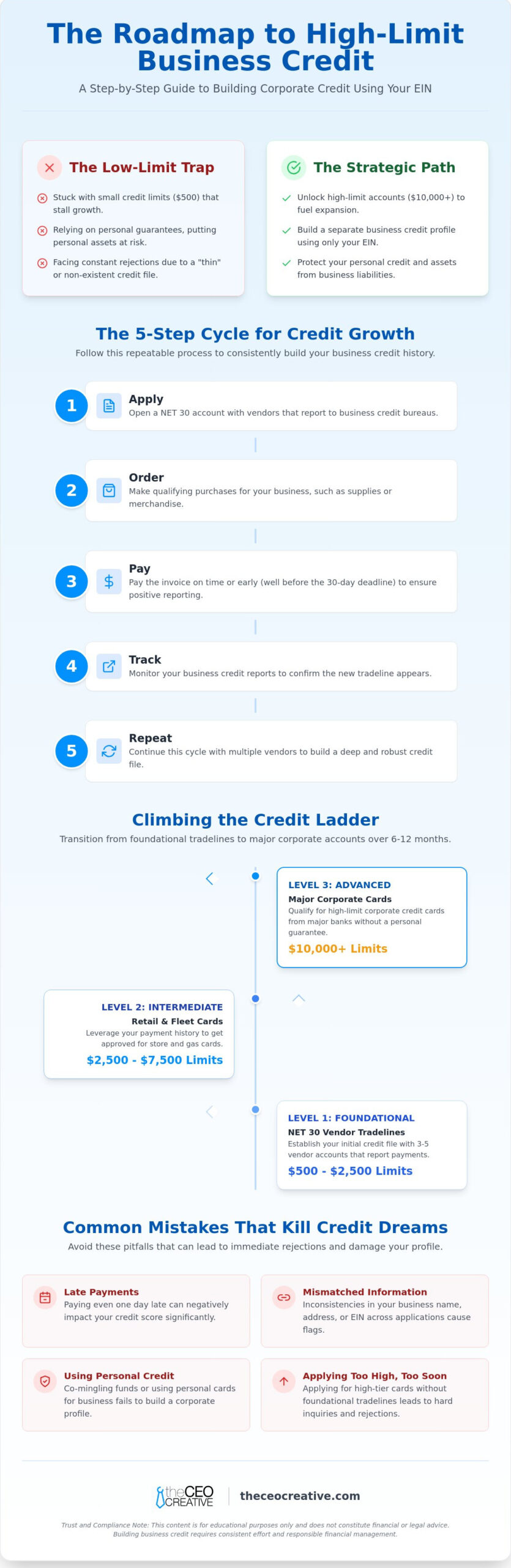
Understanding Vendor Tradelines and Payment Reporting Mechanics
A vendor tradeline is a credit relationship between your company and a supplier. When you purchase items like office supplies, the vendor extends credit to you rather than requiring immediate payment. Net 30 terms act as a bridge; they give you 30 days to pay the full invoice while the vendor reports your activity to business credit bureaus. This reporting is the most effective way to build business credit quickly. Without these reporting lines, your business remains a ghost to major lenders.
The secret to how to get high limit business credit accounts lies in who you choose as a partner. Many popular retail stores do not report to business bureaus. Buying from them helps your daily operations but does nothing for your credit profile. You need vendors that report to Equifax, Creditsafe, and FairFigure. These bureaus aggregate your payment data to create a risk profile. If your history only exists in a private ledger, you’ll never qualify for the five-figure limits necessary for major expansion. You can start building this foundation today by opening a business net 30 account to establish your first reporting tradeline.
How Payment Reporting Influences Your Limit
Lenders look closely at your “Credit Capacity.” This is a measure of the highest limit you’ve successfully managed in the past. If your profile shows five different $1,000 limits, a new lender might feel comfortable offering you $5,000. Reporting frequency matters more than the initial dollar amount of your purchases. Consistent, early payments across multiple accounts signal reliability. This data is tied to your business identity through your D-U-N-S number and EIN, creating a permanent record of your financial maturity.
Tier 1 vs. Tier 2 Accounts
Think of Tier 1 accounts as the entry point for new LLCs. These vendors, including The CEO Creative, assess applications on the EIN and help you establish your first few tradelines. They provide the essential foundation. Tier 2 accounts offer the higher limits you’re after but usually require a pre-existing credit history. If you skip Tier 1 and apply for Tier 2 immediately, you’ll likely face an automatic rejection. Lenders in Tier 2 want to see that you’ve already handled smaller accounts perfectly before they trust you with significant capital. Understanding how to get high limit business credit accounts is ultimately about respecting this hierarchy.
Overcoming the No-Credit Hurdle: Why Your EIN is Your Best Asset
Many new LLC owners feel stuck in a loop. They can’t get credit because they don’t have credit. This “thin file” problem often leads founders back to using personal credit cards, which is a mistake that can hurt your personal debt-to-income ratio. Using your Employer Identification Number (EIN) is the most effective way to break this cycle. Your EIN acts as a financial social security number for your business. It allows you to build a corporate identity that exists independently of your personal score. According to the SBA guide to establishing business credit, separating these two identities is vital for protecting your personal assets while scaling operations.
The CEO Creative serves as a strategic partner for startups by acting as a reporting NET 30 vendor that helps build business credit through real business purchases. Instead of chasing high-limit cards immediately, you use your EIN to purchase items your business already needs. This strategy is central to how to get high limit business credit accounts because it populates your report with positive data points. You aren’t just “buying credit”; you’re making functional purchases that prove your company’s legitimacy to the bureaus. This builds the trust necessary for future five-figure approvals.
Building Credibility with Business Merchandise
Strategic spending transforms routine expenses into credit assets. When you invest in customizable products, you achieve two goals at once. You professionalize your brand while creating a documented history of on-time payments. Similarly, ordering Net 30 apparel for your team builds internal culture and adds another tradeline to your profile. Credit bureaus prioritize these real business purchases over speculative financial products. They want to see that your business has a functional, operational need for the credit it receives. This activity proves you’re a low-risk borrower ready for larger accounts.
The Bureau Reporting Advantage
Visibility is the key to financial growth. The CEO Creative reports your payment activity to major bureaus like Equifax and Creditsafe. This reporting ensures that every invoice you pay early helps build your score. You can also utilize FairFigure to monitor these scores in real-time. This transparency allows you to see exactly when your profile becomes strong enough to qualify for higher tiers. Understanding how to get high limit business credit accounts requires you to track this progress closely. By maintaining a clean record with reporting vendors, you position your brand for the five-figure approvals that sustain long-term growth. You can learn more about selecting the right partners in our guide to the best net 30 apparel vendors to build business credit in 2026.
The 5-Step Checklist for Securing and Growing Your Credit Limits
High credit limits aren’t granted by luck; they’re earned through a repeatable system of performance. To master how to get high limit business credit accounts, you need to treat your credit building like a standard operating procedure. Lenders look for patterns of reliability and growth. By following a structured checklist, you move your business from a “thin file” startup to a credible enterprise that can handle significant capital. This process ensures that every dollar you spend on operations also serves as an investment in your company’s financial future.
- Step 1: Apply – Register with vendors using precise business details.
- Step 2: Order – Purchase real business goods to trigger reporting.
- Step 3: Pay – Settle invoices early to maximize your score.
- Step 4: Track – Verify that tradelines appear on your bureau reports.
- Step 5: Repeat – Increase order frequency and volume to justify higher limits.
Step 1 & 2: Laying the Foundation
Precision is your best friend during the application phase. Your LLC information must match your EIN records and your business utility bills exactly. Mismatched data, such as a missing “LLC” suffix or a different suite number, can lead to automatic rejections. Once your account is set, focus on strategic spending. Start by purchasing essential office supplies, such as custom notebooks or branded stationery. These items provide immediate utility for your team while establishing your first tradeline. For a curated list of reliable suppliers, you can explore our guide on the best websites to buy office supplies online.
Step 3, 4 & 5: Mastering the Cycle
The “Early is the New On-Time” rule is the most effective way to influence your credit capacity. While a Net 30 term gives you 30 days to pay, settling the bill by day 20 is a power move. This proactive approach is a core part of how to get high limit business credit accounts because it signals that your company has strong cash flow. After paying, monitor your reports on Equifax or Creditsafe. If a tradeline hasn’t appeared after two reporting cycles, check for data discrepancies. Once you’ve successfully managed three or four cycles of early payments, request a limit increase. You can justify this by showing a consistent need for more inventory or supplies to support your growing brand.
Ready to start building your foundation? Apply for a business net 30 account with The CEO Creative to begin your journey toward high-limit credit today.
8 Common Mistakes That Kill Your High-Limit Dreams
Securing significant funding requires more than just paying bills. It involves maintaining a flawless administrative profile. Small oversights often act as red flags for automated underwriting systems. If you want to master how to get high limit business credit accounts, you must eliminate the friction that causes rejections. Lenders don’t just look for a score; they look for a stable, professional entity that follows established corporate standards. Proving your reliability is a prerequisite for five-figure approvals, and many founders turn to Koval Investments to optimize their financial profiles through credit repair and 0% interest funding solutions.
- Late Payments: Even a single day of delinquency can drop your score significantly. It signals a lack of liquidity or poor financial management.
- Mismatched Data: Your business address, phone number, and LLC name must be identical across every application and public record.
- High Utilization: Maxing out your entry-level lines suggests financial desperation. Keep your balances low relative to your limits to show you don’t need the credit to survive.
- Lack of Branding: A missing logo design or a generic email address makes your business look like a hobby rather than a company.
- Ignoring Reports: Errors on your bureau files can stay there for years if you aren’t checking them monthly.
Administrative Errors to Avoid
Your business needs to look established on paper before a lender will trust you with five-figure limits. This starts with a dedicated business phone line and a professional email domain. Using a residential address for your LLC can sometimes trigger lower limits or manual reviews because it suggests a home-based operation with lower overhead. Don’t fall into the “Thin File” trap by relying on just one or two tradelines. To qualify for high limits, you generally need at least five active, reporting accounts to prove your creditworthiness across different sectors. This diversity shows you can manage multiple obligations simultaneously.
Strategic Spending Pitfalls
Successful credit building focuses on utility rather than just debt. Avoid buying items you don’t need just to get a tradeline. Instead, focus on products that help your brand grow, such as customized marketing materials or team apparel. Diversifying your vendor types is also critical. If all your credit comes from office supply vendors, you aren’t showing a broad range of management. Utilizing the CEO Creative Membership benefits provides a structured way to scale your credit and brand identity simultaneously. This membership helps you avoid the common pitfall of stagnant growth by offering continuous reporting and brand support. Understanding how to get high limit business credit accounts means avoiding these traps and staying focused on long-term sustainability.
Take Command of Your Business Financial Future
Mastering how to get high limit business credit accounts is a strategic process that starts with a single reporting tradeline. By leveraging your EIN and focusing on real business purchases, you build a financial identity that stands independently of your personal assets. You now have the roadmap to avoid administrative errors and use a repeatable checklist to scale your limits effectively.
Apply for a CEO Creative Net 30 Account Today
What happens next:
- Receive a decision within one business day for your net 30 vendor account.
- Shop for essential branding or office supplies to trigger your first reporting cycle.
- Monitor your profile as payments report to Equifax, Creditsafe, and FairFigure.
Apply for a CEO Creative Net 30 Account Today
Frequently Asked Questions
Do Net 30 accounts require a personal guarantee?
No, most Tier 1 Net 30 accounts don’t require a personal guarantee. They rely on your EIN to establish creditworthiness for the business. This separation protects your personal assets from business liabilities. The CEO Creative specifically offers Net 30 terms for business purchases without requiring a personal guarantee; this allows you to build credit purely on the merits of your company’s performance.
How long does it take for a Net 30 account to report to the bureaus?
Reporting typically occurs once a month, but the exact timing depends on the vendor’s specific batching schedule. Most vendors report 30 to 45 days after your invoice is paid in full. It’s best to pay early to ensure your data is captured in the next reporting cycle. Consistent activity over three months usually results in a visible tradeline on your business credit reports.
Can I get a high-limit business account with a new LLC?
Yes, you can start the process immediately, but you won’t get a five-figure limit on day one. You must first establish a history of managing smaller accounts perfectly. By starting with Tier 1 vendors and paying early, you demonstrate the reliability needed to qualify for larger lines. Learning how to get high limit business credit accounts is a strategic progression rather than an overnight event.
Which credit bureaus does The CEO Creative report to?
The CEO Creative reports your payment activity to Equifax Business, Creditsafe, and FairFigure. This multi-bureau reporting ensures that your positive payment history is visible to a wide range of lenders and suppliers. Because different lenders use different bureaus, having your data across all three major platforms significantly strengthens your overall profile and helps you scale your brand identity faster.
What is the difference between a vendor tradeline and a credit card?
A vendor tradeline is a credit relationship with a specific supplier for goods, whereas a credit card is a revolving line of credit used anywhere. Tradelines often have Net 30 terms, meaning the full balance is due in 30 days. These accounts are usually easier for new businesses to obtain and serve as the essential building blocks for eventually qualifying for high-limit corporate credit cards.
How many tradelines do I need to get a high-limit corporate card?
Most major lenders want to see at least five to ten active tradelines on your business credit report before approving high-limit corporate accounts. This variety proves you can handle multiple financial obligations simultaneously. If you’re investigating how to get high limit business credit accounts, the diversity and age of your reporting history are just as critical as the limits themselves.
What happens if my business credit tradeline doesn’t appear?
First, verify that you’ve waited at least 60 days since your invoice was paid. If it still hasn’t appeared, check that your business information with the vendor matches your bureau records exactly. Mismatched addresses or missing LLC suffixes are common culprits. Contact the vendor’s support team to ensure your EIN was recorded correctly and that the reporting cycle has been completed for that month.
Does a Net 30 account affect my personal credit score?
No, EIN-based Net 30 accounts generally don’t impact your personal credit score because they aren’t tied to your Social Security number. This separation is a key advantage for entrepreneurs who want to protect their personal debt-to-income ratio. By building credit strictly through the business, you ensure that your company’s operational expenses don’t interfere with your ability to secure personal financing for a home or vehicle.
Building business credit? Open a Net 30 Account — EIN only, no personal guarantee, $60 minimum order, credit lines up to $5,500, a decision in one business day, and every on-time payment reported monthly to Equifax Business, Creditsafe and FairFigure.