


What if the secret to a robust corporate profile isn’t a massive bank loan, but the strategic frequency of your small business orders? Most entrepreneurs feel the sting of rejection from traditional lenders because of a thin file, or they’re tired of seeing their personal credit scores dip because they’re personally funding every company expense. It’s frustrating to know your business is viable while the bureaus act like it doesn’t exist. You’re likely searching for how to accelerate your business credit building timeline because you need access to capital now, not three years from now.
We understand that the logistical hurdles of management are enough to handle without the added confusion of bureau reporting. That’s why we’ve mapped out a strategic framework to move from zero credit to a robust profile using high-frequency reporting tradelines. This article previews the exact steps to diversify your file and ensure your payment data reaches Equifax, Creditsafe, and beyond. You’ll learn how to turn your routine operational needs into your greatest financial asset with The CEO Creative, a reporting NET 30 vendor that helps build business credit through real business purchases. By the end of this guide, you’ll know how to stop relying on personal guarantees and start leveraging the power of your EIN for long-term success.
Key Takeaways
- Transform your business profile from a thin file to Tier 2 eligibility in under 180 days by following a structured reporting framework.
- Master the mechanics of credit reporting to ensure your payment history reaches critical bureaus like Equifax Business, Creditsafe, and FairFigure.
- Discover how to accelerate your business credit building timeline by strategically stacking multiple Tier 1 vendor accounts within the same 30-day window.
- Follow a repeatable five-step checklist, moving from initial application to payment tracking, to maintain consistent growth and avoid reporting delays.
- Identify and eliminate the eight most common mistakes, such as mismatched business information, that can stall your credit progress and create split files.
Understanding the Business Credit Timeline: Why Speed Matters in 2026
Many business owners spend years waiting for their credit to mature, only to find themselves stuck in a cycle of personal guarantees and high-interest online loans. In 2026, waiting for organic growth is a choice you don’t have to make. While traditional paths suggest a multi-year journey, a strategic framework allows you to move from your initial EIN registration to Tier 2 credit eligibility in under 180 days. This accelerated timeline is about forcing reporting through high-frequency activity rather than waiting for a bank to notice your existence.
Learning how to accelerate your business credit building timeline is the difference between accessing capital at 7% APR and being forced into online term loans that can reach 99% APR. This guide provides the tactical roadmap to bypass the thin file trap and attract Tier 1 lenders. Please be aware that this content is for educational purposes and does not constitute financial or legal advice.
If your organization needs additional strategic guidance to navigate growth obstacles, you can find out more about professional consulting services that help businesses scale.
The 2026 Reality: Why Traditional Banking is Too Slow
Traditional lenders still rely on legacy metrics. Most banks require at least two years of tax returns and a personal FICO score above 720 to unlock their best rates, which currently range from 6.8% to 11%. If you’re a startup or a new LLC, you simply can’t wait two years to fund your operations. This creates a thin file trap where you’re rejected because you have no history, yet you can’t build history because you’re rejected.
This is where Net 30 vendors become your most valuable partners. By providing immediate credit terms for essential business purchases, these vendors bridge the gap between a new EIN and a bankable profile. Instead of waiting for a loan officer’s approval, you take control of your data by generating reports through daily operations.
Defining the Vendor Tradeline
To move fast, you must understand your tools. A tradeline is simply a credit account listed on your business credit report. While financial tradelines involve cash loans or leases, a vendor tradeline is built through trade credit. This allows you to buy products now and pay the invoice within a set period, usually 30 days.
Vendor reporting is the foundation of your PAYDEX score, which Dun & Bradstreet uses to measure your payment performance. Unlike personal credit, which focuses heavily on utilization, your business score is primarily driven by how quickly you pay your bills. When you use a vendor like The CEO Creative, your real-world purchases for items like office supplies or custom apparel turn into data points that bureaus like Equifax and Creditsafe use to verify your reliability. Stacking these tradelines is the primary engine behind an accelerated growth strategy.
The Mechanics of Rapid Reporting: Tradelines and Credit Bureaus
Understanding the reporting cycle is the first step in learning how to accelerate your business credit building timeline. While modern lenders are shifting toward real-time data, most Net 30 vendors still operate on a monthly or quarterly reporting schedule. This creates a natural lag of 30 to 60 days between the moment you pay an invoice and the moment that positive activity appears on your credit report. You can’t skip this waiting period; however, you can maximize it by ensuring every purchase you make is with a vendor that reports to the right bureaus.
Reporting velocity is a strategic concept that focuses on the density of your data. Instead of opening one account and waiting six months, you open multiple accounts simultaneously. This creates a high-frequency stream of data points on your EIN file. When bureaus see five or six consistent, on-time payments within a single quarter, your profile gains authority much faster than a business making one payment a month. This density signals to lenders that your business is active, reliable, and capable of managing multiple obligations at once.
Equifax, Creditsafe, and FairFigure: The Big Three for Vendors
Net 30 vendors often prefer reporting to Equifax Business, Creditsafe, and FairFigure because these bureaus offer accessible data pipelines for small business activity. While Dun & Bradstreet is a common household name, these three often provide the quickest path for startups. This strategy is central to building business credit without a loan. By focusing on these specific bureaus, you ensure your operational spending is working toward your goal. The SBA also emphasizes the importance of foundational steps like business structure when building business credit quickly. These scores don’t just help with loans; they’re often checked during lease negotiations and insurance applications.
The Importance of Data Consistency
Your EIN is your primary identifier, but bureaus use your business name and address to verify your identity. If your Secretary of State filing says “123 Main Street” but your vendor application says “123 Main St,” you risk creating a split file. This stalls your progress because the bureaus can’t confidently link the payment data to your business. To keep your timeline on track, ensure every application matches your official documents exactly. This level of precision is a small but vital detail when mastering how to accelerate your business credit building timeline. If you’re ready to start building that data foundation, you can apply for a Net 30 account and begin your first reporting cycle today.
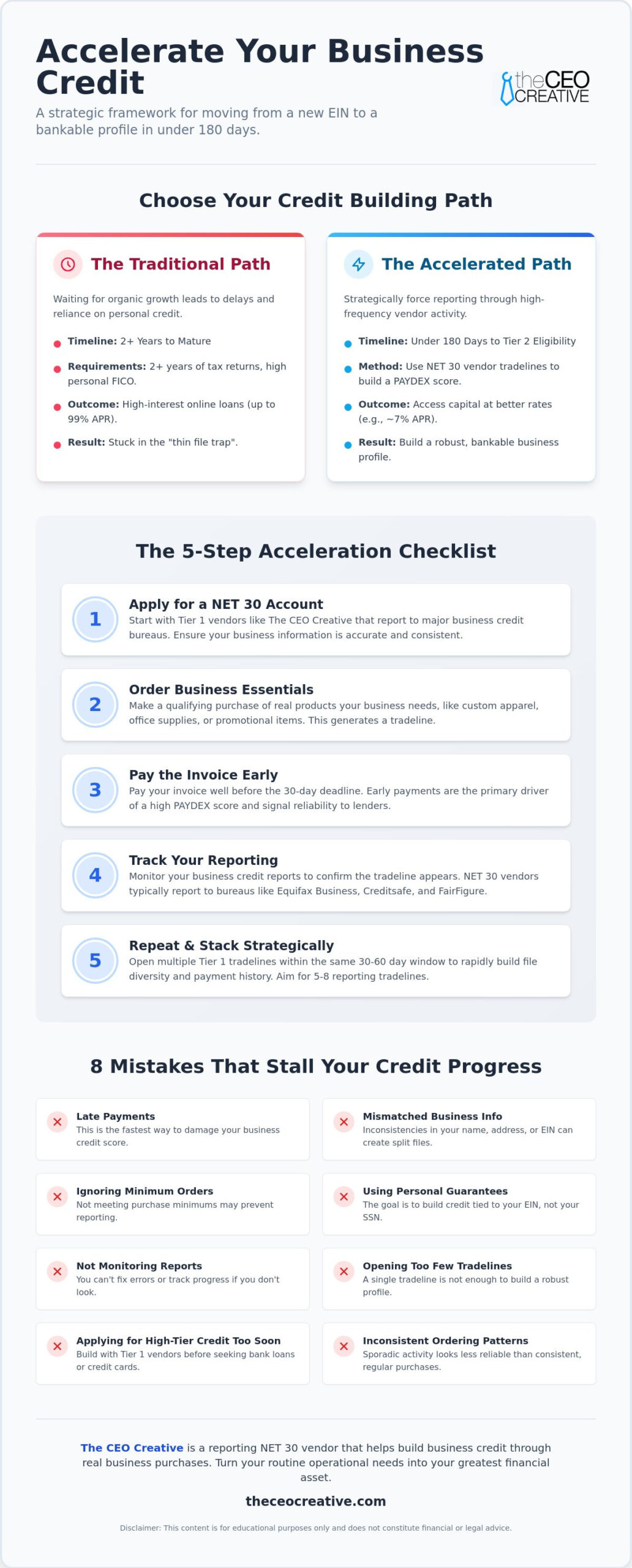
Strategic Stacking: Leveraging Tier 1 Net 30 Vendors for Growth
Opening your first account is a milestone, but the real secret to how to accelerate your business credit building timeline is a method called stacking. Stacking involves applying for and activating 5 to 7 Tier 1 accounts within the same 30 day window. Tier 1 vendors are essential because they offer low barriers to entry, often requiring only a valid EIN and a clean business registration. By grouping these applications, you ensure that multiple positive tradelines hit your credit file simultaneously during the next reporting cycle. This density of data is what moves the needle for new organizations.
Choosing the right vendors is about more than just reporting; it’s about utility. You should prioritize vendors that provide products your business actually uses to establish business credit with a professional footprint. The CEO Creative is a reporting NET 30 vendor that helps build business credit through real business purchases. When you buy items you already need, like branded merchandise or office essentials, you’re turning a routine expense into a strategic financial asset. This approach creates a “thick” credit file that signals stability to future lenders and service providers.
Branding and Supplies as Credit Tools
Lenders look for signs of a legitimate, established operation. Investing in custom branding or high quality office supplies does more than just stock your shelves. It builds the “professional look” that banks expect to see during manual underwriting. Tangible goods are often a better starting point for new files than digital only services. Physical orders create a clear paper trail of shipping and fulfillment, which adds a layer of verifiable activity to your business history. This tangible evidence of commerce is exactly what helps move your file from a startup status to a bankable entity.
The “No Personal Guarantee” Advantage
One of the biggest hurdles for new entrepreneurs is the personal guarantee (PG). A PG links your personal assets and credit score to your business debts. If your business can’t pay, your personal FICO score takes the hit. Strategic stacking with Net 30 accounts allows for EIN only credit building. This means you can scale your operations without impacting your personal credit utilization. As of 2026, SBA 7(a) loan rates can reach up to 14.75% APR, and those rates are often tied to your personal credit health. By building a strong, independent business profile now, you protect your personal financial future while positioning your company for better rates and higher limits down the road.
The 5-Step Acceleration Checklist: From Application to Reporting
Success in building credit isn’t about one-off actions; it’s about a repeatable loop. If you’re serious about learning how to accelerate your business credit building timeline, you need a structured workflow to follow every time you engage with a vendor. This checklist ensures you don’t miss the small details that trigger bureau reporting. By following these five steps, you move from a thin file to a verified profile with speed and precision.
- Step 1: Apply. Ensure your business is “credit ready.” Your legal name, address, and EIN must match your Secretary of State filing exactly. Don’t use a P.O. Box if you can avoid it, as many bureaus flag these as high risk.
- Step 2: Order. Make a qualifying purchase that triggers the reporting mechanism. For example, stocking up on office supplies or customizable products ensures you’re buying items you actually need while building history.
- Step 3: Pay. This is the most critical step. Use the “Early Pay” strategy by settling your invoice within 10 to 15 days of the invoice date.
- Step 4: Track. Set a reminder to check your Equifax Business or Creditsafe reports 60 days after payment. This is the standard window for most vendor data to be processed and displayed.
- Step 5: Repeat. One tradeline doesn’t make a score. You must maintain monthly activity across multiple accounts to keep your file active and healthy.
The Early Pay Advantage
While “Net 30” gives you 30 days to pay, waiting until the final deadline is a missed opportunity. Scoring models like the Dun & Bradstreet PAYDEX score specifically reward businesses that pay ahead of schedule. A perfect score of 100 is typically reserved for those who pay 30 days early, while a score of 80 is given for paying exactly on time. By settling your invoices in the first two weeks, you signal to every automated underwriting system that your business has excellent cash flow. Set up automated reminders or calendar alerts to ensure you never miss this window, as a single late payment can reset your progress for months.
Tracking Your Progress
Don’t assume your data is moving correctly. Use monitoring tools to verify that your tradelines are appearing. Tracking your data is a vital part of knowing how to accelerate your business credit building timeline effectively. If a tradeline doesn’t show up after 60 days, reach out to the vendor to confirm your business information matches their records. Once you have three to five reporting Tier 1 tradelines, you’re ready to move to Tier 2. This next level includes retail credit cards and fuel cards that often have higher limits but require an established baseline of credit. If you’re ready to start this cycle, you can apply for a business Net 30 account today and begin checking off these steps.
Avoiding the Pitfalls: 8 Mistakes That Stall Your Credit Progress
Even the most aggressive strategy fails if you overlook the administrative details. If you want to know how to accelerate your business credit building timeline, you must identify the hidden roadblocks that cause bureaus to ignore your data. Avoiding these common mistakes keeps your trajectory upward and ensures your file remains clean for future lenders. Many entrepreneurs lose months of progress simply because they didn’t realize a small clerical error was blocking their reporting.
- Late Payments. This is the absolute fastest way to derail your progress. A single payment made even one day past the due date can drop your score significantly and flag your account for manual review.
- Mismatched Business Info. As we discussed earlier, consistency is vital. Using “Street” on one form and “St.” on another creates two separate identities in the eyes of the bureaus, resulting in a split file.
- Low Purchase Volume. While any reporting is helpful, extremely small orders don’t always move the needle. Aim for purchases that reflect genuine business needs to demonstrate you can handle meaningful credit.
- Using Personal Funds. Don’t pay your business invoices with a personal credit card or bank account. This obscures the paper trail and prevents the EIN from standing on its own as a creditworthy entity.
- Neglecting the D-U-N-S Number. You must register with Dun & Bradstreet to obtain your unique D-U-N-S number. Without this identifier, your PAYDEX score won’t exist, regardless of how many vendors you pay.
The Danger of Inactivity
Tradelines require current, recurring data to maintain their impact. A “one and done” purchase might get you an initial score, but a dormant tradeline is far less valuable than an active one. Lenders want to see that you’re consistently managing debt, not just that you bought something once six months ago. You should rotate your purchases among customizable products and other operational essentials to keep your files fresh. This consistent activity proves your business is operational and reliable over the long term.
Structural Errors and Legal Compliance
Your business must look like a business on paper. Sole proprietorships often struggle to build independent credit because they’re legally tied to the owner’s Social Security Number. Moving to an LLC or Corporation provides the necessary legal separation. Additionally, ensure you have a dedicated business phone line listed in the 411 directory and a professional email domain. Banks also check your SIC or NAICS industry codes. If your business is accidentally flagged as “high risk,” such as in real estate or credit repair, you might face automatic rejections regardless of your score. Taking the time to fix these structural errors is a critical part of how to accelerate your business credit building timeline.
Take Control of Your Business Financial Future
Building a bankable business profile requires moving from passive waiting to proactive reporting. By utilizing strategic stacking and the five-step checklist, you now have a professional blueprint for how to accelerate your business credit building timeline. As a reporting NET 30 vendor, The CEO Creative helps you bridge the gap between a new EIN and Tier 2 credit eligibility through high-frequency reporting and essential business purchases.
Ready to establish your corporate profile? Apply for a CEO Creative Business Net 30 Account today.
What happens next:
- Receive a decision within one business day for your eligible LLC or Corporation, without a hard personal credit pull.
- Select your first reporting order from our catalog of mugs, engraved merchandise, and professional office supplies.
- Monitor your progress as your on-time payment data is transmitted to Equifax, Creditsafe, and FairFigure.
Establish your credit foundation with a partner that understands the administrative needs of a developing company. Apply for a CEO Creative Business Net 30 Account today.
Frequently Asked Questions
How long does it take for a Net 30 vendor to report to the bureaus?
Most vendors operate on a batch reporting schedule, which usually occurs once per month or once per quarter. This schedule creates a natural lag of 30 to 60 days between your invoice payment and the moment the activity appears on your file. Understanding this timeframe is a vital part of knowing how to accelerate your business credit building timeline, as it allows you to plan your purchases around these reporting windows.
Do I need a personal guarantee for a Net 30 account?
You don’t need a personal guarantee for many Tier 1 accounts. These vendors allow you to apply using only your EIN, which keeps your personal assets and credit score protected. This separation is a core advantage for new entrepreneurs who want to scale their organizations without risking their personal financial health or increasing their personal debt utilization.
Can a new LLC with no revenue get approved for Net 30 terms?
Yes, new LLCs can often get approved even without existing revenue. Tier 1 vendors specifically cater to startups by offering low barriers to entry. They rely on your legal business registration and EIN rather than your financial statements. This makes vendor accounts the ideal first step for organizations that are just beginning to establish their corporate identity.
What bureaus does The CEO Creative report to?
The CEO Creative reports to Equifax Business, Creditsafe, and FairFigure. By reporting to these three major bureaus, we ensure your payment data reaches the platforms most commonly used by lenders and service providers. This multi bureau approach is an essential strategy for those looking for how to accelerate your business credit building timeline through high frequency data points.
How many tradelines do I need to get a business credit score?
Bureaus typically require a minimum of three reporting tradelines to generate a score like the PAYDEX. However, for a file to be considered robust by bank lenders, you should aim for five to seven active accounts. This density of data proves that your business can manage multiple obligations and provides a more accurate picture of your financial reliability.
What happens if my business tradeline doesn’t show up on my report?
If a tradeline is missing after 60 days, the most likely culprit is mismatched business information. Ensure that the name and address you provided to the vendor match your Secretary of State filing exactly. If the data is correct, contact the vendor to confirm your payment was included in their most recent reporting batch to the bureaus.
Is business credit building possible without a personal credit check?
Yes, you can build credit without a personal credit check by focusing on EIN only vendors. These accounts don’t require a hard inquiry on your personal FICO score, allowing you to establish a business profile based solely on your company’s payment performance. This is a critical step for owners who want to keep their personal and professional finances completely separate.
How does the CEO Creative membership help with credit building?
The CEO Creative is a reporting NET 30 vendor that helps build business credit through real business purchases and membership activity. Your membership fee and orders for items like office supplies or custom branding act as consistent data points. These are reported to major bureaus, providing the recurring activity needed to maintain an active and healthy business credit file.
Building business credit? Open a Net 30 Account — EIN only, no personal guarantee, $60 minimum order, credit lines up to $5,500, a decision in one business day, and every on-time payment reported monthly to Equifax Business, Creditsafe and FairFigure.