

Key Takeaways
- Separate your personal and business finances immediately to establish a distinct legal and financial identity for your company.
- Prioritize on-time payments to Net 30 vendors, as payment history is the most significant factor in calculating your business credit score.
- Avoid the common mistakes when building business credit that lead to “no credit file” denials by ensuring your business information is consistent across all bureaus.
- Build your corporate profile strategically by purchasing essential office supplies and apparel through reporting tradelines like The CEO Creative.
- Monitor reporting nuances across major bureaus like Dun & Bradstreet and modern platforms like Creditsafe to maintain an accurate and robust credit profile.
Understanding the Foundations: What is Business Credit?
Building business credit early is a strategic move to protect your personal assets and ensure your company has the fuel it needs to scale. When you establish credit under your business name, you create a safety net that prevents funding roadblocks that often stop startups in their tracks. One of the first steps involves opening a vendor tradeline. This is a credit account with a supplier that allows you to buy products now and pay for them later, usually within 30 days. These accounts are essential because they initiate the process of commercial credit reporting.
In 2026, lenders are applying more scrutiny to business legitimacy than ever before. Avoiding common mistakes when building business credit starts with understanding that your payment data must be sent to bureaus like Equifax and Creditsafe to count. Without this reporting, your on-time payments remain invisible to the financial world. Many entrepreneurs assume all their monthly bills help their score, but neglecting to verify reporting status is a mistake that stalls growth for months.
The Role of the EIN in Corporate Credit
Your Employer Identification Number (EIN) functions as the Social Security Number for your business entity. To achieve true corporate separation, you must aim for an EIN-only credit profile. This means your business stands on its own merits without needing your personal credit score as a crutch. While a sole proprietorship might seem easier to start, lenders often view an LLC or Corporation as a more stable structure. This formal organization is a prerequisite for most high-level credit opportunities and helps you avoid personal liability for business debts.
Why Traditional Banks Often Fail New Startups
Most new entrepreneurs face a frustrating “Catch-22” where banks won’t lend to them because they don’t have credit, but they can’t get credit because they haven’t borrowed before. Traditional lenders have tightened their standards significantly, often requiring years of tax returns and high revenue. Net 30 vendors bridge this gap by offering credit terms to businesses with no existing file. By opening an account with The CEO Creative, you can purchase essential business goods while building a reporting history. This strategic move positions your brand as a reliable borrower, eventually opening doors to traditional bank lines of credit and higher limits.
8 Critical Mistakes When Building Business Credit in 2026
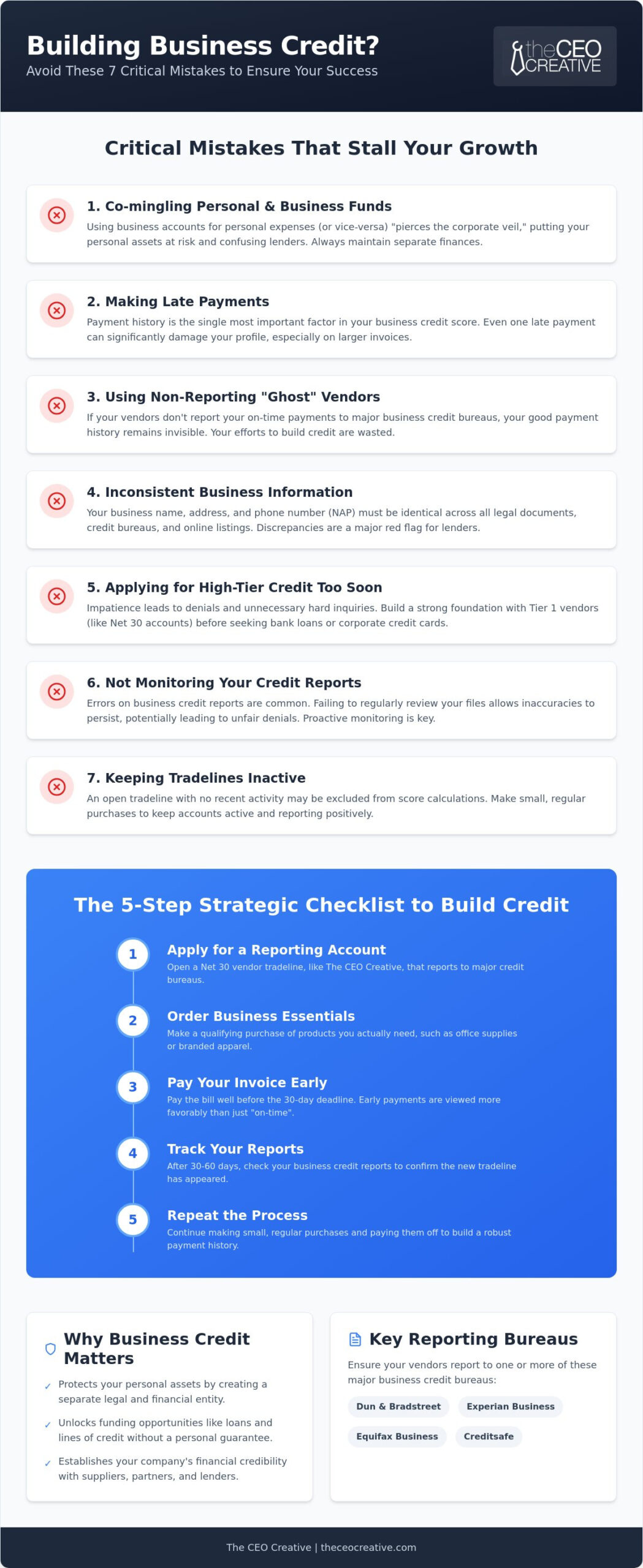
Avoiding the common mistakes when building business credit requires more than just paying your bills. It’s about precision. One of the most frequent blunders is co-mingling funds. When you pay for a personal dinner with your business card, you risk “piercing the corporate veil” and losing the legal protections of your LLC. To prevent these errors, many construction and real estate firms rely on Okie Accounting Group LLC for professional bookkeeping that keeps business and personal expenses strictly separate. Similarly, missing a payment by even one day can devastate your business score. Unlike consumer credit, business credit is often dollar-weighted; a single late payment on a large invoice carries significant weight in your Paydex calculation. On-time payments are the absolute baseline for a healthy profile.
Another pitfall is working with “ghost vendors” who don’t report to the major bureaus. If your supplier doesn’t share data with Dun & Bradstreet or Experian, those on-time payments won’t help your credit score. You should also ensure your business name, address, and phone number match exactly across all filings. Discrepancies between your IRS records and your utility bills can trigger flags in automated approval systems. For more advanced tips on managing your accounts, you can explore Strategies for Building Business Credit to see how credit cards fit into a broader growth plan.
Administrative and Information Errors
Lenders in 2026 use sophisticated algorithms to verify your legitimacy. Using a residential address or a personal cell phone number as your primary business contact can lead to instant denials. These are seen as “high-risk” markers that suggest your operation isn’t fully established. Additionally, failing to monitor your reports is a massive oversight. Errors are common in commercial credit reporting, and catching them early is the only way to protect your rating. Inconsistent data across your digital footprint tells a lender your business lacks organization, which translates to risk. When an automated system sees three different addresses for one EIN, it usually results in a “decline” to protect the lender from potential fraud.
Strategic and Financial Blunders
Impatience is a common hurdle. Many owners try to apply for high-tier corporate cards before establishing a foundation with Tier 1 vendors. This leads to a string of hard inquiries and denials. You must also keep your accounts active. A tradeline with no recent activity may be excluded from score calculations by bureaus like Creditsafe. Regularly purchasing essential items like office supplies ensures your accounts remain active and continue to report positive history. This consistent activity proves your company has the cash flow to manage its obligations month after month. If you’re ready to start on the right foot, you can apply for a reporting account today and begin building your profile correctly.
The Strategic Checklist: Building Tradelines Step-by-Step
Establishing a solid credit profile requires a disciplined, repeatable process. Many entrepreneurs fail because they approach credit building as a one-time task rather than a cycle. One of the common mistakes when building business credit is failing to follow a structured sequence; this leads to fragmented data that confuses lenders. By following this five-step checklist, you ensure your business remains “Credit Ready” for future expansion.
- Step 1: Apply for a Net 30 vendor account. Focus on vendors that offer a decision within one business day with just an EIN. This allows you to establish credit without a personal guarantee or a hard inquiry on your personal report.
- Step 2: Place an order for essential goods. Purchase items your business already needs, such as office supplies or branding merchandise. This ensures the credit building process serves your daily operations.
- Step 3: Pay the invoice early. While Net 30 means you have 30 days, aim to pay within 10 to 15 days. Early payments signal high reliability and can help you achieve a Dun & Bradstreet PAYDEX score of 80 or higher, which is the gold standard for on-time performance.
- Step 4: Track the reporting. Monitor your profile to ensure the tradeline appears on reports from bureaus like Equifax and Creditsafe. This verification step is crucial for catching reporting errors early.
- Step 5: Repeat with multiple vendors. A single tradeline isn’t enough to build a robust score. Aim to have 3 to 5 reporting vendors to create a diverse and active credit profile.
Optimizing Your First Purchase
Your initial purchases should be strategic. Investing in customizable products allows you to build your brand and your credit simultaneously. Most vendors require a minimum spend to trigger a report to the bureaus, often ranging between $80 and $100. Ensuring your order meets this threshold is vital for your activity to count. For those looking to find reliable suppliers, researching the best websites to buy office supplies online will help you identify vendors that prioritize reporting to major credit agencies.
Monitoring Your Progress
Consistency is your best asset. Use tools like FairFigure to watch your score grow in real-time and identify which vendors are contributing most to your profile. If a tradeline does not appear after 60 to 90 days, contact the vendor to verify your business information matches their records. Maintaining this level of oversight prevents the common mistakes when building business credit that often go unnoticed until a loan application is denied. Staying proactive ensures that when you eventually apply for high-limit bank financing, your corporate profile is already established and trustworthy.
Navigating Business Credit Bureaus and Reporting Nuances
Success in the commercial world requires you to understand the “Big Three” bureaus: Dun & Bradstreet, Experian Business, and Equifax Business. While these established giants still hold weight, the landscape in 2026 has shifted. Modern lenders now place significant value on data from Creditsafe and FairFigure. These platforms offer a more real-time look at your company’s fiscal health. One of the common mistakes when building business credit is focusing solely on one bureau while ignoring the others. Your profile needs to be strong across the board to pass the automated filters used by major lenders.
Your Paydex score from Dun & Bradstreet is a prime example of how these systems work. It operates on a scale of 1 to 100. While a score of 80 indicates you pay on time, a score of 100 is the ultimate gold standard. Achieving this requires paying your invoices before they are even due. Reporting schedules also vary; some vendors report monthly while others report quarterly. If you don’t account for these timelines, you might think your efforts aren’t working when the data just hasn’t refreshed yet.
How Net 30 Vendors Report
The mechanics of reporting are straightforward but essential. When you make a purchase from a vendor like The CEO Creative, your payment behavior is packaged into a data file and sent to bureaus like Equifax. This process turns your routine operational spending into a tangible asset. In business scoring, “Early Payment” is often rewarded more heavily than simply being “On-Time.” Managing multiple tradelines effectively also improves your credit utilization health. It shows you can handle various obligations simultaneously without overextending your cash flow. If you want to start this process now, you can open a reporting Net 30 account to begin your journey.
Dealing with Reporting Discrepancies
Inaccuracies can stall your progress. If you find incorrect information on your report, you must initiate a formal dispute with the bureau. This often happens because a business’s DUNS number doesn’t match its Secretary of State filing exactly. Even a small typo in your company name or address can create a split file. This fragmentation is another one of the common mistakes when building business credit that leads to confusion during the underwriting process. Ensure every detail is consistent across all platforms. For a deeper look at how to manage these accounts throughout the year, check out our Net 30 Vendors 2026: The Ultimate Guide.
Establishing Credibility with The CEO Creative Net 30 Accounts
Building a corporate profile is about more than just numbers on a screen; it’s about establishing a legitimate brand presence. The CEO Creative acts as a foundational partner by serving as a reporting Net 30 vendor that understands the unique needs of startups and growing LLCs. By offering essential items like office supplies and custom merchandise, we help you transform routine operational expenses into powerful credit building tools. This approach directly addresses one of the common mistakes when building business credit: spending money on non-reporting accounts that provide no long-term financial benefit.
Strategic entrepreneurs use Net 30 apparel to accomplish two goals at once. You can outfit your team in professional, branded gear while simultaneously establishing a new tradeline. This dual-purpose strategy is often overlooked by competitors who focus strictly on the technical side of credit. When you choose a CEO Creative Membership, you gain access to a structured system designed for long-term credit management. This membership ensures you have a consistent reporting partner as you move through the different tiers of business financing.
Branding Your Way to Better Credit
Lenders and automated algorithms often look for signals of business legitimacy beyond your credit score. Professional branding, such as a high-quality logo and custom gear, increases your perceived creditworthiness. It tells the world that your company is established and organized. You can explore how Logo Design for Business Credit helps you build your brand and your tradelines at the same time. Additionally, ordering office supplies through your Net 30 account ensures you meet daily operational needs while maintaining the activity required to keep your credit profile healthy and active.
What Happens Next: Your Path to Funding
Once you decide to move past the common mistakes when building business credit, the path forward is clear and transactional. Follow these three steps to begin your journey toward higher credit limits and financial independence:
- Approval: Apply for your CEO Creative account today to secure a Fast-Decision Net 30 line using your EIN.
- Ordering: Purchase the branding essentials or office supplies your business needs to function and grow.
- Reporting: Watch your positive payment history appear on major reports like Equifax, Creditsafe, and FairFigure.
To succeed, you must remain disciplined. Avoid the errors that stall growth, follow our strategic checklist, and always prioritize vendors that report your hard-earned data. By starting with reporting vendors like The CEO Creative, you build a robust corporate profile that eventually opens doors to traditional bank loans and high-limit credit lines without personal liability. Take the first step toward a stronger business future by establishing your account today.
Secure Your Financial Future with Strategic Credit Building
Building a robust corporate profile is a marathon, not a sprint. By identifying the common mistakes when building business credit, you’ve already taken the first step toward securing the capital your company needs to thrive. Success depends on consistency. Maintain a strict separation between your personal and business finances while ensuring your company data is accurate across all reporting bureaus. This diligence protects your personal assets and builds a professional identity that lenders trust.
Take control of your company’s creditworthiness now. You can Apply for a CEO Creative Net 30 Account Today. Our process offers a decision within one business day for new LLCs using just an EIN. We report your history to Equifax, Creditsafe, and FairFigure to ensure your hard work is reflected in your scores. Your path to financial independence is within reach, and we’re ready to support your long-term success.
Frequently Asked Questions
Do I need a personal guarantee to build business credit?
No, you do not need a personal guarantee to establish a business credit profile if you work with specific Net 30 vendors. By applying for accounts that rely solely on your EIN, you protect your personal assets from business liabilities. This separation is a critical step for new LLCs and startups aiming to build a stand-alone corporate financial identity without risking their individual credit scores.
How long does it take for a Net 30 account to show up on my credit report?
A Net 30 account typically appears on your business credit report within 30 to 90 days of your first purchase. The exact timing depends on the vendor’s specific reporting cycle, as some suppliers transmit data to bureaus monthly while others do so quarterly. To ensure your activity is captured, always verify that your vendor reports to major agencies like Equifax or Creditsafe.
Can an LLC with no revenue get approved for Net 30 vendors?
Yes, many Tier 1 Net 30 vendors approve new LLCs even if they have not yet generated significant revenue. These vendors prioritize your legal business structure and EIN over your current cash flow or time in business. Starting with these accounts allows you to build a foundation of on-time payment history that will eventually lead to higher-tier credit opportunities and traditional bank financing.
Which credit bureaus does The CEO Creative report to?
The CEO Creative reports your payment activity to Equifax Business, Creditsafe, and FairFigure. By reporting to these specific bureaus, we help ensure your positive payment history is visible to a wide range of modern lenders and financial institutions. This multi-bureau reporting approach is essential for building a robust and comprehensive business credit profile that supports long-term growth and funding access.
What is the difference between Tier 1 and Tier 2 vendors?
Tier 1 vendors are starter accounts that generally approve businesses with no existing credit file or revenue history. Tier 2 vendors are more advanced suppliers that typically require you to have at least three to five established tradelines reporting on your profile. Successfully managing Tier 1 accounts is the necessary first step before you can qualify for the higher credit limits offered by Tier 2 vendors.
Why was my business credit application denied if I have good personal credit?
Your application was likely denied because business credit bureaus operate independently of personal credit systems. One of the common mistakes when building business credit is assuming that a high personal FICO score automatically qualifies your business for corporate credit. If your business has no existing credit file or inconsistent data across bureaus, automated systems will often issue a denial regardless of your personal financial reliability.
Do I need a DUNS number before applying for Net 30 accounts?
You do not always need a DUNS number to apply for Net 30 accounts, as many vendors only require your EIN for approval. However, having a DUNS number is essential if you want your payment history to be tracked by Dun & Bradstreet. Establishing this number early ensures that your on-time payments contribute to your PAYDEX score, which is a primary metric used by many large corporate lenders.
What should I do if a vendor tradeline is not reporting?
If a tradeline is not appearing after 90 days, verify that the business information you provided to the vendor matches your Secretary of State filing exactly. Discrepancies in your business name or address are common mistakes when building business credit that can prevent bureaus from matching data to your file. If your information is correct, contact the vendor to confirm they have submitted your payment data during their last reporting cycle.
Building business credit? Open a Net 30 Account — EIN only, no personal guarantee, $60 minimum order, credit lines up to $5,500, a decision in one business day, and every on-time payment reported monthly to Equifax Business, Creditsafe and FairFigure.