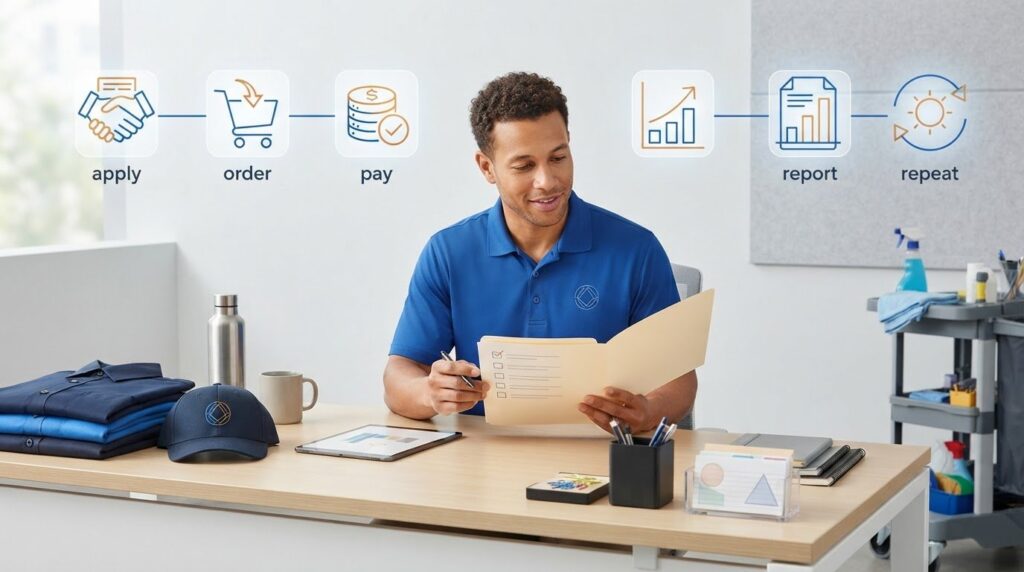


What if a minor oversight on a small invoice could freeze your company’s ability to scale for the next three years? It sounds extreme, but the impact of late payments on business credit is often immediate and unforgiving. Unlike personal credit, where you might have a small window of grace, business bureaus track your reliability with clinical precision. This means even a forty-eight hour delay can trigger a “Slow Pay” status that alerts every potential lender to a perceived risk.
We understand that managing cash flow as a new LLC or startup is a constant balancing act. It’s frustrating when one timing error feels like it’s sabotaging your hard work and growth potential. You deserve a financial foundation that supports your ambition rather than holding it back. This article will show you exactly how to navigate the mechanics of corporate reporting to protect your EIN-based tradelines. We’ll explore the specific ways late payments damage your profile and provide a step-by-step system to mitigate damage and ensure consistent, on-time reporting for long-term success.
Key Takeaways
- Learn why business bureaus track “Days Beyond Terms” and how even a forty-eight hour delay can trigger a damaging “Slow Pay” status on your profile.
- Discover the immediate impact of late payments on business credit scores like the Dun & Bradstreet PAYDEX, where falling below the benchmark of 80 signals high risk.
- Understand the ripple effect of a single delinquency, which can lead to sudden credit limit decreases from other vendors and higher interest rates on future loans.
- Master a step-by-step recovery checklist designed to repair your profile through consistent, on-time payment reporting with Tier 1 vendor tradelines.
- Explore how a strategic membership with a reporting vendor like The CEO Creative helps maintain the steady activity needed for a resilient corporate credit file.
Understanding the “Slow Pay” Status and Business Credit Reporting
The CEO Creative acts as a strategic partner for new LLCs and startups by functioning as a reporting Net 30 vendor. When you open a business net 30 account, you gain access to credit terms that allow you to pay for your purchases thirty days after the invoice date. These arrangements create vendor tradelines, which are essentially the building blocks of your corporate credit file. Establishing these lines is the first step toward a Tier 1 profile, but maintaining that profile requires a deep understanding of how timing affects your reputation.
Falling into the “Slow Pay” trap can happen faster than many entrepreneurs realize. We’ll show you how to navigate these reporting cycles so you can protect your EIN and keep your growth on track. Understanding the impact of late payments on business credit is essential because the business world operates on a strict pay-by-date mentality. Even a few days of delay can trigger a negative report that stays on your record longer than you might expect.
The Mechanics of Payment Reporting
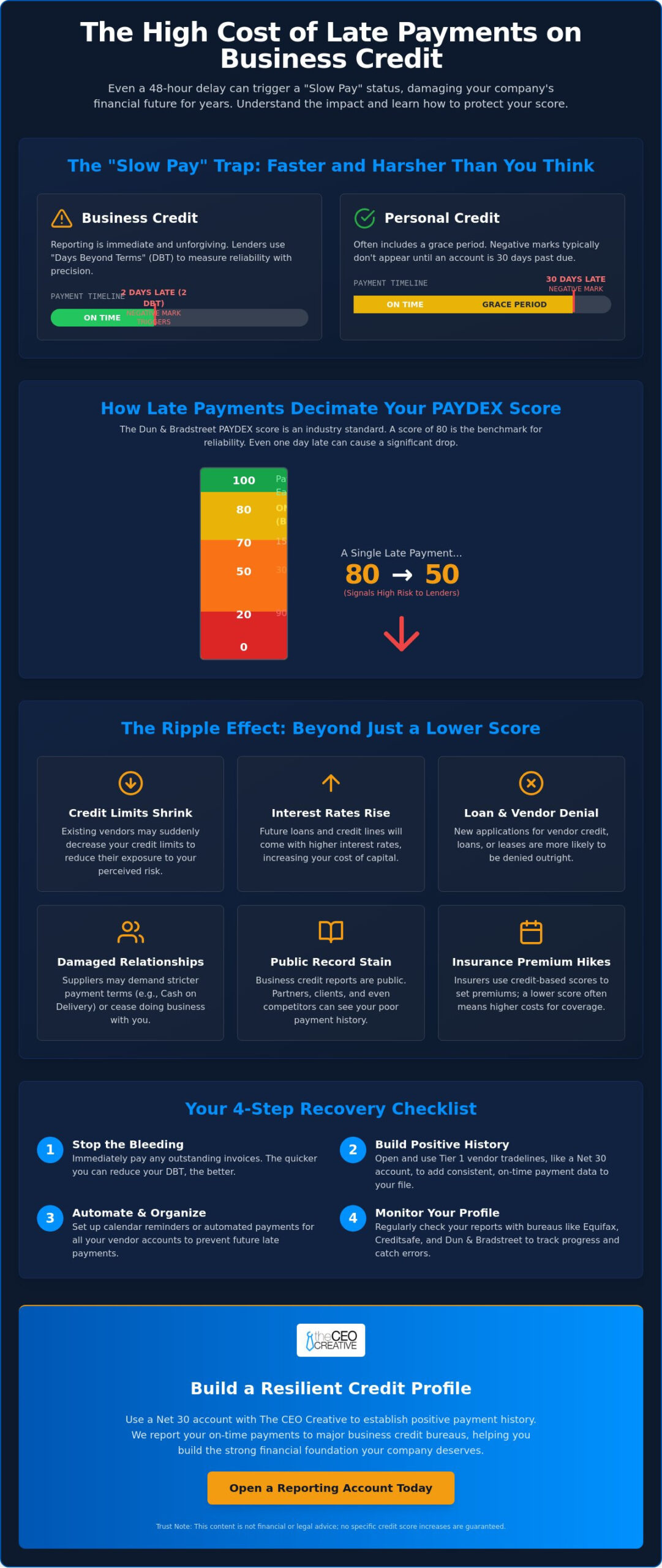
Vendors report your payment habits to major bureaus like Equifax and Creditsafe to help other creditors assess your risk level. They use a specific metric called “Days Beyond Terms” (DBT) to track your reliability. If your invoice is due on the 30th and you pay on the 32nd, you are officially 2 DBT. This is a sharp contrast to personal credit, where a late mark often doesn’t appear until you are thirty days past due. In the commercial sector, being just forty-eight hours late is documented and can lower your internal scores immediately. Trust Note: This content is not financial or legal advice; no specific credit score increases are guaranteed.
Why Business Credit is Different from Personal Credit
One major distinction is that Business credit reports are public information. Any potential partner, supplier, or competitor can pay a fee to view your payment history. Even if you haven’t provided a personal guarantee, a negative mark stays attached to your EIN and can stunt your company’s growth. Consistency is also vital for successful reporting. Ensure your business name, address, and phone number match exactly across all your vendor accounts. Small discrepancies can lead to fragmented files or missed reporting, making it harder to prove your reliability to future lenders who are looking for a clean, professional history.
How Late Payments Decimate Your Business Credit Scores
The impact of late payments on business credit is both immediate and quantifiable. Unlike personal credit, where a single late mark might take a month to appear, business bureaus like Dun & Bradstreet update scores as soon as a vendor reports a delay. The PAYDEX score, which is the industry standard for commercial creditworthiness, operates on a scale of 0 to 100. An 80 is the essential benchmark for on-time payments. If you pay even one day late, your score begins to drop; a single 30-day delinquency can cause a PAYDEX score to plummet by 20 to 30 points instantly.
Many entrepreneurs fall victim to the “Reporting Delay” myth, believing they can wait until the end of the month to settle invoices. This is a dangerous game. Vendors report based on the specific invoice due date, not the calendar month. If your terms are Net 30 and you pay on day 31, you have officially triggered a negative report. For a business with a high score of 780, research indicates a single 30-day late payment can cause a drop of 90 to 110 points. Understanding how business credit is assessed helps you realize that these bureaus prioritize recent payment behavior above almost all other factors.
The Score Breakdown: From 80 to 50
When your payment history shifts from “on-time” to “1-15 days late,” your score drops below the prime threshold of 80. This shift signals to other creditors that your cash flow may be tightening. These marks are typically visible on your report for 36 months, though some negative indicators can linger indefinitely in the business world. A single 30-day delinquency can disqualify a business from Tier 2 credit and force you back into high-interest, personal-guarantee territory. To avoid these pitfalls, it is often best to establish clear, manageable terms through a business net 30 account that rewards consistent behavior.
Bureau Specifics: Equifax, Creditsafe, and FairFigure
Each bureau interprets your payment data through a slightly different lens. Equifax Business focuses heavily on credit utilization and delinquency trends, triggering high-risk alerts the moment a payment pattern breaks. Creditsafe uses a 1-100 score where your “Days Beyond Terms” (DBT) acts as the primary driver for your risk rating. FairFigure takes a more holistic approach, providing a transparent view of your business health while remaining highly sensitive to the consistency of your Net 30 reporting. When you miss a payment, these platforms synchronize the data, creating a unified front that can make securing new vendor lines or equipment financing significantly more difficult and expensive.
The Ripple Effect: Beyond Just a Lower Credit Score
The impact of late payments on business credit extends far beyond a simple numerical drop. Think of your credit profile as a digital reputation that every potential partner reviews before deciding to work with you. When one vendor reports a “Slow Pay” status, it often triggers a defensive reaction from your other creditors. You might find that a supplier who previously granted you a $5,000 credit limit suddenly slashes it to $500 without warning. This happens because lenders use automated systems to monitor risk; a delinquency anywhere in the network suggests your cash flow is under pressure.
Beyond credit limits, your ability to secure affordable capital is at stake. As of February 2026, the starting interest rate for an SBA line of credit is 11.75%, but this rate is reserved for businesses with pristine payment histories. If your profile shows recent delays, you could be pushed toward non-bank lenders where rates can exceed 60%. Understanding how late payments affect credit scores is vital for any CEO who wants to avoid these predatory costs. A strategic way to prevent this is by maintaining consistent, small-scale activity. Regularly purchasing essential office supplies ensures your tradelines remain active and positive, proving your reliability month after month.
Vendor Account Revocation
Trust is the currency of the B2B world. Many “a decision within one business day” vendors provide accounts based on the assumption of future reliability. If their monitoring tools detect a delinquency on your Equifax or Creditsafe files, they may revoke your terms or close your account entirely to mitigate their own risk. Regaining this trust is a long, uphill battle once that “Slow Pay” tag is attached to your EIN. For a deeper look at managing these relationships effectively, consult our Net 30 Vendors 2026 Guide to ensure your account management remains flawless.
Impact on Scaling and Branding
Limited credit access directly stunts your ability to market your business effectively. If you can’t access vendor terms, you lose the ability to place large orders for customizable products that drive brand awareness. Corporate credibility is built on the underlying systems that make your business sustainable. Using professional items like business t-shirts as a tool for credit building allows you to keep your spending purposeful. It transforms a routine marketing expense into a strategic move that strengthens your credit file while simultaneously elevating your brand’s presence in the market.
Recovery Strategy: Fixing Your Business Credit Profile
Recovering from a financial misstep requires more than just an apology to your vendor. You must actively dilute the negative data by flooding your profile with consistent, on-time reports. While the impact of late payments on business credit is significant, your most recent activity carries the most weight in modern scoring models. If you have an inaccurate late mark, you should dispute it directly with the bureaus using proof of payment; however, if the mark is accurate, your best path forward is a disciplined recovery strategy.
One powerful “hack” for boosting your PAYDEX score is the early payment method. While Net 30 terms give you thirty days, paying on day 20 signals exceptional liquidity to the bureaus. This proactive approach can often push your score above the standard 80 mark, helping you stand out to future lenders. Start your recovery today by opening a business net 30 account and establishing a new baseline of reliability.
The 5-Step Credit Building Checklist
Follow this structured path to rebuild your corporate reputation and demonstrate financial stability:
- Step 1: Apply for a business net 30 account with a reporting vendor that understands the needs of growing LLCs.
- Step 2: Order essential items like net30 apparel or stationery to keep your brand looking professional while you build.
- Step 3: Pay the invoice at least 10 days before the due date to maximize the positive effect on your score.
- Step 4: Track the reporting on Creditsafe or FairFigure to ensure your consistency is being recognized.
- Step 5: Repeat this process monthly to dilute the impact of old late payments on business credit and strengthen your file.
Common Mistakes in Business Credit Management
Avoid these frequent pitfalls to ensure your recovery strategy remains effective and your corporate veil stays intact:
- Using personal funds to pay business invoices, which can lead to piercing the corporate veil and personal liability.
- Failing to update your business address with the Secretary of State and bureaus, causing fragmented or missing credit reports.
- Waiting for a physical “bill” in the mail instead of tracking the Net 30 due date proactively through your online portal.
- Only buying high-ticket items occasionally instead of making consistent, smaller professional purchases that show steady activity.
- Ignoring the “Days Beyond Terms” metric and assuming a payment is only “late” if it’s more than thirty days past due.
- Neglecting to dispute clear reporting errors with Dun & Bradstreet or Equifax because the process feels intimidating.
Building a Resilient Profile with The CEO Creative
The CEO Creative positions itself as more than just a vendor; we act as a foundational support system for the long-term success of your organization. For new LLCs and startups, the logistical hurdles of credit management can feel overwhelming, but a structured approach simplifies the process. By choosing a CEO Creative Membership, you ensure your business has access to consistent tradeline reporting that keeps your profile active and healthy. This membership transforms the routine act of purchasing essentials into a strategic move that elevates your brand’s financial standing.
Resilience in business credit is built on the back of reliability. While the impact of late payments on business credit can be devastating to your growth, a steady stream of positive data acts as a protective shield. We focus on helping you establish a rhythm of on-time payments that bureaus like Equifax and Creditsafe reward with higher scores and better risk ratings. This consistency is what allows a small, localized entity to eventually compete for the same high-level funding as established agencies.
Strategic Procurement for Growth
Every dollar you spend on your business should work double duty. When you purchase onboarding kits, uniforms, or promotional items through your Net 30 account, you’re investing in your brand’s aesthetics while simultaneously building your credit history. Professional services like logo design also play a dual role. They establish your corporate credibility in the eyes of customers and provide a verifiable reporting event for the bureaus. This consistent reporting creates a vital “safety net” for future funding needs, ensuring that when you’re ready to scale, your credit file is ready to support you.
Long-term sustainability is impossible without a clean credit file. The impact of late payments on business credit often lingers for years, but a commitment to the “Apply, Order, Pay, Track” cycle dilutes those old marks. Focus on making smaller, professional purchases every month rather than waiting for a large project to trigger an order. This keeps your tradelines warm and proves to every potential creditor that your business is a reliable, organized, and visionary partner worth their trust.
What Happens Next
- Apply for your Net 30 account today to trigger the first reporting cycle for your EIN.
- Shop the catalog for essential business branding tools, from apparel to office supplies, to keep your profile active.
- Monitor your bureau reports monthly to ensure 100% on-time accuracy and track your progress toward a Tier 1 profile.
Secure Your Company’s Financial Future
Managing the impact of late payments on business credit requires a proactive shift from reactive bill-paying to strategic financial management. You’ve learned that business bureaus track “Days Beyond Terms” with extreme precision, making on-time reporting the most critical factor in your corporate reputation. While a single delinquency can be a setback, it’s not a permanent roadblock. By establishing a consistent cycle of early payments and focusing on purposeful procurement, you can dilute old negative marks and build a profile that attracts Tier 1 funding.
Don’t let a lack of credit history or a past mistake stunt your growth. You can start building a resilient, professional profile today by leveraging the right vendor partnerships. With a decision within one business day for new LLCs using just an EIN, we provide the tools you need to succeed. Our system reports your activity to Equifax, Creditsafe, and FairFigure, ensuring your reliability is visible to the entire lending network. Apply for a CEO Creative Business Net 30 Account Today to access high-quality custom branding and office supplies while you strengthen your company’s credit file. We’re here to act as your foundational support system as you scale toward your long-term ambitions.
Frequently Asked Questions
Do late payments on Net 30 accounts affect my personal credit score?
Late payments on Net 30 accounts typically don’t affect your personal credit score as long as you haven’t signed a personal guarantee. Most vendor tradelines are tied exclusively to your EIN, isolating the activity from your Social Security number. However, if an account becomes severely delinquent and is sold to a collection agency that reports to consumer bureaus, your personal credit could be impacted.
How long do late payments stay on a business credit report?
Negative marks can remain on a business credit report indefinitely, though their influence on your score usually diminishes after 36 months. The impact of late payments on business credit is most severe during the first year, as bureaus prioritize recent payment behavior. Unlike consumer credit, there is no federal law requiring the removal of accurate business data after seven years.
Can I remove a late payment from my business credit file?
You can only remove a late payment if it is factually inaccurate or the result of a reporting error. If the mark is correct, you cannot have it removed; instead, you must focus on diluting its impact by adding multiple positive tradelines. Consistent on-time payments over the next six to twelve months will eventually outweigh the old negative data.
Does paying a Net 30 invoice early help my business credit score?
Paying a Net 30 invoice early provides a significant boost to your Dun & Bradstreet PAYDEX score. While paying exactly on time earns you a score of 80, paying 10 to 20 days before the due date can push your score into the 90s. This proactive behavior signals to future creditors that your business has superior liquidity and is a low-risk partner.
What is the difference between a 30-day and a 60-day delinquency in business credit?
A 30-day delinquency is viewed as a cash flow oversight, whereas a 60-day delinquency often signals a serious risk of business failure. Once an account reaches the 60-day mark, many vendors will permanently revoke your credit terms and report the status as high-risk. This level of delinquency can lead to automated rejections from other lenders across the entire bureau network.
Will one late payment stop me from getting other Net 30 accounts?
One late payment can indeed trigger automated rejections for new Net 30 accounts because many vendors use risk-monitoring software. If your Creditsafe or Equifax file shows a recent “Slow Pay” status, other vendors may view you as a liability. You will likely need to demonstrate at least three to six months of perfect payment history to regain access to new credit lines.
Does The CEO Creative report late payments to the credit bureaus?
The CEO Creative reports both positive and negative payment activity to Equifax, Creditsafe, and FairFigure to ensure a transparent credit profile. As a foundational support system for entrepreneurs, we prioritize accurate reporting to help you establish a Tier 1 profile. Maintaining on-time payments with us ensures your reliability is documented and visible to future financial partners.
How can I track which bureaus my vendors are reporting to?
You can track which bureaus your vendors report to by using monitoring tools like FairFigure or Creditsafe. These platforms provide a consolidated view of your tradelines and show which specific bureaus are receiving your data. Regularly checking these reports helps you ensure your business info consistency and allows you to catch the impact of late payments on business credit before applying for new loans.
Building business credit? Open a Net 30 Account — EIN only, no personal guarantee, $60 minimum order, credit lines up to $5,500, a decision in one business day, and every on-time payment reported monthly to Equifax Business, Creditsafe and FairFigure.