

What if you could fund your startup’s essential operations and build a robust business credit profile without ever stepping into a bank or signing a personal guarantee? Most founders believe that a lack of established history or limited cash flow means they’re stuck waiting for traditional loans that may never come. It’s frustrating to feel like your growth is stalled because you don’t yet have the “right” numbers on a bureau report. This guide shows you how to implement creative funding solutions for startups by leveraging net 30 vendor accounts and strategic tradelines.
You’ll learn to use your EIN to secure the supplies you need while simultaneously reporting positive payment data to bureaus like Equifax, Creditsafe, and FairFigure. We’ll break down the exact steps to establish your profile, from choosing the right reporting vendors to avoiding common pitfalls that keep most businesses invisible to lenders. This information is provided for educational purposes and is not intended as financial or legal advice; we make no guarantees regarding specific credit score increases or financing approvals.
Key Takeaways
- Learn how to implement creative funding solutions for startups by using net 30 vendor accounts to manage cash flow while establishing a business credit profile.
- Understand the mechanics of vendor tradelines and how reporting to bureaus like Equifax and Creditsafe builds your company’s financial reputation.
- Discover how to turn routine operational costs, such as uniforms and office supplies, into strategic assets that strengthen your corporate credit.
- Follow a clear, step-by-step process for applying with your EIN and placing orders that generate positive payment history.
- Identify and avoid common pitfalls like inconsistent business data that can prevent your credit building efforts from being recognized by major bureaus.
What is Creative Funding for Startups? The Hook and Promise
Creative funding isn’t just a search for capital; it’s a strategic approach to managing cash flow and building institutional leverage. For many new ventures, traditional startup funding options like bank loans or venture capital often feel out of reach due to a lack of established history. Implementing creative funding solutions for startups involves using non-traditional methods to acquire assets and build a reputation. By leveraging vendor credit, you can secure the supplies your business needs today while manufacturing the credit history required for larger financing tomorrow.
The Role of The CEO Creative in Your Funding Journey
The CEO Creative acts as a reporting net 30 vendor designed specifically for the growth of modern organizations. When you secure a business net 30 account, you gain access to a dual-benefit system. You can purchase essential branding products, such as professional uniforms or onboarding kits, while the transaction generates a reporting event for your business. This makes us a strategic partner for new LLCs that need to look professional and build a financial footprint simultaneously. We focus on providing the tools that help you scale without the friction of traditional retail barriers.
The Hook: Credit Without a Personal Guarantee
The most significant hurdle for most founders is the requirement of a personal guarantee. Traditionally, lenders want you to put your personal assets on the line because your business doesn’t have its own score. Our approach flips this script. You can build a corporate credit profile using only your EIN. This guide promises to show you exactly how to establish your first tradelines and secure operational supplies. By the end of this article, you’ll have a clear roadmap to funding your operations through smart, strategic spending.
Trust Note and Compliance
Integrity is the foundation of our partnership. Please understand that this content is not financial or legal advice. We provide educational resources to help you understand the business credit landscape. We make no guarantees regarding specific credit score increases or future loan approvals. Success in building credit requires your commitment to consistent, on-time payments and maintaining accurate business records across all bureaus. Always consult with a qualified professional for specific financial planning needs.
The Mechanics of Net 30: How Vendor Tradelines Fuel Growth
Net 30 payment terms are the engine behind many creative funding solutions for startups. Simply put, “Net 30” means you have a 30-day window to pay your invoice in full after the purchase date. This creates a short-term, interest-free credit facility that allows you to keep cash in your business longer. For a detailed look at how to select the right partners for this strategy, check out our Net 30 Vendors 2026: The Ultimate Guide. By using these terms, you aren’t just buying time; you’re building a track record of financial responsibility.
Vendor tradelines are the bedrock of a healthy business profile. A tradeline is a record of a credit account on your business credit report. When you use a net 30 vendor, they extend credit to your company based on its own merits. As you pay these invoices on time, that activity is reported to credit bureaus. This process builds a history of reliability that eventually qualifies you for more substantial financing, such as SBA loans, which often require a proven track record of managing debt.
Understanding the Reporting Ecosystem
Business credit isn’t a single score. It’s an aggregate of data from multiple sources. We report your payment history to Equifax Business, Creditsafe, and FairFigure. These bureaus track how quickly you settle your debts and assign a score based on your patterns. For a new startup, reporting frequency is vital. Regular, monthly reporting ensures your profile stays active and accurately reflects your current financial discipline. This visibility is what transforms a routine purchase into a strategic credit-building event.
EIN vs. SSN: Building Credit Without a Personal Guarantee
One of the biggest advantages of vendor accounts is the ability to build credit using your Employer Identification Number (EIN) alone. This separates your personal finances from your business operations. Most net 30 accounts allow for “no PG” (no personal guarantee) approvals. This means your personal assets, like your home or personal savings, aren’t at risk if the business faces challenges. To make this work, you must maintain absolute consistency with your business information. Your name, address, and phone number must match exactly across all filings and vendor applications to ensure the bureaus correctly attribute the data to your company.
If you’re ready to establish your company’s independent financial identity, you can apply for a business net 30 account today and start building your legacy.
Strategic Spending: Using Branded Products to Build Corporate Credit
Many founders overlook the power of their daily operational budget. Instead of seeing expenses as a drain on cash, you should view them as a vehicle for growth. While traditional lenders might suggest equipment leasing or high-interest lines of credit, creative funding solutions for startups often start with the items already on your desk. By purchasing customizable products through a net 30 account, you’re effectively financing your brand’s physical presence. This strategy allows you to conserve cash while ensuring every dollar spent works toward building your company’s credit profile.
Strategic spending means prioritizing items that serve a dual purpose: professionalizing your team and generating a reporting event. For example, investing in high-quality onboarding kits or staff uniforms creates a professional image for clients and investors alike. There are many creative ways to finance a new venture, but few are as practical as turning routine supply runs into tradeline activity. Consistency is the goal here. Regular, professional spending ensures your credit file remains active and growing.
Operational Essentials as Credit Assets
Routine items like office supplies and stationery are the lifeblood of administrative work. When you buy these on terms, they become strategic assets. You’re no longer just buying pens or notebooks; you’re acquiring the “proof of business” that bureaus look for. Custom apparel also plays a vital role. Unifying a growing team with branded gear builds culture and signals to the market that your LLC is established and operational. Unlike equipment leasing that requires high revenue, this model is accessible for day-one startups, providing the supplies you need today without the upfront cash burden typical of traditional retail.
Branding and Credibility
Professionalism and creditworthiness are closely linked in the eyes of potential lenders. A cohesive brand identity suggests stability and long-term vision. This is why we emphasize Logo Design for Business Credit as a foundational step. When your branding is polished, your business appears more reliable to the automated systems used by credit bureaus. Beyond the data, there’s a psychological impact on you as a founder. Walking into a meeting with professional gear and an established credit profile changes your posture. It moves you from “trying to start” to “actively managing” a sustainable enterprise.
The Step-by-Step Checklist to Secure Creative Funding Solutions
Securing creative funding solutions for startups requires a disciplined sequence of actions. It’s not enough to simply know about vendor credit; you must execute the process with precision to ensure the bureaus recognize your activity. This roadmap takes you from initial application to a verified credit history, turning your routine business needs into a powerful financial engine. By following these steps, you transform from a new venture into a creditworthy organization in the eyes of major reporting agencies.
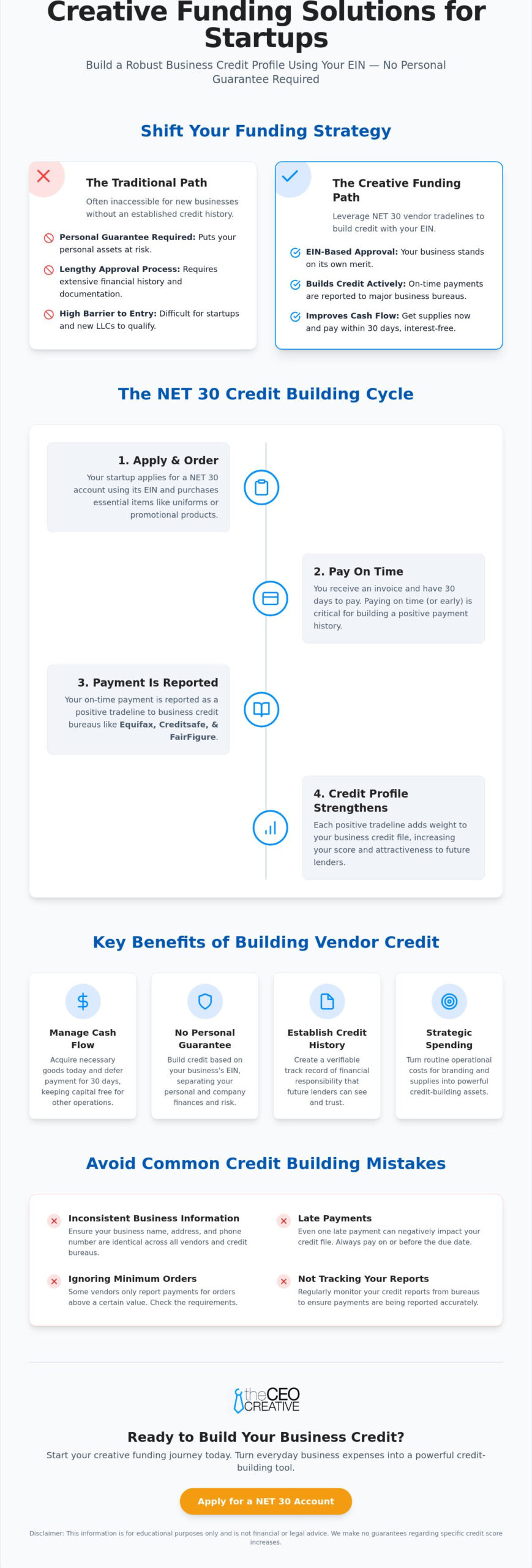
- Step 1: Apply for an account. Submit an application for a business net 30 account using your EIN. This step initiates your company’s independent credit journey without requiring a personal guarantee.
- Step 2: Place your first order. Select essential merchandise or office supplies that your business actually needs. This creates the invoice that triggers the reporting cycle.
- Step 3: Settle the invoice. Pay your balance in full before the 30-day deadline. Paying early is even better, as it signals high liquidity and financial discipline to reporting agencies.
- Step 4: Monitor your data. Use platforms like FairFigure to track how your payments are being reported. Visibility into your profile helps you understand how lenders view your company’s risk level.
- Step 5: Maintain consistency. Repeat the process. A single purchase is a start, but a multi-month history of on-time payments is what builds a robust, reliable score.
Preparation: Ensuring Business Consistency
Before you hit submit on any application, your foundational data must be perfect. Bureau reporting relies on data matching. If your business name on an application doesn’t exactly match your Secretary of State filing, the bureaus might fail to link the payment to your profile. Verify that your business phone number and physical address are consistent across your website, social media, and official documents. An active EIN correctly linked to your LLC is the primary identifier that separates your corporate identity from your personal SSN. Small discrepancies in these details are the most common reason credit building efforts stall.
Managing the Payment Cycle
Success in the “Repeat” phase defines the strength of your profile. While a net 30 term gives you a full month, early payments are often more beneficial for your internal metrics. Many bureaus calculate scores based on how many days ahead of the due date a payment is received. Set up digital alerts or calendar reminders to ensure you never miss a deadline. One purchase won’t convince a large lender of your creditworthiness. You need a consistent pattern of professional spending and prompt repayment over several months to demonstrate true financial maturity. This habit builds the trust necessary for future large-scale financing.
If you’re ready to start this sequence and build your business’s future, apply for your business net 30 account today and take the first step toward independent funding.
Avoiding the Friction: Common Mistakes in Startup Credit Building
Success in building business credit depends on precision. While implementing creative funding solutions for startups, many founders accidentally stall their own progress through avoidable administrative errors. These mistakes don’t just delay your profile growth; they can create a negative history that takes months to correct. Understanding where others stumble allows you to maintain a clean, professional trajectory from day one.
- Inconsistent business information. Using “Inc.” on one application and omitting it on another creates fragmented files. Your business name, address, and phone number must match your official filings exactly to ensure bureaus can link the data to your EIN.
- Failing to verify reporting. Some vendors offer net 30 terms as a convenience but do not report to the major bureaus. If they don’t report, you aren’t building credit.
- Mistreating the tradeline. A net 30 account is a short-term tool for cash flow and credit building. Treating it like a long-term loan or a revolving credit card leads to mismanagement and potential late fees.
- Missing the deadline. In the early stages of credit building, your profile is fragile. A single late payment can severely damage your score and signal high risk to future lenders.
- Impulse spending. Overextending your cash flow on non-essential items just to “build credit” is a dangerous trap. Focus on professional essentials that keep your operations lean and sustainable.
The Trap of Non-Reporting Vendors
Many “net 30” accounts exist purely for transactional convenience. They provide no benefit to your corporate credit profile because they don’t share data with agencies like Equifax or Creditsafe. Before you apply or place an order, you must verify that the vendor is a reporting entity. This due diligence ensures that every dollar you spend is also an investment in your company’s financial reputation. For a deeper look at strategies that don’t involve traditional borrowing, read our guide on How to Build Business Credit Without a Loan. This proactive verification is what separates strategic founders from those who are simply spending money.
Bureau Blind Spots
Build Your Business Legacy Today
You’ve seen how vendor tradelines transform routine purchases into powerful financial assets. By implementing creative funding solutions for startups, you move beyond the limitations of personal credit and start building a profile that stands on its own. The key is absolute consistency; ensuring your business data is accurate and your payments are always ahead of schedule. This isn’t just about buying office supplies or apparel; it’s about manufacturing the credibility you’ll need for future expansion. Every reporting event is a brick in the wall of your company’s financial stability.
Ready to establish your independent financial footprint? When you Apply for Your Business Net 30 Account Today, you gain a strategic partner that reports to Equifax, Creditsafe, and FairFigure. We prioritize your growth with a decision within one business day for qualified EINs and a structure that requires no personal guarantee. This approach allows you to fund your operations while protecting your personal assets.
Your startup deserves a foundation that supports long-term success. Take that first step today and start building the corporate credit profile your vision requires. We’re here to help you turn your operational needs into a sustainable credit-building engine.
Frequently Asked Questions
Do I need a personal guarantee for a net 30 account?
No, you don’t need a personal guarantee to open a net 30 account with most business credit vendors. These accounts are designed to help you build credit using your company’s independent identity rather than your personal assets. This structure protects your personal savings and property from business liabilities while you establish a professional financial footprint.
How long does it take for The CEO Creative to report to credit bureaus?
We report your payment activity to the bureaus on a monthly schedule. Once we transmit the data, it typically takes the bureaus between 30 and 60 days to process the information and update your business credit profile. Consistency is vital, so maintaining a regular purchasing and payment cycle ensures your report stays active and current.
Can I build business credit if my startup is less than 30 days old?
Yes, you can start building credit the moment your LLC is formed and you have an EIN. You don’t need years of history to access creative funding solutions for startups through vendor tradelines. These accounts are specifically built to provide new organizations with the foundational credit history they need to scale operations from day one.
Which credit bureaus does The CEO Creative report to?
We report your payment data to Equifax Business, Creditsafe, and FairFigure. By reporting to multiple major agencies, we ensure that your company’s financial reliability is visible to a wide range of lenders and suppliers. This broad visibility is essential for startups looking to graduate from vendor credit to larger institutional financing in the future.
Does paying a net 30 invoice early help my credit score?
Yes, paying your invoices early can positively influence your business credit score. Many bureaus use metrics that reward businesses for paying “days before terms” rather than just on the due date. Settling your balance ahead of time signals high liquidity and superior financial management to anyone reviewing your corporate credit file.
Can I use an EIN only to apply for these funding solutions?
Yes, you can apply using only your Employer Identification Number (EIN). This allows you to keep your Social Security Number separate from your business debts. Using your EIN as the primary identifier is a critical step in establishing a truly independent corporate entity that can secure its own funding without relying on your personal credit history.
What happens if I miss a payment on a net 30 account?
Missing a payment can severely damage a new business credit profile. Late payments are reported to the bureaus and act as a major red flag for future lenders, suggesting that your company is a high-risk borrower. To protect your reputation, always prioritize paying your invoices on time or early to maintain a clean and professional reporting history.
How many tradelines do I need to see a significant impact?
Most industry experts recommend having at least three to five active tradelines to establish a robust credit score. A single reporting account is a great start, but a diverse mix of vendors shows that multiple companies trust your business with credit. Building a portfolio of several reporting accounts provides the depth needed to satisfy the requirements of major banks and lenders.
Building business credit? Open a Net 30 Account — EIN only, no personal guarantee, $60 minimum order, credit lines up to $5,500, a decision in one business day, and every on-time payment reported monthly to Equifax Business, Creditsafe and FairFigure.