


Related: Net 30 Vendors Compared — the four things worth comparing, and a direct comparison against every major vendor.
Meta Title: What Are the Tiers of Business Credit? A 2026 Step-by-Step Guide
According to the 2026 Report on Employer Firms, 59% of small business owners still use personal guarantees to secure debt. It’s a cycle that often leads to denied bank loans and capped growth. You likely agree that risking your personal assets for business growth feels unsustainable and stressful. If you’re ready to break that cycle, you must understand what are the tiers of business credit and how they function as a strategic ladder for your company. Building a powerful corporate profile starts with your EIN, not your Social Security number.
This article promises to demystify the credit building process by providing a clear, four-tier roadmap. We’ll define how reporting Net 30 vendors like The CEO Creative provide the foundation you need to reach unsecured bank lines. You’ll gain a step-by-step checklist to apply, order, and pay your way to a stronger financial future while avoiding common pitfalls in bureau reporting.
Key Takeaways
- Learn how to establish your company’s first tradelines with reporting Net 30 vendors like The CEO Creative.
- Gain a clear understanding of what are the tiers of business credit to build a roadmap from basic accounts to unsecured bank lines.
- Identify the specific benchmarks and number of tradelines needed to graduate from Tier 1 office supplies to Tier 2 retail credit accounts.
- Discover the strategy for unlocking Tier 4 corporate credit cards and fleet accounts using only your EIN.
The Foundation: Defining the Tiers of Business Credit
Building a powerful corporate profile is a structured journey. This guide shows you how to climb from Tier 1 to Tier 4 using your Employer Identification Number (EIN). Before we begin, understand that this content is for educational purposes only. It is not financial or legal advice. We make no guarantees regarding specific credit score increases or loan approvals. Success depends on your business’s financial habits and reporting accuracy.
To scale your organization, you must first understand what are the tiers of business credit and how to leverage trade credit. Business credit relies on “vendor tradelines.” These are credit accounts with suppliers who report your payment history to major bureaus. A “NET 30” account gives you 30 days to pay your invoice in full after the purchase date. The CEO Creative acts as a reporting Net 30 vendor, helping startups and established LLCs build their first tradelines by reporting to Equifax, Creditsafe, and FairFigure.
What is Tier 1 Business Credit?
Tier 1 is the “Starter Tier.” It focuses on vendor accounts that usually require no personal guarantee. This means you aren’t personally liable for the business debt. For new LLCs and startups, these accounts are the essential first step to building a credit file from scratch. By purchasing items your brand already needs, such as custom uniforms, promotional mugs, or office supplies, you create a track record of reliability. You can find more details on these mechanics in our strategic guide to business credit building.
The Role of EIN-Only Reporting
Many founders ask what are the tiers of business credit because they want to stop using personal funds for corporate expenses. A primary goal is building credit without linking a Social Security number. This separation protects your personal credit score while establishing the business as its own legal entity. Accuracy is vital during this stage. Your business name, physical address, and phone number must be identical on every application. This consistency ensures bureaus correctly attribute your on-time payments to your EIN, preventing fragmented or “thin” credit files.
Tier 1 vs. Tier 2: Comparing the Early Stages of Credit Building
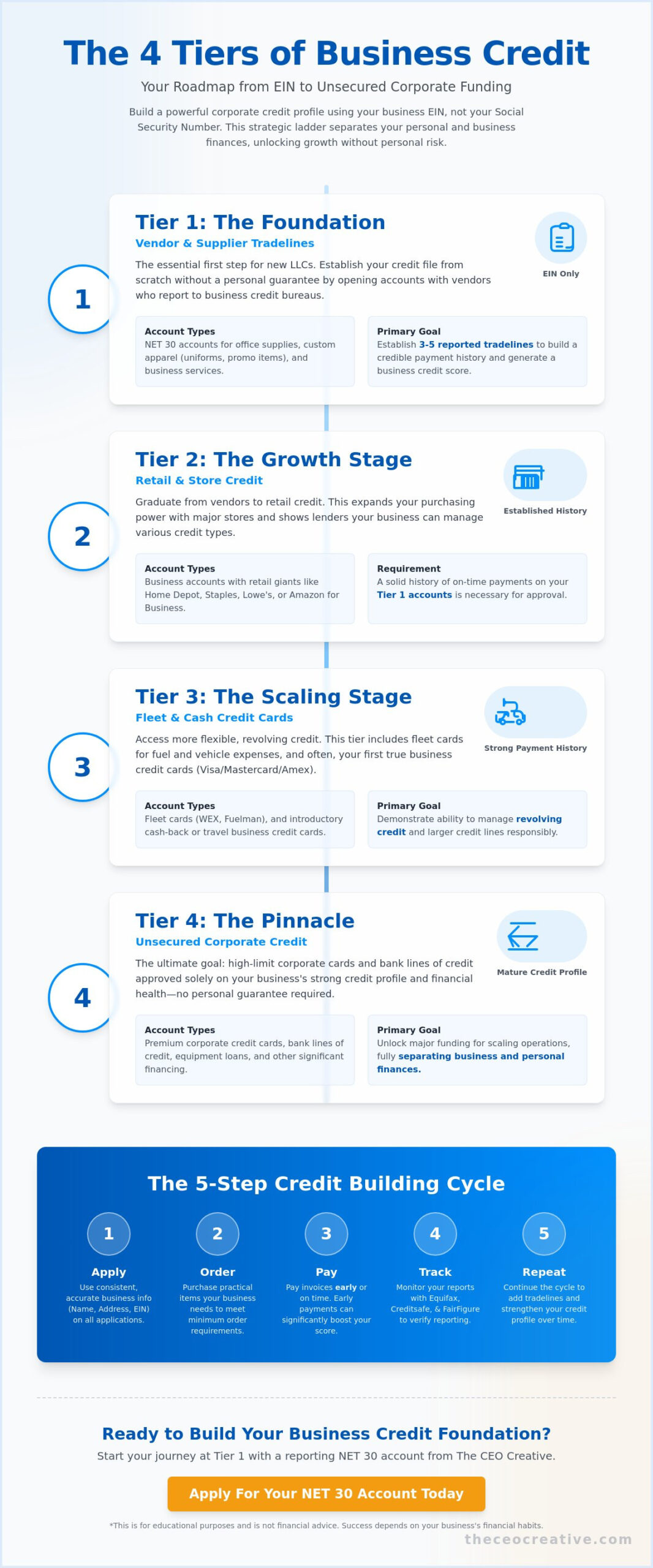
Moving from Tier 1 to Tier 2 is where your corporate profile starts to gain real momentum. Understanding what are the tiers of business credit helps you realize that Tier 1 is about establishing a track record with vendor tradelines. These accounts, like those offered by The CEO Creative, focus on essentials like Net 30 apparel, branding materials, and office supplies. These vendors usually offer approval with just an EIN, making them the perfect entry point for new LLCs.
Tier 2 credit shifts the focus toward retail and store accounts. Once you’ve successfully managed 3 to 5 Tier 1 tradelines, you can often qualify for credit at stores like Home Depot or Staples. This transition is a critical phase in building business credit because it expands your purchasing power beyond specialized suppliers. To keep your progress on track, you might consider opening a business Net 30 account to secure the foundational tradelines you need.
Climbing the Ladder: From Vendors to Store Credit
Approval requirements change as you climb. Tier 1 is your foundation; skipping it is a mistake even if you have personal capital. Lenders want to see that the business entity itself is reliable. You’ll move from “EIN-only” approvals to accounts that require an established history of on-time payments. For a complete strategy, review our Tier 1 Net 30 Vendors list to find reporting partners that fit your operational needs.
Success in these early stages follows a simple, repeatable checklist:
- Apply: Submit applications using consistent business information.
- Order: Buy practical items like onboarding kits or uniforms to keep spending professional.
- Pay: Settle invoices early to maximize your score.
- Track: Monitor your reports on Equifax, Creditsafe, or FairFigure.
- Repeat: Continue the cycle until you have enough tradelines to graduate to the next tier.
Common Mistakes in Tiers 1 and 2
Avoid these pitfalls to ensure your credit building remains efficient and effective:
- Applying for Tier 2 retail cards too early without at least 3 reported Tier 1 tradelines.
- Using different phone numbers or addresses on applications, which triggers “unverified” status at bureaus.
- Buying items with no business utility; stick to functional products like promotional gear or stationary.
- Failing to realize that a D&B PAYDEX score of 80 only indicates on-time payments, while a score of 100 requires paying 30 days early.
- Neglecting to check if a vendor actually reports to the bureaus you’re targeting.
Tier 3 and Tier 4: Scaling to Unsecured Corporate Credit
Reaching the upper levels of business financing requires a proven track record. Once you’ve mastered the first two stages, you’ll understand what are the tiers of business credit and how they lead to significant capital. Tier 3 introduces fleet cards and fuel accounts, which require a more robust credit profile than basic vendors. Tier 4 is the ultimate goal; it consists of unsecured business credit cards like Visa or Mastercard and traditional bank lines of credit. Maintaining a business net 30 account remains essential throughout this cycle to keep fresh data flowing to your profile.
Bureau Reporting and Monitoring
Lenders in the higher tiers look for consistent data across multiple bureaus. Reporting to Equifax and Creditsafe is vital because these agencies provide the risk assessments that big banks trust. For a consolidated view of your health, tools like FairFigure track your progress across different models. Remember that timing is everything. While a D&B PAYDEX score of 80 shows you pay on time, reaching a score of 100 requires paying 30 days before the due date. These early payments signal to Tier 4 lenders that your business is exceptionally low-risk.
Transitioning to High-Limit Financing
A solid foundation in Tiers 1 through 3 naturally leads to larger credit limits. Banks often perform a manual review for high-limit Tier 4 applications. Professionalism matters during these checks. Having established branding, including your logo, custom uniforms, and stationery, builds credibility during these reviews. It shows you’re a legitimate, organized entity rather than a side project. To see how to align your vendors with these goals, consult our ultimate guide to Net 30 vendors in 2026. This strategic approach turns routine operational spending into a powerful financial asset.
Launch Your Corporate Credit Journey Today
Building a robust profile is a strategic marathon that decouples your personal assets from your company’s liabilities. By mastering what are the tiers of business credit, you’ve equipped your organization with a roadmap for sustainable growth. Success relies on consistent data, functional spending, and the discipline to pay invoices before they are due to maximize your scores across Equifax, Creditsafe, and FairFigure.
Take control of your company’s financial future right now. Apply for a CEO Creative Membership to Start Building Tier 1 Credit Today. Our accounts offer a decision within one business day with your EIN and require no personal guarantee, ensuring your progress starts immediately.
What happens next:
- Submit your application to receive a decision within one business day on your EIN-only Net 30 account.
- Place an order for essential business items to activate your first reporting tradeline.
- Pay your invoice early to ensure positive payment data is transmitted to the major business credit bureaus.
Establishing business credit is a foundational move for any visionary entrepreneur. Start your journey today by browsing our professional Net 30 apparel, custom mugs, or engraved office essentials. These small, strategic purchases build the credit history required to access high-limit bank financing in the future.
Frequently Asked Questions
Do I need a personal guarantee (PG) for Tier 1 business credit?
No, you don’t need a personal guarantee for foundational vendor accounts. These accounts use your EIN to establish creditworthiness based on the business entity alone. This separation is vital for protecting your personal assets while you scale. The CEO Creative provides Net 30 terms without a PG, allowing new LLCs and startups to build a profile safely.
How long does it take for Net 30 vendors to report to the bureaus?
Most reporting vendors transmit data every 30 to 60 days. The specific timing depends on the vendor’s internal reporting cycle and when your invoice was paid in full. It’s best to allow two full billing cycles to see the tradeline appear on your reports. Monitoring your file through FairFigure can help you track these updates in real time.
Can I build business credit with just an EIN?
Yes, building credit with just an EIN is the primary strategy for new companies. By focusing on what are the tiers of business credit, you can identify vendors that don’t require an SSN for approval. This process creates a dedicated credit history for your business. Over time, this EIN-only profile allows you to qualify for larger loans and corporate credit cards.
Which credit bureaus do Tier 1 vendors typically report to?
Tier 1 vendors usually report to Equifax Business, Creditsafe, and sometimes Dun & Bradstreet. These bureaus track your payment habits to generate scores like the Payment Index or PAYDEX. Diverse reporting is beneficial because different lenders prefer different bureaus. Having your data on multiple reports ensures a more complete picture of your financial reliability.
What is the difference between a vendor tradeline and a credit card?
A vendor tradeline is a “buy now, pay later” arrangement with a specific supplier for products or services. A business credit card is a revolving line of credit that you can use anywhere. You typically need to manage several vendor tradelines successfully before a bank will approve you for a high-limit revolving credit card in the later tiers.
How many tradelines do I need to move from Tier 1 to Tier 2?
You generally need 3 to 5 active, reporting tradelines to graduate to Tier 2 retail accounts. Lenders like Home Depot or Staples want to see that other companies have already trusted you with credit. If you apply too early with a “thin” file, you’ll likely face a denial. Consistency across your first few accounts is the fastest way to progress.
Does paying my Net 30 invoice early help my business credit score?
Yes, early payments have a significant positive impact on your business scores. While paying exactly on the due date is good, paying 10 to 20 days early signals exceptional financial health. This behavior can result in a higher score than simply meeting the deadline. It demonstrates to future Tier 4 lenders that your business manages cash flow efficiently.
What happens if my business address doesn’t match my credit application?
A mismatched address often leads to an automatic denial or an “unverified” status on your credit report. Consistency is the most important factor in the application process. Your business name, physical address, and phone number must match your Secretary of State filings exactly. If the data is inconsistent, bureaus may fail to link your payments to your EIN.
Are there any annual fees for Tier 1 vendor accounts?
Some vendors use a membership model to cover the costs of reporting and credit building tools. For instance, a CEO Creative Membership provides reporting to Equifax, Creditsafe, and FairFigure. While some basic accounts are free, paid memberships often offer more robust reporting and additional business resources. Always review the terms to ensure the account fits your growth strategy.
Can I use business credit to buy custom branded apparel?
Yes, purchasing custom branded apparel is an excellent way to build credit while professionalizing your team. It’s a functional expense that serves a practical business purpose. By using a Net 30 account for uniforms or promotional gear, you create a tradeline that helps you master what are the tiers of business credit. This turns routine branding costs into a strategic financial asset.
Building business credit? Open a Net 30 Account — EIN only, no personal guarantee, $60 minimum order, credit lines up to $5,500, a decision in one business day, and every on-time payment reported monthly to Equifax Business, Creditsafe and FairFigure.