


Did you know that less than half of small businesses that applied for credit in the past year received the full amount they requested? This often happens because owners don’t realize that lenders look beyond just a score; they look for a professional narrative. If you have a thin file or inconsistent data, you’re likely facing rejections that could be avoided. Learning how to present your business credit profile to a lender is the difference between a high-interest denial and a high-limit approval. This guide provides a framework to organize your data and build confidence before your next meeting.
Before exploring the strategy, it’s essential to define two core components of your profile. A vendor tradeline is a credit account with a supplier that allows you to buy products now and pay later. Payment reporting is the process where these vendors share your transaction history with bureaus like Equifax and Creditsafe. The CEO Creative is a reporting Net 30 vendor that helps build business credit through real business purchases. By stacking these accounts, you prove your company’s operational stability. Please note that this content is for educational purposes and is not financial or legal advice.
Key Takeaways
- Understand that modern lenders prioritize corporate credibility and a professional brand presence over a simple numerical credit score.
- Ensure your business data is 100% consistent across all official records to avoid automatic red flags during the underwriting process.
- Master how to present your business credit profile to a lender by auditing your own reports from Equifax and FairFigure before submitting an application.
- Identify and correct common mistakes like mismatched addresses or relying solely on personal credit history for corporate funding.
- Leverage reporting Net 30 vendor accounts from The CEO Creative to build a robust tradeline history while acquiring essential branded merchandise.
The Importance of Corporate Credibility: Why Presentation Matters
Lenders don’t just fund credit scores. They fund businesses they believe in. When you look at how to present your business credit profile to a lender, you have to think about “Corporate Credibility.” This is the invisible layer that sits on top of your EIN. It tells an underwriter that your company is a separate, professional entity capable of managing debt without relying on your personal bank account. By organizing your file correctly, you minimize the perceived risk that leads to high interest rates or flat denials.
Managing your profile effectively can save your business thousands of dollars over the life of a loan. Lenders use your credit data to determine your risk tier and set your interest rates. In July 2026, with the prime rate at 6.75%, even a slight shift in your risk profile could mean the difference between a 9% APR and a 13% APR on an SBA Express loan. Please note that this content is for educational purposes only and is not financial or legal advice.
The Narrative of a Fundable Business
A “thin file” is often a dealbreaker for traditional banks. Even if you have never missed a payment, a profile with only one or two tradelines looks like a gamble to an underwriter. You want to transition from a personal guarantee mindset to a corporate-only profile. This happens by stacking reporting accounts that show you can handle multiple obligations simultaneously. Consistent payment history tells a story of operational stability. It proves your business has the cash flow to meet its commitments every single month without fail.
What Lenders Look for Beyond the Score
Underwriters perform a deep dive into your business identity before they ever approve a high-limit credit line. They verify your LLC status, your EIN, and whether your business address is consistent across all platforms. A mismatch between your utility bill and your credit report can trigger an automatic rejection. To understand the full scope of what underwriters see, it’s helpful to review What is Inside Your Business Credit Report? including data from bureaus like Equifax, Creditsafe, and FairFigure.
Beyond the data, your brand identity acts as a secondary trust signal. A professional website and branded apparel show that you are an established organization rather than a temporary project. When you master how to present your business credit profile to a lender, you are showing them “tradeline depth.” Lenders want to see that you’ve successfully managed diverse credit lines before they hand over a high-limit loan for your next expansion.
Decoding the Lender View: What is Inside Your Business Credit Report?
A business credit profile is a public record of your company’s debt repayment history linked directly to your Employer Identification Number (EIN). It serves as your corporate reputation in the financial world. Understanding how to present your business credit profile to a lender starts with knowing exactly what they see when they pull your file. Most lenders look at your payment reporting frequency to judge your current cash flow. If your reports only update once a year, your business can look stagnant. Frequent, positive reporting builds a more dynamic and trustworthy image.
To effectively Prepare Your Profile for Review, you need to look beyond the basic scores and analyze the depth of your data. Lenders want to see that you can manage multiple types of debt simultaneously without straining your operations.
The Role of Major Reporting Bureaus
Traditional banks often lean on Equifax. It provides a deep look into your financial history and remains a staple for conventional lending institutions. However, modern and global lenders are increasingly prioritizing Creditsafe. This bureau offers a more comprehensive look at international trade data and real-time risk assessments. Then there is FairFigure. This platform is essential for modern CEOs because it allows you to monitor your fundability score. It helps you see exactly what a lender sees before you ever submit an application.
Understanding Vendor Tradelines
There is a major difference between a vendor tradeline and a bank tradeline. Bank tradelines usually involve loans or traditional credit lines. Vendor tradelines, specifically Net 30 accounts, are the primary building blocks of a lender-ready profile. These accounts allow you to buy supplies now and pay later, usually within 30 days. They are often easier to obtain for new LLCs and startups.
Your Days Beyond Terms (DBT) score is a critical metric found within these reports. Paying your invoices early, rather than just on time, significantly boosts this score. It shows lenders you aren’t just scraping by; you have surplus capital and excellent management habits. The CEO Creative acts as a reporting Net 30 vendor that tracks these real business purchases. By reporting your activity to bureaus like Equifax, Creditsafe, and FairFigure, we help you establish the tradeline depth required for larger funding limits. You can start building this history today by opening a business Net 30 account to support your long term growth.
The Business Credit Success Checklist: Prepare Your Profile for Review
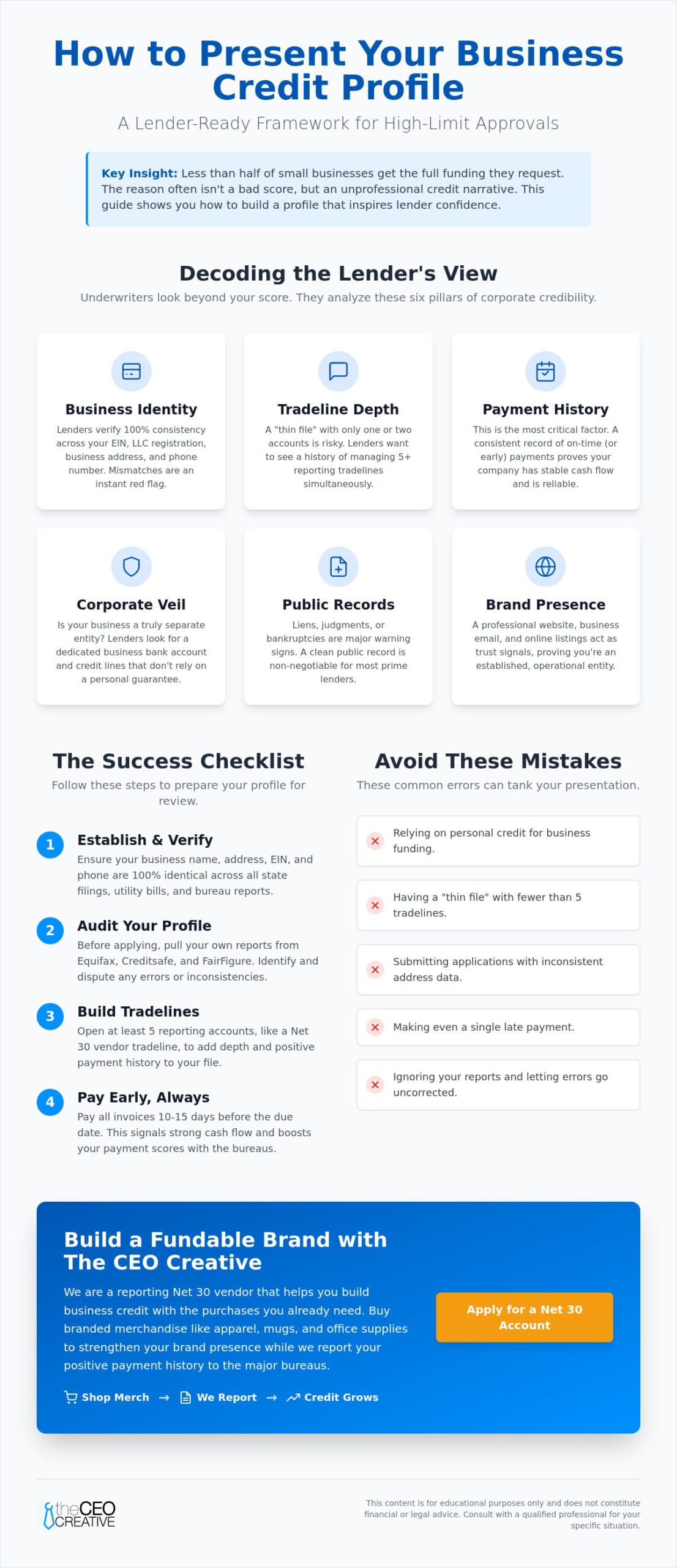
Organization is the final bridge between having a credit file and securing a loan. When you sit down with a loan officer, your data must be structured to eliminate any doubt about your operational discipline. Follow this checklist to ensure you understand how to present your business credit profile to a lender with complete transparency. This preparation phase is where you turn raw data into a compelling case for funding.
- Step 1: Audit your business data. Your legal name, commercial address, and phone number must be identical across your Articles of Organisation, utility bills, and credit reports. Automated underwriting systems often flag even minor discrepancies as high-risk inconsistencies.
- Step 2: Pull your own reports. Access your files from Equifax and FairFigure before the lender does. Identifying a mistake early allows you to dispute it or prepare a factual explanation before it becomes a reason for denial.
- Step 3: Verify tradeline depth. Aim for at least 3-5 active reporting accounts. A lender wants to see that you can successfully manage multiple obligations simultaneously.
- Step 4: Create a Trade Reference sheet. Compile a professional list of your current reporting vendors and their contact details. This acts as a “resume” for your business’s financial reliability.
- Step 5: Document credit inquiries. Be prepared to explain any recent applications for new accounts. Lenders view strategic growth differently than they view desperate “shotgunning” for capital.
The “Apply, Order, Pay, Track, Repeat” Framework
Establishing corporate credibility requires a consistent, cyclical approach. Start by applying for Net 30 accounts with vendors that report to major bureaus. Once approved, order essential business supplies to trigger a reporting event on your EIN. As a reporting NET 30 vendor, The CEO Creative helps build business credit through real business purchases like engraved merchandise or office essentials. Always pay your invoices early—ideally 10 days before the due date—to maximize your score algorithms. Use FairFigure to track your progress and ensure the data is appearing correctly. Finally, you must repeat this process. Consistency is the only way to build business credit without a loan while creating the tradeline depth lenders demand.
Organising Your Financial Documentation
Lenders are humans who respond to professional aesthetics. Beyond your EIN confirmation letter and financial statements, the physical presentation of your documents matters. Using custom stationery or professional folders shows a level of brand maturity that simple printouts cannot match. A high-quality logo on your documentation acts as a secondary trust signal, proving you’ve invested in a fundable brand. This attention to detail helps you avoid Common Mistakes That Tank Your Lender Presentation, such as appearing disorganized or undercapitalized. Mastering how to present your business credit profile to a lender means treating your documentation as a high-level executive summary of your company’s future potential.
7 Common Mistakes That Tank Your Lender Presentation
Even a solid credit score won’t save you if your presentation is sloppy. Lenders look for precision and stability. If you’re wondering how to present your business credit profile to a lender, start by cleaning up these common errors that trigger automatic rejections. Underwriters often use automated systems to filter out high-risk applications before a human ever sees them. Avoiding these pitfalls ensures your application actually reaches the review stage.
- Mistake 1: Mismatched business information. If your utility bill says “Suite 100” but your credit report says “Unit 100,” it can trigger a fraud alert.
- Mistake 2: Relying solely on personal credit. 45% of firms denied funding were rejected due to a low personal score. Your business needs its own identity.
- Mistake 3: Having zero vendor tradelines. A thin file with no history on your EIN makes your business look like a “zombie” entity with no real operations.
- Mistake 4: Inquiry shotgunning. Applying for 10 loans in a single week looks desperate and signals financial instability to a lender.
- Mistake 5: Late payments on Net 30 accounts. Being late by even one day can drop your score. Net 30 terms are a test of your cash flow management.
- Mistake 6: Using a personal cell phone. Lenders want to see a dedicated business line that matches your registered business address.
- Mistake 7: Inconsistent business names. Alternating between “Your Business LLC” and “Your Business” across different records creates confusion in the bureaus.
The Danger of the “Personal Guarantee”
Lenders prefer businesses that can stand on their own credit. While many small business products require a personal guarantee, relying on it indefinitely is a mistake. It ties your personal assets to your corporate debts, creating massive liability. Moving toward EIN-based credit allows your company to secure higher funding limits without risking your personal mortgage or savings. This transition is a key part of how to present your business credit profile to a lender as a mature, sustainable organization.
Mismatched Data and “Zombie” Profiles
A simple typo in your business address can lead to a “file not found” error during a credit pull. If the lender can’t find your profile, they won’t call you to clarify; they’ll simply deny the application. Using a residential address also lowers your corporate credibility score. Underwriters view commercial addresses as a sign of a legitimate, established operation. To fix a thin file, you should partner with the best Net 30 vendors for building business credit to ensure your data is reporting correctly. You can take the first step toward a professional profile by opening a business Net 30 account today to start reporting your positive payment history.
Building a Fundable Brand: How The CEO Creative Strengthens Your Profile
Lenders don’t just look at spreadsheets; they look at the brand behind the numbers. If you want to master how to present your business credit profile to a lender, you need to look like a professional outfit from the first interaction. The CEO Creative acts as a reporting Net 30 vendor that bridges the gap between operational needs and corporate creditworthiness. We help you acquire the tools you need to run your business while simultaneously building the tradelines that lenders demand. This dual approach ensures you aren’t just another “thin file” in a stack of applications.
Establishing a high-quality brand identity starts with a professional logo design. This isn’t just about aesthetics. It’s a foundational step in corporate credibility that signals to underwriters that your company is established, organized, and visionary. The CEO Creative Membership serves as a strategic tool for ongoing credit reporting. It keeps your file active and “thick” enough to pass the strict lending criteria often found in traditional banking environments.
From Merchandise to Tradelines
Purchasing high-quality custom gear makes your team look “bank-ready” and established during site visits or meetings. When you use your Net 30 account to buy branded apparel, you’re doing more than just outfitting your staff. You’re creating a paper trail of real business purchases that translate into positive bureau data. This strategy allows you to manage cash flow effectively while stacking the reporting events needed to strengthen your profile. It transforms routine operational expenses into strategic moves for your long-term success.
What Happens Next After You Apply
Once you join the community of modern entrepreneurs at The CEO Creative, your path to a fundable profile becomes much clearer. Here is the logical progression of your membership:
- Approval: Get instant access to Net 30 terms for branding and supplies without the need for a personal guarantee in many cases.
- Reporting: Your on-time payments are sent to Equifax, Creditsafe, and FairFigure, ensuring your hard work is visible to the entire financial industry.
- Growth: Use your strengthened profile to approach lenders for larger capital, lower interest rates, and higher funding limits.
Learning how to present your business credit profile to a lender involves showing them a business that is both financially disciplined and professionally branded. By leveraging vendor tradelines for essential merchandise, you build a narrative of success that traditional banks find hard to ignore. You’re proving that your business is a reliable partner with the underlying systems necessary for sustainable growth.
For businesses facing more complex challenges, it can be helpful to explore Professional Advisory and Consulting Fees options that specialize in corporate recovery and the development of a professional financial narrative.
Secure Your Corporate Future Today
Mastering the art of presentation means more than just having a high score. It requires a commitment to data consistency across all bureaus and a strategic approach to building tradeline depth. By auditing your reports from Equifax and FairFigure, you eliminate the surprises that lead to denials. You’ve learned that a professional brand identity, from your logo to your team’s apparel, acts as a powerful trust signal to underwriters.
When you understand how to present your business credit profile to a lender, you shift from being a risk to becoming a reliable investment. The CEO Creative is here to support that journey as a reporting Net 30 vendor. We report your real business purchases to Equifax, Creditsafe, and FairFigure to ensure your hard work is documented. Best of all, we offer Net 30 terms with no personal guarantee required for many accounts.
Join the thousands of new LLCs and startups that use our platform to establish corporate credibility. Apply for a CEO Creative Net 30 Account and Start Building Your Profile Today. Your vision deserves the right funding, and a professional profile is the key to unlocking it. We’re excited to be your partner in long-term success.
Frequently Asked Questions
Are new LLCs and startups eligible for Net 30 vendor accounts?
Yes, new LLCs and startups are fully eligible for Net 30 vendor accounts, often with no prior credit history required. Most vendors simply require a valid EIN and a business that is in good standing with the Secretary of State. This inclusivity allows developing companies to start building corporate credibility from day one, providing the foundational data needed for future lender presentations.
How long does it take for a new tradeline to appear on my business credit report?
Most tradelines typically appear on your business credit reports within 30 to 60 days after your first invoice is settled. This timeline depends on the specific reporting cycle of the vendor and the processing speed of bureaus like Equifax or Creditsafe. Consistency is critical; ensuring your initial purchases are paid early helps establish a positive pattern as soon as the data is indexed.
Do I need a personal guarantee to build business credit with The CEO Creative?
No, The CEO Creative offers Net 30 terms that do not require a personal guarantee for many business accounts. This structure is designed to help you separate your personal finances from your corporate entity. By using your EIN for purchases, you build a credit profile that stands on its own merit, which is exactly what underwriters look for when evaluating your company’s independent stability.
What should I do if a tradeline doesn’t appear after I’ve paid my invoice?
If a tradeline doesn’t appear after 60 days, first verify that your business name and address match your credit bureau records exactly. When you are learning how to present your business credit profile to a lender, ensuring your data is correctly indexed is the first step toward approval. If the information is correct, contact the vendor to ensure the payment was included in the last reporting cycle.
Does applying for a business account result in a hard pull on my personal credit?
Applying for a Net 30 account with The CEO Creative does not result in a hard pull on your personal credit. We evaluate your eligibility based on corporate data and EIN verification rather than your personal credit score. This approach allows you to scale your business credit limits and build a robust profile without the risk of lowering your personal FICO score through excessive hard inquiries.
Which bureaus does The CEO Creative report to, and why does it matter?
The CEO Creative is a reporting Net 30 vendor that reports to Equifax, Creditsafe, and FairFigure. This broad coverage is a key part of how to present your business credit profile to a lender with total confidence. Because different lenders prefer different bureaus, having a consistent and positive history across all three major platforms ensures you are prepared regardless of which report a loan officer pulls.
Building business credit? Open a Net 30 Account — EIN only, no personal guarantee, $60 minimum order, credit lines up to $5,500, a decision in one business day, and every on-time payment reported monthly to Equifax Business, Creditsafe and FairFigure.