

What if the most effective way to scale your company isn’t a bank loan, but a strategic shift in how you buy your daily essentials? Many entrepreneurs believe they must wait years to build a corporate profile, yet creditworthiness is often built through smart purchasing rather than just time. If you’ve felt the sting of a credit card denial or the pressure of high personal liability for business expenses, you’re facing a common hurdle. It’s frustrating when you don’t know which vendors actually report your payments to the major bureaus.
This article provides a clear roadmap on how to get initial trade references for a new business to help you establish a robust corporate credit profile from scratch. You’ll discover how to identify Tier 1 vendors, understand the reporting mechanics of bureaus like Equifax and Creditsafe, and follow a step-by-step system to separate your personal and business finances. We’ll break down the specific actions needed to secure your first tradelines and unlock higher credit limits. This content is for educational purposes only and does not constitute financial or legal advice.
Key Takeaways
- Understand how trade references act as the primary data points for calculating business credit scores and establishing your company’s financial reputation.
- Discover how to get initial trade references for a new business by identifying Tier 1 vendors that offer Net 30 terms without requiring a personal guarantee.
- Learn the specific steps to make your LLC credit-ready, from securing an EIN to ensuring your business information matches across all bureau records.
- Master the reporting cycle to ensure your on-time payments are accurately transmitted to major bureaus like Equifax, Creditsafe, and FairFigure.
- Leverage strategic purchases, such as custom brand merchandise and office supplies, to build your corporate credit profile while growing your professional identity.
What is a Trade Reference and Why Startups Struggle to Get Them?
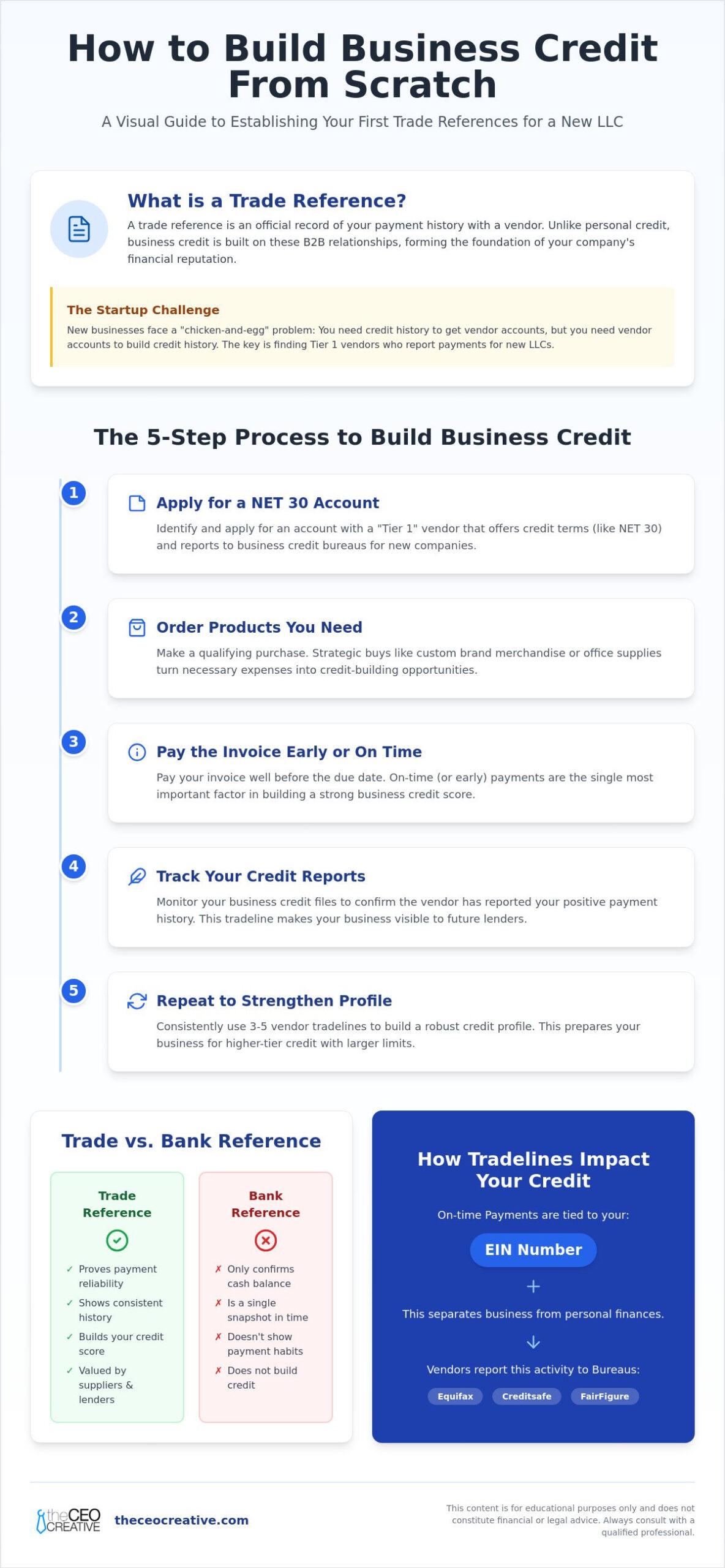
A trade reference is an official report of your payment history with a supplier or vendor. While personal credit relies on how you manage credit cards and loans, business credit is built on these specific business-to-business relationships. Understanding What is a Trade Reference is the first step toward financial independence for your company. These references are the primary data points used by bureaus to calculate your business credit scores, such as the Paydex or Equifax Business Delinquency Score.
Startups often struggle because most traditional vendors require at least two years of established history before they’ll offer credit terms. This creates a “chicken and egg” problem. You need credit history to get vendor accounts, but you can’t get vendor accounts without history. As of 2026, the CFPB defines a small business as one with $1 million or less in gross annual revenue, making accurate reporting even more vital for early-stage growth. Learning how to get initial trade references for a new business requires finding specific “Tier 1” vendors who are willing to work with new LLCs from day one.
The Difference Between Trade References and Bank References
A bank reference simply confirms you have cash in your accounts. It’s a snapshot of liquidity that doesn’t tell the full story of your financial habits. In contrast, a trade reference proves you actually pay your bills on time. Suppliers value payment history over a high bank balance because it demonstrates reliability. Even if you have thousands in the bank, a vendor doesn’t know if you’ll prioritize their invoice. Establishing a net 30 vendor relationship builds your EIN-only credit profile, allowing the business to stand on its own without relying on your personal wallet.
Why Initial Tradelines are Essential for Your LLC
Securing your first few tradelines is the only way to establish a credit file with major bureaus like Equifax and Creditsafe. Without these, your business is invisible to lenders. The CEO Creative is a reporting NET 30 vendor that helps build business credit through real business purchases, providing the data points needed to populate your file. By building this profile early, you reduce your reliance on personal guarantees for growth. This protects your personal assets and prepares your business for Tier 2 and Tier 3 credit accounts with significantly higher limits. Establishing these initial references is a strategic move that transforms routine operational expenses into a foundation for long-term success. This content is for educational purposes only and is not financial or legal advice.
How Trade References Impact Your Business Credit Profile
Your business credit profile isn’t just a number; it’s a living record of your company’s reliability. How Trade References Impact Your Business Credit Profile depends heavily on the reporting cycle of your vendors. Establishing how to get initial trade references for a new business is a strategic milestone that moves your company toward total financial independence.
The EIN serves as the primary tracker for your payment behavior. Unlike personal credit which uses your social security number, business credit is tied to this federal tax ID. This separation allows you to build a profile that doesn’t impact your personal debt-to-income ratio. Every time you fulfill an obligation, that data point attaches to your corporate identity. Consistency is key. Paying your invoices early or on time consistently leads to a higher Paydex score. This score is the benchmark many lenders use to determine if you’re a high-risk or low-risk borrower.
When learning how to get initial trade references for a new business, remember that the quality of the reporting matters as much as the payment itself. Some vendors only report to niche bureaus, while others don’t report at all. You want partners that broadcast your success to the major players. To begin building your file today, you can apply for a business Net 30 account with a reporting vendor like The CEO Creative, which helps build business credit through real business purchases.
Reporting to Major Bureaus: Equifax, Creditsafe, and FairFigure
In 2026, the landscape of business credit has shifted significantly. Equifax remains a gold standard for startups seeking traditional bank financing or high-limit credit cards. However, Creditsafe has gained significant ground as a global leader in risk assessment. Many modern fintech lenders and international suppliers now prioritize Creditsafe data when evaluating new LLCs. Additionally, FairFigure provides a comprehensive look at your tradeline health. It acts as a bridge, allowing you to monitor how each specific purchase moves the needle across different scoring models.
The “Net 30” Mechanism: How it Creates a Reference
A Net 30 account allows you to buy essential products today and pay the balance in full within thirty days. This short-term credit acts as the foundation of the vendor-client relationship. Once the invoice is settled and reported, it officially becomes a tradeline on your report. It’s the most common way to prove you can handle credit without needing a massive bank loan first. Understanding these mechanics is essential for sustainable growth. You can learn more about What is Net 30? Understanding Business Payment Terms to optimize your cash flow and credit-building strategy simultaneously.
This content is for educational purposes only and does not constitute financial or legal advice.
Identifying the Best Vendors for Initial Trade References
Finding the right partners is the most critical phase of your credit-building journey. With a projected 5.8 million new business applications in 2026, the competition for funding is high, making your credit profile a vital differentiator. When you are learning how to get initial trade references for a new business, you must focus on Tier 1 vendors. These are suppliers that offer credit terms to companies with zero existing credit history. Unlike traditional lenders, Tier 1 vendors don’t require years of tax returns or high annual revenue. They provide an accessible entry point for new LLCs and startups looking to establish their first tradelines.
Success starts with selection. You should prioritize vendors that offer terms without a personal guarantee (PG). This ensures your personal credit remains separate from your company’s financial obligations. Look for vendors with low entry barriers and a simple EIN-based application. A quality vendor should meet these standards:
- No personal guarantee required for Net 30 terms.
- Reporting to major bureaus like Equifax, Creditsafe, and FairFigure.
- Inventory consisting of real business products like apparel or stationery.
Tier 1 vs. Tier 2 Vendor Accounts
The business credit ladder has a specific order. Tier 1 accounts, like those offered by The CEO Creative, are designed for beginners and report to major bureaus. Once you have three to five of these references reporting, you can move to Tier 2. Tier 2 vendors often require established history and higher revenue. Many entrepreneurs make the mistake of skipping tiers. Supplying Strong Trade References is essential for a standout application, and skipping straight to Tier 2 usually results in immediate denials. These denials can leave inquiries on your report, making future approvals harder.
Essential Criteria for a Credit-Building Vendor
Not every vendor with “Net 30” in their name is helpful for your goals. A truly valuable vendor must have confirmed reporting to major business credit bureaus. If they don’t report, your on-time payments are essentially invisible to future lenders. This is a common mistake when researching how to get initial trade references for a new business; don’t waste capital on vendors that don’t help you build credit. You also want a vendor with inventory that supports your growth, such as customizable products for your brand. Look for transparent terms and avoid memberships with hidden fees. For a curated selection of reliable partners, consult our Tier 1 Net 30 Vendors Top List to ensure you’re applying with companies that actually help you scale. This content is for educational purposes only and is not financial or legal advice.
5 Steps to Secure Your First Business Tradelines
Securing your first tradelines is a methodical process. It requires more than just making a random purchase; it requires precision. Knowing how to get initial trade references for a new business starts with the structural foundation of your LLC. If your business information isn’t consistent across all public records, bureaus may fail to link your payment history to your credit file. This sequence ensures your activity is captured accurately by the major reporting agencies.
Preparing Your LLC for Credit Approval
Before you apply for terms, your business must look credible on paper. Use a professional business address rather than a residential one. Secure a dedicated business phone number and ensure it is listed in the 411 directory. Your Secretary of State filing must be active and exactly match the name on your EIN. Mismatched business information is the primary cause of reporting delays and application denials. When a vendor tries to report your data, any discrepancy in your address or legal name can cause the bureau to reject the update. You can begin this process today when you apply for a business Net 30 account to start building your profile.
Follow these five steps to ensure your first references are successfully recorded:
- Step 1: Confirm your business is “credit-ready” with an active LLC, EIN, and professional contact details.
- Step 2: Apply for Net 30 accounts with Tier 1 vendors that report to Equifax, Creditsafe, or FairFigure.
- Step 3: Make a qualifying purchase of at least $100. This amount often serves as the internal threshold for many vendors to trigger a report to the bureaus.
- Step 4: Pay the invoice early. Aim for Day 15 to Day 20 of your thirty-day term. Early payments can result in a higher score than simply paying on the due date.
- Step 5: Monitor your credit file. It typically takes 30 to 90 days for a new tradeline to appear on your business credit report.
The Order-to-Reporting Lifecycle
Understanding the reporting timeline prevents unnecessary frustration. Most vendors report on a monthly or quarterly cycle. Your “Days Beyond Terms” (DBT) is a critical metric bureaus use to calculate your score. A DBT of zero means you paid exactly on time. A negative DBT, which is the goal, means you paid before the deadline. This proactive behavior is the fastest way to a high Paydex score. For more strategies on scaling your profile, read our guide on How to Build Business Credit Without a Loan. This content is for educational purposes only and does not constitute financial or legal advice.
Building Your Brand and Credit with The CEO Creative
The CEO Creative is a reporting NET 30 vendor that helps build business credit through real business purchases. For a startup, identifying how to get initial trade references for a new business is often the biggest hurdle to growth. We bridge this gap by offering a simple application process that doesn’t require a personal guarantee or years of tax history. By focusing on essential items your business already needs, you transform routine costs into powerful credit assets.
Our system reports your payment activity to Equifax, Creditsafe, and FairFigure. This ensures that every on-time payment you make has a maximum impact on your corporate profile. Instead of your success remaining a secret, it becomes a public record that other lenders and suppliers can see when you eventually apply for Tier 2 or Tier 3 credit. It’s a strategic move that positions your company as a reliable partner from its earliest stages.
Leveraging Net 30 Accounts for Custom Branding
One of the most effective strategies for a new LLC is to combine brand identity creation with credit building. Purchasing customizable products like branded apparel or stationery allows you to establish a professional presence while generating a trade reference. Why spend capital at a retail store that doesn’t report your history? Turning necessary expenses like office supplies into credit-building tools is a logical step for any new EIN. Branding products are often the smartest “first purchase” because they serve a dual purpose. They market your business and populate your credit file simultaneously.
The CEO Creative Membership is designed to be a foundational support system for your long-term success. It provides access to exclusive Net 30 terms and a suite of business credit building tools tailored for growing organizations. This membership facilitates consistent monthly reporting, which is the key to maintaining a high business credit score over time. It simplifies management, and for those in the fashion industry, PowerSweet Fashion provides custom manufacturing to help your brand grow alongside its credit profile.
The CEO Creative Membership is designed to be a foundational support system for your long-term success. It provides access to exclusive Net 30 terms and a suite of business credit building tools tailored for growing organizations. This membership facilitates consistent monthly reporting, which is the key to maintaining a high business credit score over time. It simplifies the logistical hurdles of management by providing a structured system for growth.
In addition to credit management, handling facility maintenance is another key operational hurdle; to simplify this process, check out Nationwide Janitorial Connect for professional janitorial project management.
The process is efficient and purposeful. Apply for your account, place an order for the essentials your brand needs, and pay your invoice early. This simple cycle creates the data points bureaus need to validate your company’s reliability. By choosing a partner that understands the administrative needs of a developing company, you simplify your path to financial independence. This content is for educational purposes only and does not constitute financial or legal advice.
Start Building Your Corporate Financial Legacy Today
Establishing a strong credit profile is a strategic necessity for any modern brand. By identifying Tier 1 vendors and maintaining a proactive payment schedule, you move your company toward total financial independence. You now understand that how to get initial trade references for a new business involves choosing partners that report your success to major bureaus like Equifax, Creditsafe, and FairFigure. This structural foundation protects your personal assets and opens doors to higher credit limits and better financing terms. This content is for educational purposes only and does not constitute financial or legal advice.
What happens next:
- Apply for your account in minutes with our simple online form.
- Order essential branding materials or office supplies to trigger reporting.
- Pay your invoice early to maximize your business credit score impact.
Ready to establish your first tradelines? Apply for a Net 30 Business Account with The CEO Creative to access a decision within one business day for new LLCs with no personal guarantee required. Take action today and watch your business credit grow alongside your brand.
Frequently Asked Questions
Do I need a personal guarantee to get initial trade references?
No, many Tier 1 vendors allow you to open accounts using only your EIN. The CEO Creative offers Net 30 terms without a personal guarantee, which means your personal credit score isn’t at risk during the application process. This structure allows new LLCs to build a corporate profile that stands independently from the owner’s personal finances. It’s an essential step for protecting your personal assets while scaling your company.
How long does it take for a trade reference to show up on my credit report?
It typically takes 30 to 90 days for a trade reference to appear on your business credit file. Vendors report on their own internal schedules, which are often monthly or quarterly. Once the bureau receives and verifies the data, it will be added to your profile as a new tradeline. Consistency is vital, so continue making on-time purchases to ensure your file stays active and updated regularly.
Which credit bureaus do Tier 1 vendors typically report to?
Tier 1 vendors often report to major bureaus like Equifax Business, Creditsafe, and FairFigure. Some suppliers may also report to Dun & Bradstreet or Experian Business. It’s essential to confirm a vendor’s reporting partners before making a purchase. If a vendor doesn’t report to at least one of the major agencies, your payment history won’t help you establish the credit score you need for larger loans.
Can I get a trade reference if my LLC was just formed today?
Yes, certain Tier 1 vendors provide a decision within one business day for new LLCs and startups regardless of their time in business. As long as you have a registered EIN and an active Secretary of State filing, you can qualify for accounts. Learning how to get initial trade references for a new business from day one is the fastest way to bypass the “chicken and egg” credit problem many founders face.
What is the minimum purchase amount required for a vendor to report a tradeline?
Most vendors require a minimum purchase of at least $100 to trigger an official report to the credit bureaus. While some smaller purchases might be recorded, the $100 threshold is a common industry standard used to validate that your business has active operational needs. Meeting this minimum ensures your transaction is significant enough to be considered a valid data point for your corporate credit profile.
What happens if a vendor I paid doesn’t report to the credit bureaus?
If a vendor doesn’t report, your payment won’t impact your business credit score. You should contact the vendor’s billing department to ensure your business information matches their records exactly. If they don’t offer reporting services, that account acts only as an internal reference. To build your score, prioritize vendors that explicitly state they report to agencies like Equifax or Creditsafe to ensure your efforts are captured.
Are trade references the same as vendor tradelines?
Yes, these terms are frequently used interchangeably in the business credit industry. A trade reference is the record of your payment history provided by a supplier, while a tradeline is the specific entry that appears on your credit report. Both serve as the primary evidence lenders use to assess your risk level. Securing multiple tradelines is the most effective way to establish a high Paydex or Equifax score.
Do I need a D-U-N-S number before applying for trade references?
You don’t always need a D-U-N-S number to apply for Tier 1 vendor accounts, but having one is highly beneficial. Many bureaus use your EIN as the primary identifier for your business. However, a D-U-N-S number ensures your data is correctly categorized by Dun & Bradstreet. Obtaining one is free and helps clarify how to get initial trade references for a new business by creating a complete profile across all major agencies.
Building business credit? Open a Net 30 Account — EIN only, no personal guarantee, $60 minimum order, credit lines up to $5,500, a decision in one business day, and every on-time payment reported monthly to Equifax Business, Creditsafe and FairFigure.
What is a trade reference?
A trade reference is a supplier that has already extended your business credit and can confirm, if asked, how reliably you pay your bills. Lenders, landlords, and other suppliers request them because payment history with an existing vendor is one of the clearest signals of how a business will pay in the future. A reference usually comes with the vendor’s name, a contact person, and how long the account has been open.
What are trade references on a credit application?
On a credit application, trade references are the section where you list suppliers you already have accounts with, so the company reviewing your application can contact them to check your payment history. You typically provide the vendor’s name, an account or contact, and how the account has been paid. If your business is new and doesn’t have any yet, opening a starter account with a supplier willing to extend credit to a new business is one way to have something to list.
How do you get trade references for a new business?
You build trade references by opening accounts with suppliers, then paying on the agreed terms until a payment history accumulates. Start with vendors you already buy from for routine needs, packaging, office supplies, inventory, since those relationships can double as references once a few invoices have been paid on time. Ask each supplier directly whether it reports payment activity to a business credit bureau, because not all of them do, and that’s what turns a paid invoice into something a future lender can actually verify. The CEO Creative extends net-30 terms assessed on the business EIN, with no personal guarantee, and reports payment activity monthly to Equifax Business, Creditsafe, and FairFigure.
How many trade references does a new business need?
There’s no fixed number, but most credit applications ask for more than one, since a single account doesn’t yet show a pattern of on-time payment. A new business generally benefits from building a few active accounts across different suppliers rather than relying on one relationship. The stronger factor tends to be consistency over time, not the raw count of references you can list.
Who can act as a trade reference?
A trade reference is normally a current supplier or vendor your business already pays on credit terms, not a bank, a customer, or a personal contact. Common examples are wholesalers, distributors, and suppliers you buy from regularly under net-30 or similar terms. The vendor needs an actual payment history with your business to speak to, so a one-time cash purchase usually won’t qualify.