


What if your business could secure its own financing without ever touching your personal credit score or risking your family’s assets? For many entrepreneurs, establishing corporate credit for the first time feels like a catch-22 because you need history to get approved, yet you can’t get approved without history. It’s a common frustration that leads to bank denials and unnecessary personal liability. You deserve a financial structure that supports your ambition rather than limiting your growth.
This article provides the exact steps to build a robust business credit profile from scratch using Net 30 tradelines and your EIN. You’ll learn how to bypass the need for personal guarantees by working with vendors that report to major bureaus like Equifax and Creditsafe. We’ll walk through a practical checklist to help you access vendor terms and separate your finances once and for all. By the end, you’ll have a clear plan to turn routine operational spending into a powerful asset for your company’s future.
Key Takeaways
- Learn how to decouple your personal finances from your business by building a credit profile linked exclusively to your EIN.
- Discover the strategic advantages of establishing corporate credit for the first time using reporting Net 30 tradelines that require no personal guarantee.
- Master a simple five-step checklist to ensure your business information is consistent and your vendor payments are reported accurately.
- Transform routine purchases like branded apparel and office supplies into strategic tools for strengthening your bureau reporting history.
- Access the resources needed to move from basic vendor accounts to higher credit tiers through a structured membership model.
What is Corporate Credit and the Role of Net 30 Vendors?
Corporate credit is a distinct financial profile tied directly to your Employer Identification Number (EIN). Unlike personal credit, which relies on your Social Security Number (SSN), this profile tracks how your business manages its debts and obligations independently. When you begin the process of establishing corporate credit for the first time, you’re essentially creating a reputation for your entity that banks, lenders, and suppliers use to determine your reliability. Trust Note: This guide is for educational purposes only and does not constitute financial or legal advice. We make no guarantees regarding specific credit score increases or timeline results.
The CEO Creative acts as a strategic partner in this journey by serving as a reporting Net 30 vendor. We provide the essential products your business needs while simultaneously reporting your payment history to major credit agencies. This moves you away from a “thin file” status where you have no history toward a verified, creditworthy corporate profile. You’ll stop relying on personal credit cards for business expenses and start building a foundation that supports long-term growth.
Key Definitions: Net 30, Tradelines, and Reporting
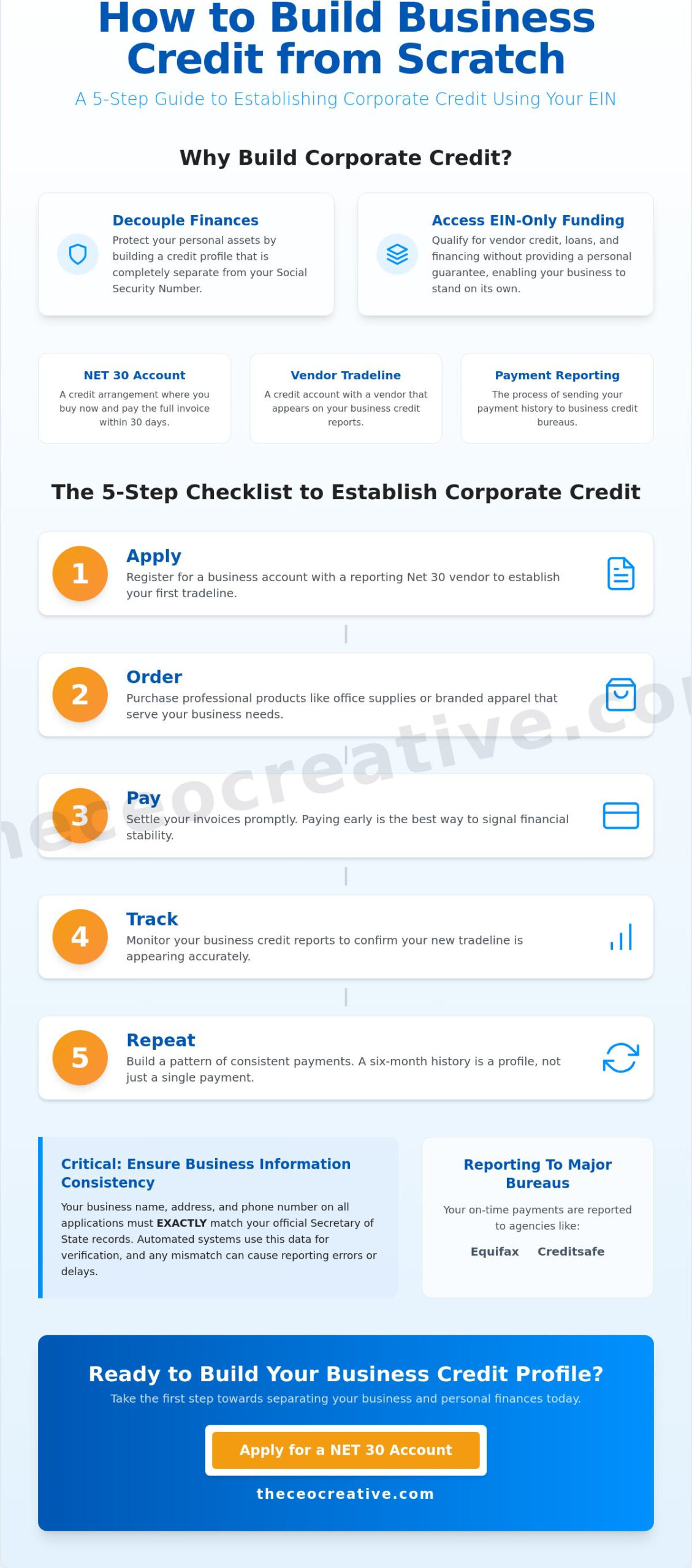
Understanding the mechanics of credit building requires mastering a few core terms. A Net 30 account is a credit arrangement where a vendor allows you to buy goods now and pay the full invoice amount within 30 days. This is often referred to as a vendor tradeline, which is simply a credit account listed on your business credit reports. The final piece is payment reporting, the automated process where the vendor sends data about your payment behavior to bureaus like Equifax and Creditsafe. When you pay on time, this data signals to the market that your business is a safe bet for future loans.
The Importance of EIN-Only Credit Building
Separating your personal and business finances is vital for true asset protection. If you constantly use personal guarantees for company purchases, you remain personally liable for business debts. This creates a ceiling for your growth and puts your personal assets at risk. Establishing corporate credit for the first time allows you to access net 30 accounts that don’t require an SSN. These accounts bridge the gap for new LLCs and startups that haven’t yet qualified for traditional bank loans. By using an EIN-only approach, you build a barrier between your private life and your professional obligations, ensuring your business stands on its own two feet.
The 5-Step Checklist for Establishing Corporate Credit
Establishing corporate credit for the first time requires more than just opening an account; it demands a repeatable operational loop. This process transforms your business from a “thin file” entity into a recognized brand in the eyes of credit bureaus. By following a structured checklist, you ensure every dollar spent on essentials also works to strengthen your financial profile. Success in this area is less about the size of the loan and more about the consistency of your reporting activity.
- Apply: Register for a business account with a reporting Net 30 vendor. This provides the foundation for your first tradeline.
- Order: Select professional products, such as office supplies or branded apparel, that serve your actual business growth needs.
- Pay: Settle your invoices promptly. Paying before the 30-day deadline is the most effective way to signal financial stability.
- Track: Monitor your business credit reports to confirm that your new tradeline entries are appearing accurately.
- Repeat: Build a pattern of consistent payment behavior. A single payment is a start, but a six-month history is a profile.
Ensuring Business Information Consistency
Before you submit your first application, you must verify that your business name, address, and phone number match your Secretary of State records exactly. Credit bureaus use automated systems to cross-reference your data. If your application says “Suite 100” but your state filing says “Ste 100,” it can cause a mismatch. These small discrepancies often lead to the creation of “ghost files” or outright denials because the bureau cannot verify your entity’s existence. Treat your business information as a static, professional identity that never wavers across different platforms.
Maximizing the Impact of Your First Purchase
When you’re ready to place an order, choose initial purchases that meet the vendor’s reporting thresholds. Not every small transaction is reported, so focus on meaningful orders that contribute to your operational success. You can research how to build business credit to understand how these early steps prepare you for larger lines of credit later. For those ready to begin, you can browse Net 30 business accounts to secure a decision within one business day and start your first order. Remember that paying early is often viewed more favorably than paying “on-time.” It demonstrates to future lenders that your business manages its cash flow with precision and foresight.
Understanding the Bureau Reporting Ecosystem
Establishing corporate credit for the first time is a process of strategic data management. You’re moving from a consumer-focused mindset to an entity-focused one. Consumer bureaus like Experian or TransUnion prioritize your individual habits, but business bureaus look at your company’s operational reliability. To establish business credit correctly, you need to understand the reporting cycles. Most tradelines update every 30 to 60 days. This means your first few months will require patience as the bureaus aggregate your new payment history into a visible score.
You must also recognize the tiered structure of the credit world. Tier 1 vendors, such as Net 30 suppliers, are the gatekeepers. They provide the initial data points that prove your business can handle small amounts of credit. Once you have a foundation of 3 to 5 reporting accounts, you can scale to Tier 2 store cards and Tier 3 unsecured cash lines. Diversifying your reporting is essential; having accounts that report to different bureaus ensures your creditworthiness is visible no matter which report a lender decides to pull.
Reporting to Equifax, Creditsafe, and FairFigure
Equifax Business is a primary source for traditional lenders. A strong score here is often the gatekeeper for SBA loans or bank lines of credit. Creditsafe operates on a global scale. Many suppliers use this bureau to decide whether to offer you Net 30 or Net 60 terms on raw materials or inventory. FairFigure provides a specialized platform where you can monitor these scores in real time. It helps you see the direct correlation between your vendor payments and your overall credit health, making the reporting process transparent and actionable for growing brands.
How Tradelines Influence Your Business Credit Score
Your business credit score is heavily weighted by “Days Beyond Terms” (DBT). This metric measures your punctuality with precision. If you pay five days early, your score reflects that proactive behavior. Over time, multiple tradelines build “depth” in your profile. A company with ten reporting accounts is seen as far more stable than a company with only one. This depth proves you can manage multiple obligations simultaneously. For many startups, learning how to build business credit without a loan is the most efficient way to achieve this depth without taking on the burden of high-interest debt.
Strategic Branding: Building Credit with Merchandise
Establishing corporate credit for the first time shouldn’t feel like a chore. Instead, view it as a strategic branding exercise. Every item you buy to build your team culture or increase visibility can double as a reporting tradeline. When you purchase onboarding kits or employee uniforms on Net 30 terms, you’re investing in your brand while feeding data to credit bureaus. This “Strategic Move” concept ensures your operational budget works twice as hard. You aren’t just buying gear; you’re building a financial reputation.
High-Utility Products for New Businesses
Focus on items that provide immediate value to your daily operations. Office Supplies: Stock up on essential office supplies like paper, folders, and mailing materials using Net 30 terms to keep your cash flow fluid. Custom Apparel: Strengthen your team culture with branded shirts and hats that act as walking billboards for your services. Stationery and Branding: Establish corporate credibility from day one with professional logo designs and high-quality business cards. These assets help you look the part while you build the underlying credit systems that make your company sustainable.
Common Mistakes to Avoid When Building Credit
Avoid these frequent pitfalls to ensure your credit-building journey remains on track. Many entrepreneurs stumble on the details, which can lead to delayed reporting or profile errors.
- Using a personal address: Always use a commercial or virtual business address. Residential addresses can trigger red flags during the verification process.
- Ignoring reporting status: Don’t assume every vendor reports. Always verify they send data to major bureaus like Equifax or Creditsafe before ordering.
- Late payments: A single late payment on a Net 30 account can damage a new profile instantly. Set reminders to pay at least five days early.
- Inconsistent cycles: Failing to maintain a regular “order and pay” cycle can cause your score to stagnate. Aim for at least one transaction per month.
- Neglecting monitoring: Errors happen. Regularly check your business credit files to ensure your payments are being recorded correctly and your information is accurate.
Ready to start your branding journey? Apply for a business net 30 account today to start turning your branding needs into credit-building milestones.
Scaling Your Profile with The CEO Creative Membership
Scaling your organization requires more than just a single account. The CEO Creative Membership serves as a foundation for long-term success. It offers exclusive purchasing power and advanced credit-building tools designed to help you outpace traditional retail limitations. By establishing corporate credit for the first time through this structured model, you create a documented history of financial responsibility. This isn’t just about buying supplies; it’s about positioning your organization for future Tier 2 and Tier 3 opportunities.
Membership provides access to a wider range of products and reporting advantages that guest accounts often lack. It streamlines the administrative side of management, allowing you to focus on growth while your tradelines work in the background. You’ll gain the visibility needed to attract more substantial lenders and professional partners.
Transitioning to Larger Credit Lines
A solid Net 30 history is the prerequisite for business credit cards and high-limit lines of credit. When you demonstrate a pattern of early payments, you gain leverage. Tradelines help you negotiate better terms with future suppliers, allowing you to secure Net 60 or Net 90 agreements. As you prepare your business for significant capital investments in 2026, a robust credit profile becomes your most valuable asset. Banks are more likely to approve large-scale financing when they see a diversified history of vendor management and consistent fiscal discipline.
As you scale, partnering with reliable vendors for custom packaging and outreach is key; you can visit Micro Printing to see how their direct mail expertise can complement your company’s expansion in 2026.
What Happens Next: Your Action Plan
Ready to move forward? Follow these three steps to secure your company’s financial future and start establishing corporate credit for the first time.
- Step 1: Secure your EIN and ensure all business registration data is accurate across state and federal records. Consistency is your best defense against reporting errors and ghost files.
- Step 2: Apply for a Net 30 account with The CEO Creative to start your first tradeline. This moves your business out of the thin file category and into the reporting ecosystem.
- Step 3: Place an order for essential customizable products and pay the invoice early. This proactive step ensures your reporting reflects a high level of reliability to bureaus like Equifax and Creditsafe.
Establishing corporate credit for the first time is a strategic journey from initial application to long-term credibility. By using reporting Net 30 vendors and consistent payment cycles, you build a profile that stands independently of your personal finances. This foundation allows your business to scale with confidence, accessing the capital and terms needed for sustainable growth.
Take Command of Your Business Financial Future
Your journey toward financial independence starts with a single, strategic decision. By decoupling your personal assets from your entity’s obligations, you create a foundation for limitless growth. Establishing corporate credit for the first time is a deliberate process of turning routine operational costs into powerful reporting tradelines. You’ve learned how to navigate the bureau ecosystem and use high-utility merchandise to prove your reliability to major agencies like Equifax, Creditsafe, and FairFigure.
The CEO Creative is a trusted partner for thousands of new LLCs and startups looking to simplify this complex process. We return a decision within one business day for Net 30 terms and ensure your positive payment history reaches the bureaus that matter most. It’s time to stop relying on personal guarantees and start building a profile that stands on its own. Apply for a Net 30 Business Account and Start Building Credit Today to begin your first reporting cycle. Your future as a creditworthy organization is within reach; take the first step toward professional empowerment now.
Frequently Asked Questions
Do I need a personal guarantee to establish corporate credit?
You don’t need a personal guarantee when working with specific Net 30 vendors like The CEO Creative. This approach allows you to build a financial profile using only your EIN. It’s a strategic way to protect your personal assets while growing your company’s independent reputation.
How long does it take for a Net 30 account to report to the bureaus?
Most vendors report on a monthly or quarterly cycle, so you should expect to see activity on your profile within 30 to 60 days. The bureaus need this time to process the data sent by the supplier. Consistency in your “order and pay” cycle ensures that your file updates regularly and accurately.
Will paying my Net 30 invoice early help my credit score?
Yes, paying early is one of the most effective ways to strengthen your business payment history. Business credit bureaus track “Days Beyond Terms” (DBT) to measure your reliability. A proactive payment history signals to future lenders that your cash flow is stable and your management is disciplined.
Which credit bureaus does The CEO Creative report to?
We report to Equifax Business, Creditsafe, and FairFigure. This broad reporting ensures that your creditworthiness is visible to a wide range of lenders and suppliers. Establishing corporate credit for the first time is more effective when your data is shared across multiple major agencies simultaneously.
Can I build business credit if my LLC is brand new?
You can start building credit the moment your LLC is registered and you have an EIN. Net 30 accounts are specifically designed to bridge the gap for startups with no existing credit file. It’s the standard first step for new entities to prove they are financially responsible without needing years of history.
What is the difference between a vendor tradeline and a credit card?
A vendor tradeline is a short-term credit arrangement where you must pay the full balance within a set period, like 30 days. Business credit cards are revolving lines of credit that allow you to carry a balance and pay interest over time. Tradelines are usually much easier to secure for new businesses.
Does my personal credit score affect my ability to get a Net 30 account?
Your personal credit score typically isn’t a factor for Tier 1 Net 30 accounts. These vendors focus on your business’s legal standing and its ability to pay invoices rather than your individual history. This makes it an ideal solution for entrepreneurs who want to keep their personal and professional finances completely separate.
How many tradelines do I need to get a business credit score?
You generally need at least three to five reporting tradelines to generate a visible business credit score. Establishing corporate credit for the first time requires building “depth” in your profile. A diverse mix of accounts shows bureaus that you can manage multiple obligations at once with professional precision.
Building business credit? Open a Net 30 Account — EIN only, no personal guarantee, $60 minimum order, credit lines up to $5,500, a decision in one business day, and every on-time payment reported monthly to Equifax Business, Creditsafe and FairFigure.
How do you establish corporate credit for the first time?
You establish corporate credit by separating the business from its owner legally and financially, then opening accounts that report payment activity to a business credit bureau. That generally means registering the business as its own legal entity, getting an EIN, opening a business bank account, and getting approved for trade credit with a supplier that reports on-time payments. Each payment made as agreed becomes an entry on the business’s own credit file rather than the owner’s personal one. The CEO Creative, for example, assesses trade credit applications on the business EIN alone, with no personal guarantee and no personal credit check.
How do you build corporate credit?
Corporate credit gets built the same way personal credit does: by using it and paying on time, repeatedly, so a payment history accumulates on the business file. Opening more than one trade account and keeping payments current tends to matter more than any single application, since a bureau’s score reflects a pattern over time rather than one approval. It also helps to ask a supplier directly, in writing, which bureaus it reports to, since not every supplier reports to the same ones.
What is corporate credit?
Corporate credit, also called business credit, is a credit history that belongs to a company itself rather than to the person who owns it. It is built when a business opens accounts, such as trade credit with a supplier or a business credit card, and those accounts report payment activity to a business credit bureau. A separate business credit file means the owner’s personal credit score is not the only thing a lender or supplier can look at when deciding whether to extend terms.
What does a company need before it can get credit?
A company generally needs to exist as its own legal entity with an EIN before a supplier or lender will consider it for credit, since that is what lets the account be tied to the business rather than to the owner personally. Many businesses also get a D-U-N-S number and open a business bank account, since bureaus and lenders often use those to identify and track the business. Some suppliers ask for a minimum time in business or an existing banking relationship as well, though what’s required varies from supplier to supplier.