

The CEO Creative is a reporting NET 30 vendor that empowers entrepreneurs by providing essential tools while establishing a verifiable financial history. A NET 30 account provides payment terms that allow your business to buy now and pay the full balance within 30 days. When this activity is documented as a vendor tradeline, it becomes part of your payment reporting to major bureaus. Many entrepreneurs naturally wonder are business credit building programs legitimate when they encounter high fees and vague promises from unverified sources. We agree that the fear of personal credit impact and the confusion surrounding bureau reporting schedules can be overwhelming.
This article promises to show you how to distinguish legitimate credit-building tradelines from scams and provide the exact steps to build your business credit safely. You’ll learn the mechanics of vendor credit and how to establish a clean profile that qualifies for higher-tier financing. We’ll also preview the red flags to avoid so you can focus on sustainable growth. By the end, you’ll have a clear roadmap to navigate the reporting process with confidence and clarity.
Key Takeaways
- Learn how to identify legitimate vendor tradelines that report real commerce to major bureaus instead of just charging administrative fees.
- Discover how Net 30 accounts allow you to build a robust business credit profile using only your EIN, keeping your personal credit scores protected.
- Understand the specific criteria used to determine are business credit building programs legitimate, including the value of membership infrastructure and exclusive terms.
- Master the monthly reporting cycle to ensure your business activity is consistently tracked by major agencies like Equifax, Creditsafe, and FairFigure.
- Avoid common approval pitfalls by maintaining strict consistency in your business name, address, and phone number across all financial records.
Understanding the Legitimacy of Business Credit Building Programs
The CEO Creative functions as a reporting Net 30 vendor, giving startups the tools they need to succeed while building a solid financial foundation. When asking are business credit building programs legitimate, you must look closely at the reporting structure and the value of the products offered. A business Net 30 account provides short term credit for purchasing office essentials and custom brand gear. This creates a vendor tradeline, which is a formal record of your credit relationship with a supplier. Payment reporting is the final step, where your on-time behavior is shared with credit bureaus to establish your score.
Trust Note: This content is for educational purposes only. It does not constitute financial or legal advice. We make no guarantees regarding specific credit score increases or financing approvals.
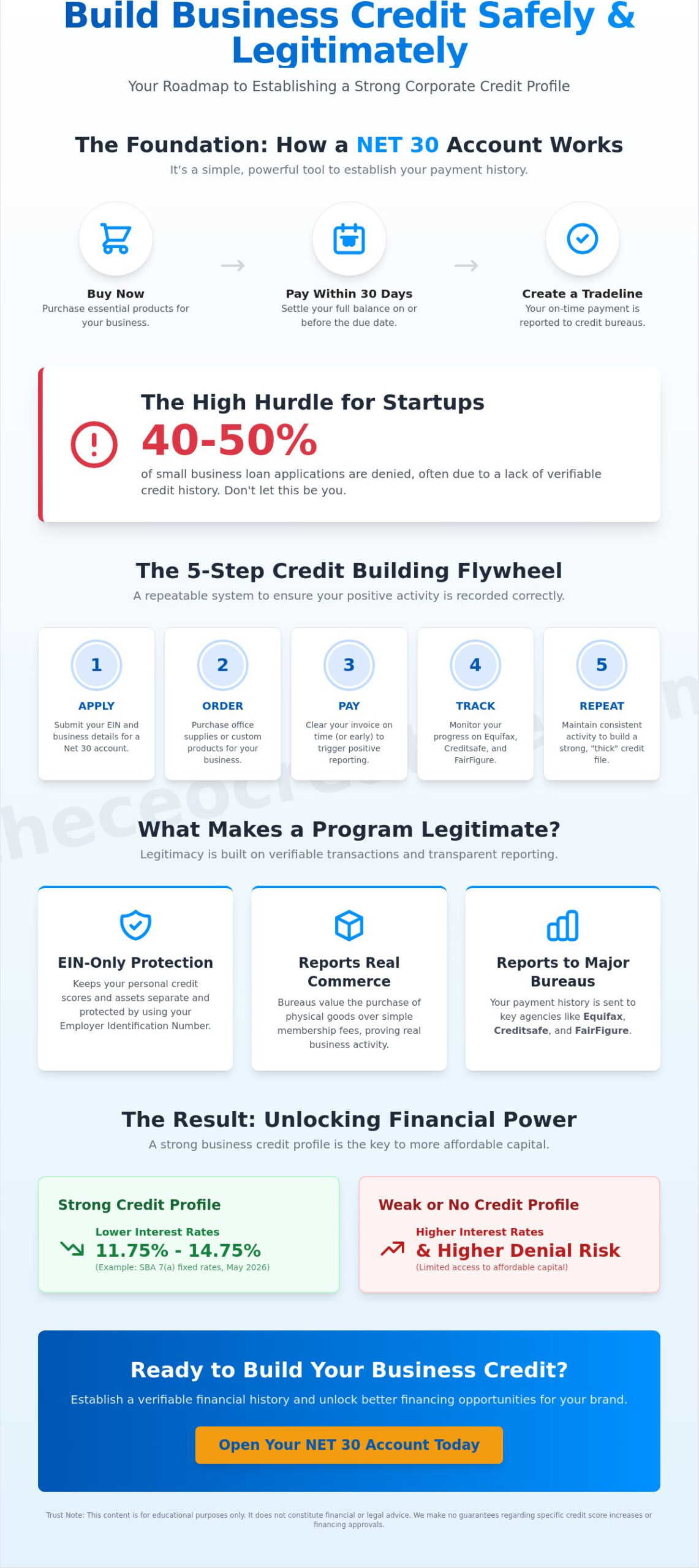
Building a strong profile is a strategic move that requires patience and consistency. Our 5-step process helps you establish credit legitimacy by moving from initial application to active payment tracking. Following this structured path helps you avoid the high denial rates that plague many new companies. Research from May 2026 shows that 40% to 50% of small business loan applications are denied, often because the business lacks a verifiable credit history.
What Makes a Program Legitimate?
Legitimacy depends on the reporting of actual trade activity. Predatory “credit repair” schemes often make unrealistic promises about deleting data, but utility-based credit building relies on verifiable, positive transactions. Real programs report your activity to business credit reports. In 2026, lenders prioritize data from major bureaus like Equifax, Creditsafe, and FairFigure. These agencies require documented payment history from real vendors. By choosing a program that focuses on these standards, you ensure your brand is seen as a reliable entity by future lenders and partners.
How Legitimate Programs Build Your Corporate Credit Profile
Legitimate programs focus on the reporting cycle. By using an EIN-only account, you effectively separate your business and personal finances. This is crucial for protecting your personal assets and ensuring your business stands on its own. When people ask are business credit building programs legitimate, they’re looking for evidence of real trade activity. Net 30 accounts for LLCs bridge the gap for startups that don’t have years of history. Integrating professional logo design services also adds to your corporate credibility while providing a reporting tradeline.
Consistent monthly activity is the engine of a “thick” credit file. Lenders want to see that you can handle multiple obligations over time. Understanding how to build business credit involves more than just paying a membership fee. It requires purchasing physical goods that serve your business needs. This demonstrates diverse trade activity, which bureaus like Creditsafe and Equifax value more than subscription fees alone. Establishing this profile early helps you qualify for lower interest rates. For instance, SBA 7(a) fixed rates sat between 11.75% and 14.75% in May 2026. Higher credit scores are the key to unlocking these more affordable capital options for your brand.
The 5-Step Credit Building Checklist
Success in credit building comes down to a repeatable system. Follow these steps to ensure your activity is recorded correctly. You can begin the process by opening a business Net 30 account today to start your first reporting cycle.
- Apply: Submit your EIN and business details for a Net 30 account to get started.
- Order: Purchase essential office supplies or customizable products for your team.
- Pay: Clear your invoice early or on-time to trigger positive reporting to the bureaus.
- Track: Monitor your profile on Equifax and FairFigure to see your progress in real-time.
- Repeat: Maintain consistent monthly activity to build a strong history and a “thick” credit file.
Red Flags vs. Real Results: Avoiding Common Pitfalls
One common question entrepreneurs ask is why some vendors charge a membership fee. These fees aren’t just administrative costs. They support the complex reporting infrastructure required to send your data to major bureaus. They also unlock exclusive terms that allow you to establish business credit without a personal guarantee. When evaluating are business credit building programs legitimate, look for those that provide real utility. For example, purchasing Net 30 apparel for team onboarding is a professional way to use your credit line for actual business essentials while building history.
Consistency is your best friend when building a corporate profile. Your business name, address, and phone number must be identical on every application you submit. Automated systems at bureaus are sensitive. Even a small typo can cause them to create duplicate files or flag your account as high risk. This is a major reason why 45% of business owners don’t realize they already have a score. Their data is often fragmented across multiple incomplete profiles because their business information wasn’t consistent from the start.
Legitimate programs focus on modern reporting standards. While traditional banks might take years to recognize your growth, Tier 1 vendor reporting happens much faster. In May 2026, lenders are increasingly looking at data from Creditsafe and FairFigure to assess small business risk. Using a program that reports to these specific agencies gives you a competitive edge. It shows you’re a proactive CEO who understands the modern financial landscape. Just remember that no specific credit score increase can be guaranteed by any legitimate program. Your results depend on your total financial behavior.
Common Mistakes to Avoid
- Failing to verify reporting: Don’t assume every vendor reports to Equifax or Creditsafe. Always ask for their reporting schedule first.
- Inconsistent addresses: Using a home address on one application and a virtual office on another triggers bureau red flags instantly.
- Late invoice payments: Paying even one day late can damage a new EIN profile. Set up reminders to clear balances early.
- Neglecting monitoring: You can’t fix what you don’t see. Check your FairFigure or Creditsafe reports monthly to catch errors.
- Over-applying: Don’t apply for ten Tier 1 accounts at once. Focus on 2 or 3 and build a solid payment history with them first.
Take Control of Your Business Financial Future
Establishing a standalone credit profile is one of the most empowering steps you can take as a business owner. You now have the knowledge to distinguish high-utility reporting vendors from ineffective programs. As you’ve discovered, the question of are business credit building programs legitimate is answered by the transparency of the reporting process and the real-world value of the products offered. By choosing a partner that prioritizes your brand’s growth, you position your LLC for long-term sustainability and financial independence.
What happens next:
- Submit your application for a decision within one business day using your EIN only.
- Shop for premium branding tools or office essentials to activate your account.
- Your consistent, on-time payments are reported to major bureaus to strengthen your profile.
Building your brand’s financial reputation is a strategic process that rewards consistency and professional presentation. By leveraging reporting vendor accounts, you transform necessary business expenses into powerful credit-building milestones. Start today by exploring our custom mugs and engraved items or our branded apparel to equip your team while strengthening your profile. This structured approach ensures your brand remains sustainable and ready for future growth.
Frequently Asked Questions
Do I need a personal guarantee for these programs?
No personal guarantee is required for many legitimate vendor tradelines. These programs use your EIN to establish credit, which protects your personal assets from business liabilities. This separation is a key reason why many entrepreneurs ask are business credit building programs legitimate. It allows your company to stand on its own financial feet without risking your personal credit score or home.
How long does it take for a Net 30 account to report?
Reporting typically occurs within 30 to 45 days after your invoice is cleared. Most vendors batch their data and send it to the bureaus once per month. If you pay your bill on the 5th but the vendor reports on the 30th, you’ll see the update in the next month’s cycle. Consistent activity over several months is the best way to ensure your file stays active.
Does paying an invoice early help my business credit score?
Yes, paying early can significantly boost scores like the Dun & Bradstreet PAYDEX. While a score of 80 represents on-time payments, scores of 90 or 100 generally require paying 10 to 20 days before the actual due date. Early payments demonstrate superior cash flow and financial reliability. This behavior signals to future lenders that your brand is a low-risk borrower.
Which credit bureaus does The CEO Creative report to?
The CEO Creative reports trade activity to Equifax Business, Creditsafe, and FairFigure. These agencies are vital for modern lending assessments in 2026. By reporting to multiple bureaus, we help you build a “thick” credit file. This gives lenders a comprehensive view of your financial habits. It also ensures your hard work is recognized across the most influential business credit reporting platforms.
Can I build business credit with a brand new LLC?
You can start building credit the same day you receive your EIN from the IRS. New LLCs often struggle to secure traditional bank loans, but vendor accounts provide the initial tradelines needed to establish a profile. This is why are business credit building programs legitimate for startups. They provide a structured path to move from zero credit to qualifying for higher-tier financing.
What happens if I miss a payment on a Net 30 account?
Missing a payment can lead to negative reporting that damages your business profile for several years. Business bureaus are often stricter than personal ones. They may flag payments that are only one day past the due date. Late marks can lower your score instantly and make it difficult to get approved for new terms. Always prioritize your vendor invoices to keep your record clean.
Is the membership fee tax-deductible for my business?
Most business-related membership fees are considered ordinary and necessary expenses for tax purposes. You should consult with a qualified tax professional to confirm how this applies to your specific LLC. Keeping accurate records of these expenses helps maintain your corporate veil. It also simplifies your year-end accounting by clearly separating business costs from personal spending.
Do these programs report to Dun & Bradstreet?
Reporting varies by vendor, so you must verify which bureaus each specific program uses. While some vendors focus on Dun & Bradstreet, many modern programs prioritize Equifax and Creditsafe because of their widespread use in fintech lending. Review your vendor’s reporting policy before you apply. This ensures their reporting matches your long-term goals for establishing corporate credit.
Building business credit? Open a Net 30 Account — EIN only, no personal guarantee, $60 minimum order, credit lines up to $5,500, a decision in one business day, and every on-time payment reported monthly to Equifax Business, Creditsafe and FairFigure.