

See also: Net 30 Office Supplies Vendor — order office supplies on 30-day terms with your EIN.
| Summary:
When purchased, office supplies are tracked as current assets. The journal entry involves debiting supplies (asset) and crediting accounts payable (liability). Supplies are categorized as current assets or expenses based on usage. Proper classification ensures accurate financial reporting and efficient expense management for your business. |
When a company buys office supplies on credit, it must keep track of them as supplies on hand. Because the goods on hand are often consumed within a year, they are represented as a current asset on the company’s balance sheet.
Office supplies are costs that are incurred throughout the course of business activities. In reality, it can be observed that there are a variety of distinct demands in daily office work that must be met by the company.
These expenses, while not large on their own, become enormous when added together in yearly totals. As a result, they are primitive in terms of accounting and must be dealt with appropriately in accordance with accounting rules. Hence, proper accounting treatment of office supplies on hand is important to ensure accurate financial reporting.
To comprehend the bifurcation of office supplies and the corresponding categorization, it is necessary to first comprehend the types of office supplies and their applications.
Example of a Purchase Office Supplies on Account Journal Entry
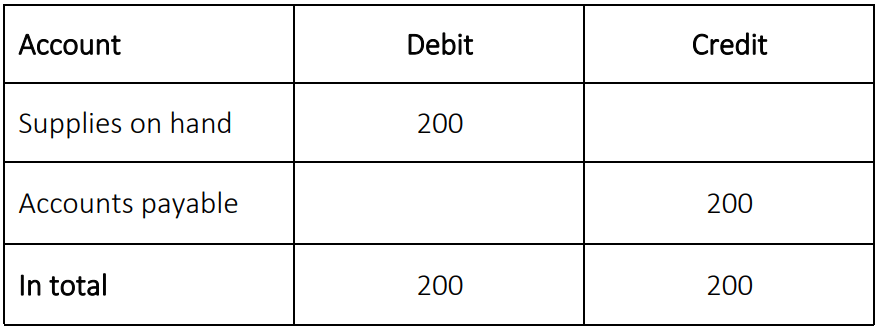
Assume a company spends $200 on pens, stationery, and other office supplies and receives credit terms from the supplier, and purchases office supplies on account with credit terms from the supplier. On account journal entry, the accounting records will indicate the following bought supplies.
Explanation of Bookkeeping
Debit
Consumable office goods (pens, stationery, etc.) have been received by the company and are being held as a current asset as supplies on hand.
Credit
The credit entry indicates the obligation to pay the provider for the products provided in the future.
Accounting Equation for Purchasing Office Supplies
The accounting equation states that:
Assets = Obligations + Owners’ Equity
This is an accounting equation that states that a company’s total assets are always equal to its total liabilities(obligations) plus its total equity. This holds true at all times and for all transactions. The accounting equation for this transaction is presented in the table below.
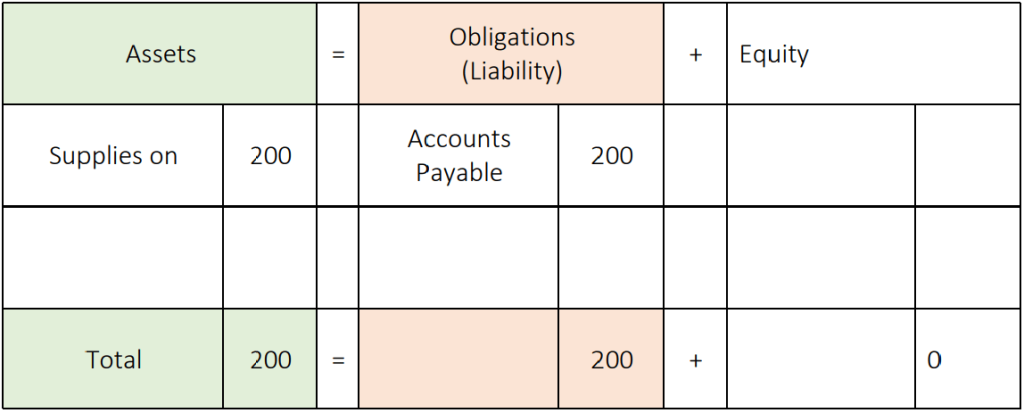
In this example, when the company purchases office supplies on account, the supplies on hand (asset) increase, while the liability to pay the supplier in the future (accounts payable) also increases.
Categories of Office Supplies
It is necessary to divide time into the following subcategories in order to comprehend the proper accounting method.
1. Supplies at the Start of the Year
Some supplies may be carried over from the previous year at the start of the financial year. These would be included as supplies on the balance sheet under current assets. Another way to look at it is that they were Prepaid Expenses that had been paid in advance, but the value of the goods had yet to be determined.
2. Other Supplies Utilized Throughout the Year
When a company purchases office supplies on credit, the journal entry records a debit to the supplies account, increasing the assets, and a credit to accounts payable, reflecting the obligation to pay the supplier later.
3. Unused Supplies at the End of the Year
Supplies that are left unutilized at the end of the year are meant to be classified as Current Assets since the firm has already paid for them in advance, but has yet to extract the utility from them. As a result, they are recorded on the balance sheet as current assets.
Final Thoughts
To summarize, office supplies are commodities utilized by a firm to perform essential activities. Stationery, fittings, documents, and other miscellaneous things required in everyday operations are examples of office supplies.
They are classified as non-capital or operational costs since they do not represent a major financial investment. In reality, these costs are deducted from earnings with each passing year, and the balance is considered as a Current Asset if paid in advance, and as a Current Liability(Obligation) if not.
Frequently Asked Questions (FAQs)
1. What is the difference between office expenses and supplies?
- Office expenses are ongoing costs for running your business, like website services, software, merchant fees, domain names, and office phone systems. Expensive items like computers and smartphones are considered assets and can be depreciated over time.
- Office Supplies are everyday items that are used up quickly and need to be replaced often, such as printer ink, paper, pens, staples, and janitorial or break room supplies. These are usually small costs that help your business run day-to-day.
2. How do you record office supplies in accounting?
Office supplies are recorded as operating expenses in accounting as they are consumed during normal business operations, usually within a year. They are recorded in an expense account, such as:
- Office Supplies Expense: This is the most direct and common way to record office supplies. When supplies are purchased, they are immediately categorized as expenses.
- Office Expense: A broader category that can include office supplies and other related costs such as utilities or repairs.
- General and Administrative Expenses: In some cases, office supplies might fall under G&A expenses, particularly in companies that group general office costs together.
3. What is a journal entry for a purchase?
A purchase journal entry records a business’s acquisition of goods or services. It involves a debit to an asset or expense account and a credit to Cash or Accounts Payable, ensuring that debits equal credits.
4. How to record the purchase of office supplies?
Follow these steps to record the purchase of office supplies:
- Debit the Supplies Account: This increases your supplies (asset) account, showing that you now have more supplies.
- Credit Cash or Accounts Payable: If you paid for the supplies right away, credit your Cash account to show the money spent. If you bought the supplies on credit, credit Accounts Payable to show the amount you owe.
5. Is the office supply debit or credit?
When you buy office supplies, you debit the supplies account because you are increasing the value of your supplies (an asset or expense). The other side of the entry is a credit to either Cash (if you paid immediately) or Accounts Payable (if you bought on credit).
Building business credit? Net 30 Office Supplies Vendor — EIN only, no personal guarantee, $60 minimum order, credit lines up to $5,500, a decision in one business day, and every on-time payment reported monthly to Equifax Business, Creditsafe and FairFigure.
Building business credit? The CEO Creative offers net 30 accounts to US businesses on an EIN only – no personal guarantee and no personal credit check – and reports your payment history monthly to Equifax Business, Creditsafe and FairFigure.
The Full Journal Entry Set: Purchase, Use, and Year-End
Following the $200 purchase already shown on this page through to the end of the period fills in the two entries most guides skip. First, the purchase on account: debit Supplies on Hand $200, credit Accounts Payable $200. This is the entry already shown above — it records that the company now holds $200 of supplies and owes its vendor $200, with no cash paid yet.
Second, as those supplies are actually used, the value moves off the balance sheet. If $150 of the $200 is used during the period, the entry is: debit Office Supplies Expense $150, credit Supplies on Hand $150. This is the entry most “office supplies journal entry” guides never show, and it’s the one that actually reduces net income for the period. The remaining $50 of unused supplies stays on the balance sheet as a current asset, exactly matching the $200 asset minus the $150 now expensed, with no separate entry required under this asset-first method.
Some businesses instead expense the full $200 at the point of purchase for simplicity, debiting Office Supplies Expense $200 directly instead of Supplies on Hand. If that’s the method used, a year-end adjusting entry is needed to move the $50 still on hand back onto the balance sheet: debit Supplies on Hand $50, credit Office Supplies Expense $50. Either method arrives at the same ending numbers — $50 as an asset, $150 as an expense — the difference is only which entries get made along the way.
Do You Need to Track Office Supplies as an Asset at All?
For most small businesses, the honest answer is no, not in any detailed way. Accounting standards apply a materiality principle: if the dollar amount involved is too small to change how a reader would interpret the financial statements, precision isn’t required. A business spending a few hundred dollars a month on pens, paper, and toner can simply debit Office Supplies Expense at the time of purchase every time, skip the asset-tracking step entirely, and never be materially wrong.
Tracking supplies as an asset and running a year-end adjustment starts to matter more once the unused balance at any point is large enough to meaningfully affect the numbers — a business that stockpiles a few thousand dollars of supplies ahead of a busy season, for example, or one where an external accountant or lender is reviewing the balance sheet closely. If that’s not the situation, the simpler expense-at-purchase method described in the FAQ above is standard practice, not a shortcut, and it’s what most small business accounting software defaults to unless inventory tracking is turned on.
Frequently Asked Questions
What is the journal entry for office supplies expense?
When supplies are consumed rather than held as inventory, the entry is a debit to Office Supplies Expense and a credit to Supplies on Hand (or Cash, if bought and used immediately) for the amount used. This moves the cost off the balance sheet and onto the income statement in the period the supplies were actually used, not the period they were originally bought.
Are office supplies an asset or an expense?
Both, depending on timing. Supplies purchased but not yet used sit on the balance sheet as a current asset, "supplies on hand," because the company has paid for a benefit it hasn't consumed yet. As supplies are used, that value moves to an expense account on the income statement. Small businesses with little supplies inventory often just expense the full purchase immediately for simplicity.
How do I record office supplies purchased on account?
Debit Supplies on Hand (or Office Supplies Expense, if expensing immediately) and credit Accounts Payable for the invoice amount. This records that the business now owns the supplies and owes the vendor, without any cash changing hands yet. When the invoice is later paid, debit Accounts Payable and credit Cash to clear the liability.
Where do office supplies go on the balance sheet?
Unused office supplies sit under current assets, usually grouped with or near prepaid expenses, since they represent value the business already paid for but hasn't consumed. Once supplies are used, they leave the balance sheet entirely and appear as an expense on the income statement instead. Only the unused portion at period-end should still show as an asset.